Reduce Phone Addiction : 10 Realistic Strategies That Actually Work .
You don’t need to escape technology to feel better.
You just need to stop letting it run on autopilot.
“Small boundaries beat dramatic detoxes every time.”
Table of Contents
I didn’t realize how habitual my phone use had gotten until one evening when I opened Instagram “for five minutes” after dinner and realized it was almost 11:30.
There is no emergency. There’s no genuine purpose.
Just scrolling.
I wasn’t even worried about the time missed.
It was the sense I had afterwards, like my brain was fatigued but not rested. Overstimulated, worried, and strangely empty.
If you’re trying to reduce phone addiction, here’s what you need to know right away:
You do not need to discard your phone.
You don’t need a complete digital detox.
You require practical limitations that operate in everyday situations.
Especially in India, where WhatsApp work groups never sleep, family calls stream in at any time, UPI apps are important, and notifications seem to never end.
Let’s fix this step by step.
Quick Reality Check: Are You Addicted or Overusing?
Before you attempt to reduce phone addiction, you should first understand what is happening.
Excessive phone use is not the same as addiction.
Control is the key distinction.
Overuse vs. addiction to phones
Heavy use implies:
- You’re on the phone frequently.
- However, you can stop when you wish.
Addiction-like patterns appear as follows:
- You check without thinking
- You get concerned when it’s not nearby.
- You lose hours without realizing.
- Your sleep and concentration continue to decline.
A reality check statistic
According to DataReportal’s 2024 Global Digital Overview, the average internet user spends 6 hours and 40 minutes a day online, the majority of which is spent on mobile devices.
This adds up to weeks of time per year.
This is not to make you feel bad. Just to demonstrate how common this has become.
The first step is raising awareness.
Why Giving Up Phones Is So Difficult (It’s Not a Willpower Issue)
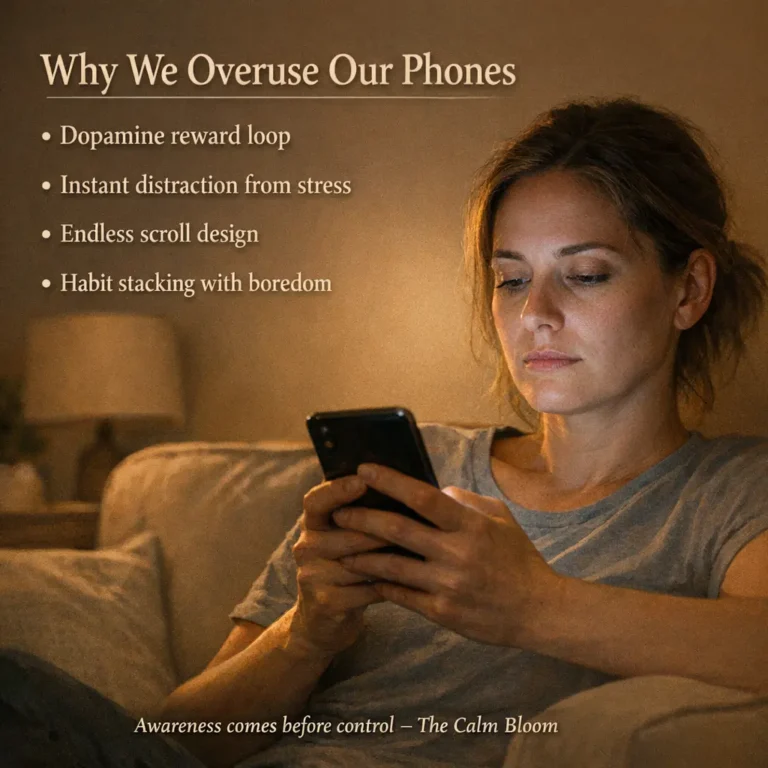
To put it bluntly, phones are addictive because they are made to be.
Apps are based upon dopamine loops :
- Unlimited scrolling
- Autoplay
- Push notifications
- Likes and streak
Your brain is programmed to anticipate modest amounts of pleasure.
According to data available through the NCBI, behavioural addictions engage reward circuits similar to other compulsive behaviour’s.
It is not a weakness. It’s the design.
Why your mind keeps coming back
Most phone addictions aren’t about the phone itself. It’s about what it delivers.
- Stress can be relieved quickly.
- Boredom results in stimulation.
- Loneliness leads to connection.
- Exhaustion can lead to escape.
Your brain learns that a phone can provide comfort on demand.
Once you grasp this, you can stop blaming yourself and start altering the system.
The Invisible Costs of Phone Addiction
Reducing phone addiction is more than just being more productive.
It’s about your health.
Mental impact.
- Stress and over stimulation
- Reduced attention span.
- Feeling cognitively disorganized.
Physical Effects
- Poor sleep quality
- Eye strain and headaches.
- Pain in the neck and shoulders (tech neck is genuine)
The Mayo Clinic describes how screen time, particularly at night, impairs sleep patterns.
Lifestyle consequences
- Reduced movement
- Less authentic conversation
- More “busy” feelings, less fulfilment.
Over time, it gently steals your energy.
The Calm Bloom Method: Ten Effective Ways to Reduce Phone Addiction
Instead of severe detoxes, take a planned approach:
Awareness, environment, replacement, boundaries, and consistency.
Quick Summary Box (Save this)
If you could only remember four things:
- Turn off unnecessary notifications.
- keep your phone out of the bedroom.
- Instead of scrolling, develop an tiny offline habit.
- Develop one daily phone-free anchor.
Small limits outperform extreme detoxes.
1. Identify Your Triggers (Do Not Guess)
Most individuals scroll at specified times and not at random.
Common Triggers:
- Morning autopilot
- Work Breaks
- Stress peaks
- Late-night exhaustion
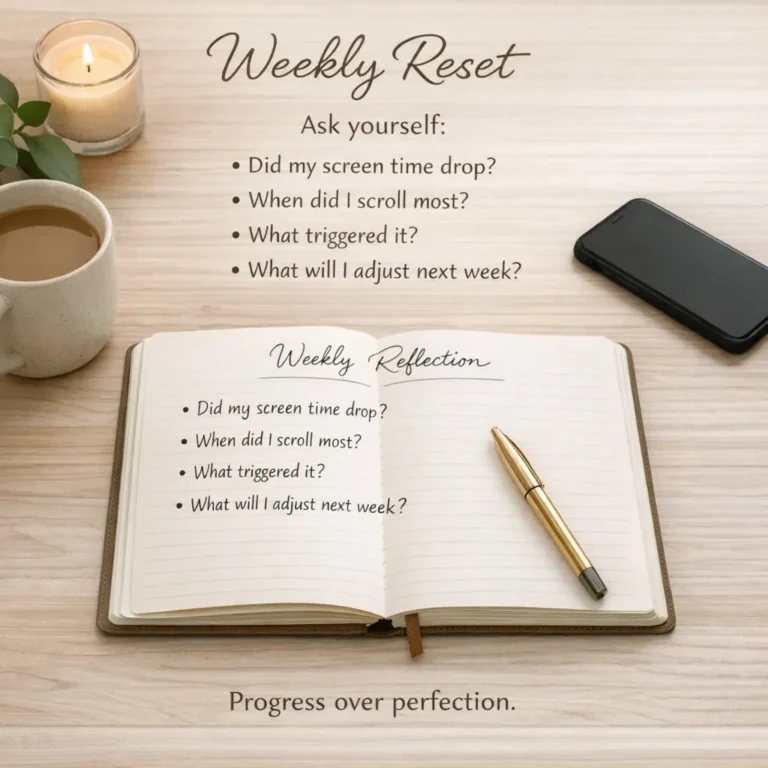
I observed that my worst scrolling occurred outside of my free time.
It occurred during emotional pauses, such as waiting for food to cook or avoiding a stressful chore.
Try it for 3 days.
Write:
- Time
- Emotion
- App was opened.
- Feeling later
Awareness rapidly boosts self-regulation.
2. Begin with reduction, not detoxification.
Phones are important for:
- Workplace communication
- Payments
- Navigation
- Family contact
The goal isn’t to be eliminated.
The idea is to use responsibly.
An effective change in perspective:
“I make use of my phone. I am not used by it.
3. Fix Your Environment First (Willpower Cannot Save You)
Motivation is overshadowed by the environment.
Changes with little effort:
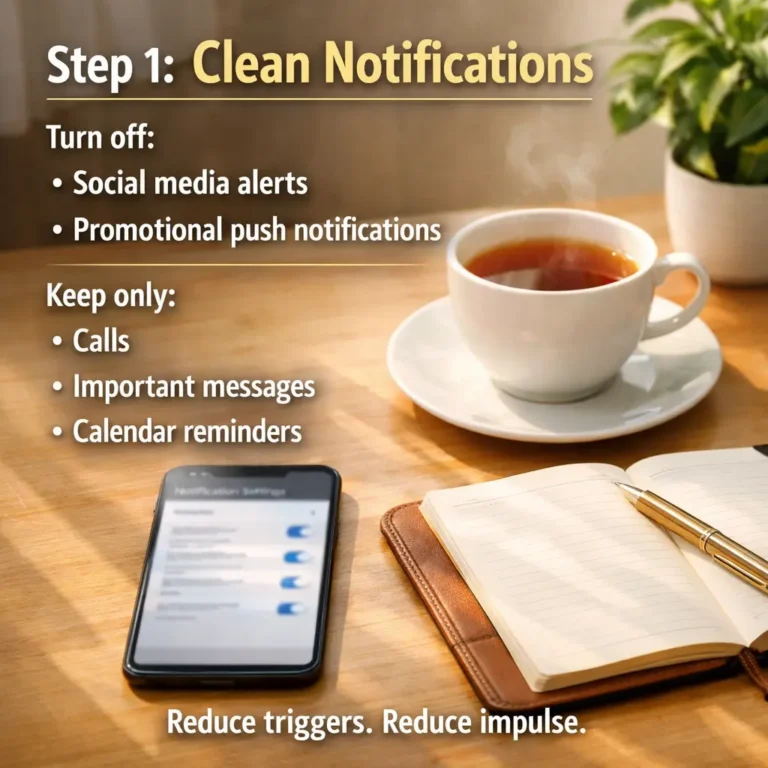
- Turn off unnecessary notifications.
- Remove social apps from your home screen.
- Change to grayscale mode
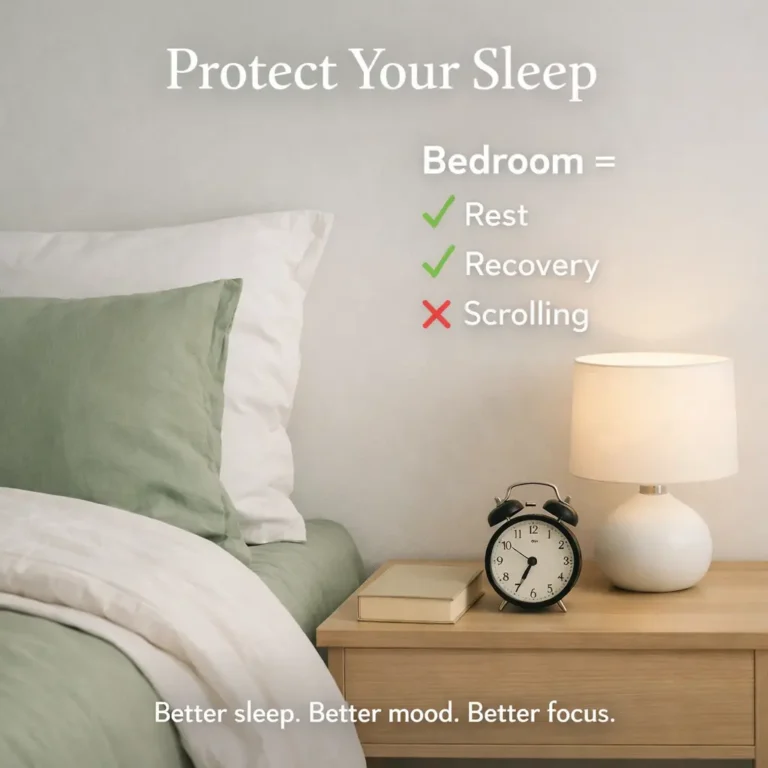
- Charge your phone outside the bedroom.
Micro-example:
- If your phone is by your bed, you will scroll.
- If it’s charging in the hallway, you’re unlikely to get it.

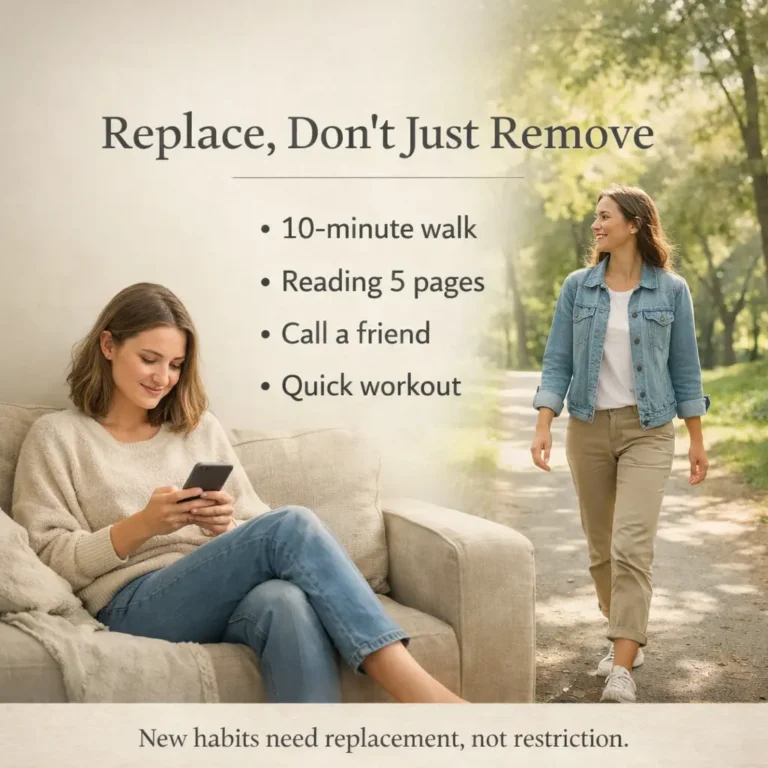
4. Replace the Habit Loop (Do not Leave a Vacuum)
Scrolling fills up the emotional gaps.
Replace it on purpose:
- Walk for 5 minutes after lunch.
- While the tea brews, stretching.
- Reading a single page rather than a single reel.
- One sentence in a journal.
Avoid leaving a behavioral void.
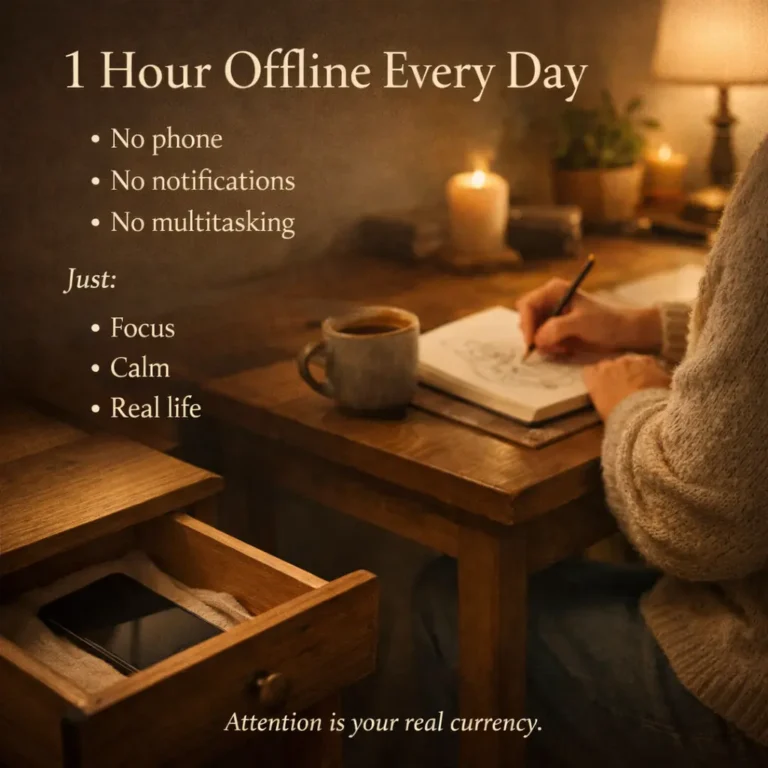
5. Make Phone-Free Anchors in Your Day.
Set boundaries around routines:
- First 30 minutes after awakening
- During the meals
- 1 hour before sleeping.
- One offline hour per day.
Begin with just one.
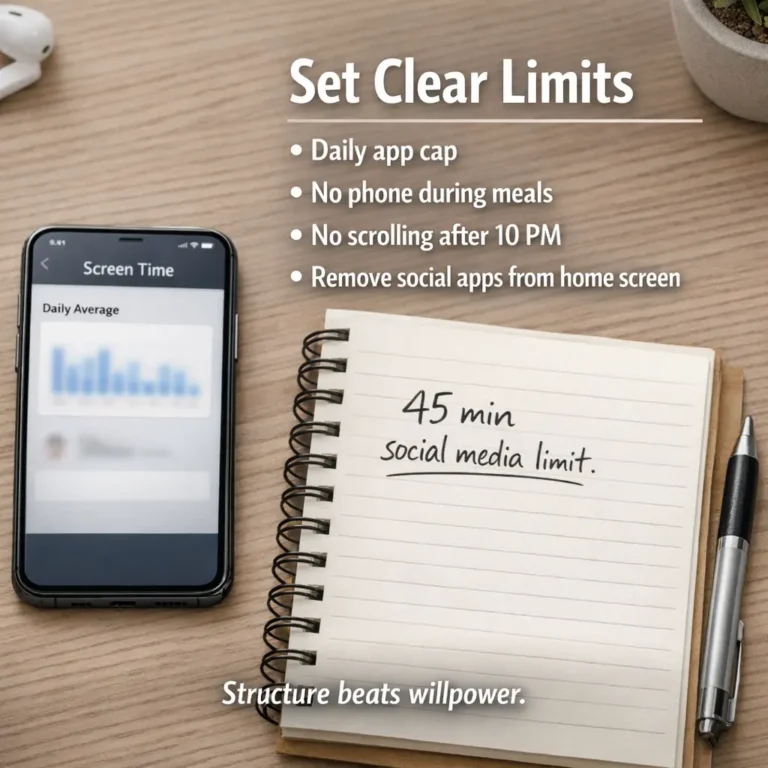
6. Limit your use of technology.
Practical tools:
- Screen Time settings.
- Focus mode
- Blockers for apps (Freedom, Forest)
- Schedule downtime.
Set restrictions that you will truly stick to.
This is not “0 minutes.”
Opt for “20 minutes after dinner.”
7. Improve Your Attention Span
Digital multitasking interferes with concentration.
To be rebuilt:
- Practice single-tasking.
- Implement 25-minute attention blocks.
- Allow boredom with no stimulation.
Attention returns slowly, just like fitness.
8. Decrease Reliance on Social Media
Most phone addiction is cantered on social media platforms.
Strategies:
- Unfollow accounts with comparative triggers.
- Remove reel/short triggers.
- Check only when it’s scheduled.
Micro-boundary:
- Instagram for just fifteen minutes at 8 p.m.
- Not 12 different times throughout the day.
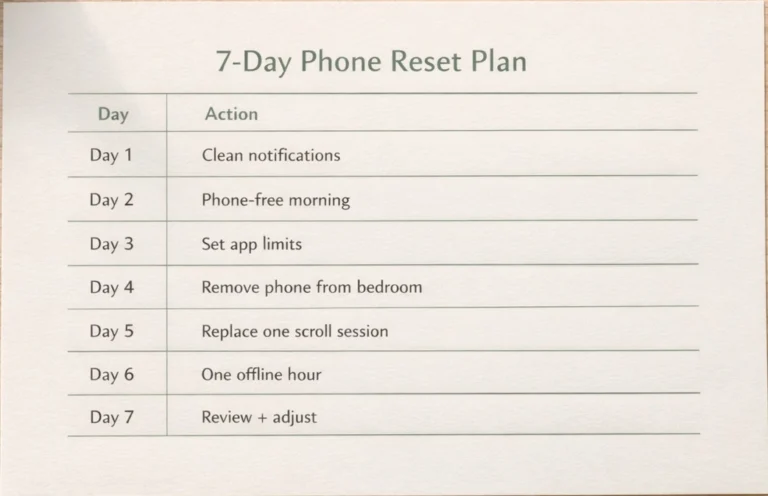
10. Follow the 7-Day Phone Reset Plan.
FAQs on How to Reduce Phone Addiction
If it interferes with sleep, mood, or relationships, it is excessive regardless of the number.
Yes. Dependence can be considerably reduced with disciplined behaviors and environmental design.
Turn off notifications and take your phone from your bedroom.
Not always. Limits are typically more durable than complete erasure.
Conclusion: Small Boundaries Beat Big Detoxes.
Extreme measures are not necessary to lessen phone addiction.
You need:
- Habits that are made intentionally
- Clearly defined limits
- Improve your sleep hygiene
- Maintaining consistency on a daily basis
Begin with a single anchor today.
Not ten.
Only one.
Your focus, sleep, and mental clarity will improve far faster than you anticipate.
You do not need to withdraw from life.
All you have to do is reconnect with control.

Sibani is the founder of The Calm Bloom, sharing mindful living tips, wellness guides, and practical routines for a balanced lifestyle.