Self-Improvement & Mindfulness
AI and Mental Clarity: Is AI Improving Your Thinking or Replacing It?
The more we rely on AI to think faster, the easier it becomes to overlook something more important—our own mental clarity.
Efficiency is valuable. But clarity comes from staying engaged with your own thinking, not simply reaching answers more quickly.
“Efficiency can increase output, but clarity depends on how much thinking you keep for yourself.”
-
 By
Sibani
By
Sibani - February 9, 2026
- 10 Min Read

You finish tasks faster than ever. AI helps you write, plan, summarize, and solve problems in seconds. It feels productive—but does it leave your mind feeling clearer?
Not always.
Mental clarity isn’t about how quickly you find answers. It’s your ability to think independently, stay focused, weigh different possibilities, and trust your own judgment when there isn’t an obvious solution.AI and mental clarity are closely connected, but they’re not the same thing
When AI becomes a replacement for thinking instead of a tool to support it, it can gradually weaken focus, confidence, and cognitive effort. The goal isn’t to use AI less—it’s to use it in a way that strengthens your thinking instead of quietly replacing it.
This article isn’t about whether AI is good or bad. It’s about understanding how it shapes the way you think.
You’ll discover how everyday AI use can influence mental clarity, why these changes happen, how they show up in daily life, and what you can do to stay mentally sharp without giving up technology.
No fear. No hype. Just a balanced look at how to use AI in a way that supports your focus, judgment, and independent thinking.Building AI and mental clarity together requires using technology intentionally rather than depending on it for every decision.
In This Article
- 1 Why does this pattern exist?
- 2 How This Affects Everyday Life
- 3 What Actually Helps
- 4 When It's Time to Look Beyond AI Habitsce
- 5 FAQ
- 6 Final Thoughts
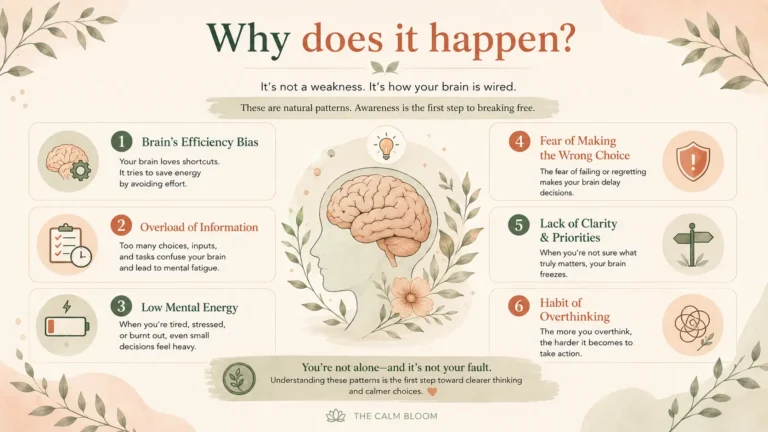
AI and Mental Clarity - Why does this pattern exist?
If you’ve ever felt more productive but somehow less mentally clear after using AI, you’re not imagining it.
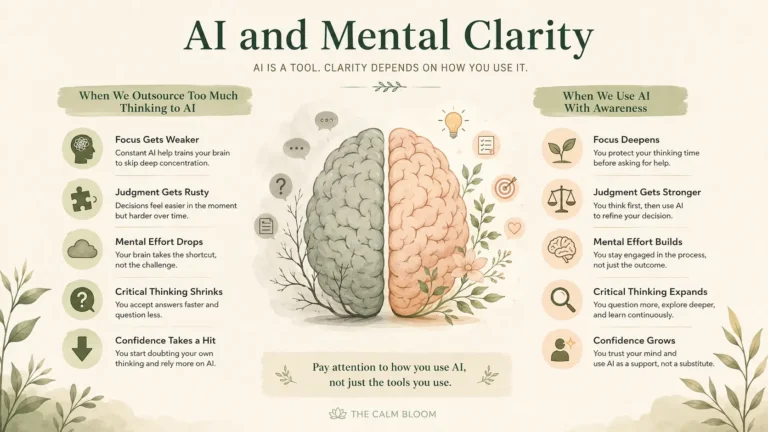
The issue isn’t that AI makes us less intelligent. It’s that the brain changes with the habits we practice. The more often we let AI think for us instead of with us, the less opportunity our mind has to strengthen skills like focus, reflection, problem-solving, and independent judgment.
Over time, these small habits can quietly shape the way we think.Healthy AI and mental clarity habits begin with thinking first and asking AI second.

“AI isn’t the Problem .Unintentional habits are. Awareness is the first step to clarity.”
Here are some of the key reasons why.

Cognitive Offloading
Every time AI writes, remembers, or solves a problem for you, your brain gets a little less practice doing those things itself.
Helpful sometimes, harmful when it becomes your default.
Attention Fragmentation
Jumping between prompts, responses, edits and notification trains your brain to switch constantly.
This makes deep focus harder and shallow thinking easier.
Less Productive Struggle
Struggle is part of learning. When AI fills every gap, you miss the small moments that built judgement, creativity and depth.
Comforts feel good, but growth lives in challenge.

Reduced Self-Reflection
AI can organize thoughts, but it can’t replace the process of thinking through an idea yourself.
Less reflection = weaker reasoning and lower clarity.

Lower Tolerance for Uncertaint
Instant answers feel reassuring. Over time, ambiguity starts to feel uncomfortable and even threatening.
This raises stress and reduces resilience.

Habit Formation
Convenience creates automatic patterns. You reach for AI first before trying your own thinking.
It’s not laziness, it’s how habits are built.

None of this means AI is harmful or should be avoided.
It Simply Reminds us that mental clarity grows through active thinking, not effortless answers.
AI and Mental Clarity - How This Affects Everyday Life
The effects of AI on mental clarity are often subtle. They don’t appear overnight, and they don’t mean you’re becoming less intelligent. Instead, they show up as small shifts in the way you think, focus, and make decisions.
According to the World Health Organization, protecting mental well-being requires healthy daily habits and stress management.
You might notice that you…..

Find it harder to start a task without asking AI for help.

Feel mentally busy but struggle to think clearly.

Trust AI’s suggestions more than your own judgment.
Have difficulty organizing your thoughts without prompts.

Feel mentally drained during deep, independent work.

Become impatient when answers aren’t immediately available.

Lose confidence when facing complex or uncertain problems.
You might notice that you…..

Seeking reassurance even after making a decision.

Finding it difficult to explain your thinking without referring to AI.
Constantly rewriting AI-generated content because it doesn’t feel like your own.

Finishing tasks successfully but still feeling strangely unsatisfied.
If some of these feel familiar, it doesn’t mean AI is harming your brain. More often, it suggests that convenience has started replacing cognitive engagement.

The goal isn’t to stop using AI—it’s to stay actively involved in your own thinking.

AI and Mental Clarity – What Actually Helps
The answer isn’t to stop using AI. It’s to use it more intentionally.
Mental clarity grows when AI supports your thinking instead of replacing it. Small changes in how you use these tools can help you stay focused, strengthen your judgment, and keep your mind actively engaged.
THE GUIDING PRINCIPLE

Use AI to reduce effort—not to replace thinking.
Let AI handle repetitive tasks, but keep the important decisions, ideas, and reflections your own.
01
Think First,
Then Ask AI
Before opening an AI tool, spend a few minutes writing, brainstorming, or outlining your own thoughts.
02
Choose the Right
Tasks
Not every task needs AI.Use it for repetitive work, proofreading, summaries, or routine planning. Save creative thinking, problem-solving, and important decisions for yourself whenever possible.
03
Make Space for
Productive Struggle
It’s natural to want an instant answer, but not every problem should be solved immediately.Before asking AI, pause for a few minutes. Try recalling information, exploring different ideas, or working through the problem on your own
04
Set Boundaries
Around AI
Instead of checking AI throughout the day, use it during specific work sessions.Creating clear boundaries helps you stay immersed in your own thinking and reduces the habit of reaching for AI every time you feel uncertain.
05

Protect Your Deep
Thinking Time
Some moments deserve your full attention.When you’re reading, journaling, planning, or reflecting on important decisions, let your mind work without AI. These quieter moments build confidence in your own judgment.
06
Support Your Mind,
Not Just Your Workflow
Mental clarity isn’t created on a screen alone.Take short walks, close unnecessary browser tabs, and give yourself regular breaks without constant input. A calmer mind makes better decisions and stays focused for longer.
These small habits don’t require giving up AI. They simply help you stay in charge of your own thinking while using technology as a helpful assistant—not a replacement.

For more ways to improve focus and attention naturally, explore Mindfulness Habits for Mental Wellness.
AI and Mental Clarity - When It's Time to Look Beyond AI Habits
Sometimes the problem isn’t AI itself. It simply makes existing stress, burnout, or mental fatigue more noticeable. If you’ve already improved your AI habits but still don’t feel mentally clear, it’s worth looking a little deeper.
You may benefit from extra support if…
Find it harder to start a task without asking AI for help.

Feel mentally busy but struggle to think clearly.
Trust AI’s suggestions more than your own judgment.
Have difficulty organizing your thoughts without prompts.
Calm Bloom Insight
Sometimes AI isn’t creating the problem—it’s revealing one that was already there.
Persistent brain fog, anxiety, chronic stress, or burnout deserve attention, whether AI is involved or not.
A Gentle Reminder
Seeking professional support isn’t a sign that you’ve failed.
It’s a healthy step when your own strategies are no longer enough.
Taking care of your mental well-being is one of the strongest decisions you can make.
FAQ
Can using AI every day affect mental clarity?
Not necessarily. AI itself isn’t the problem—how you use it matters. When AI becomes a replacement for thinking instead of a tool that supports it, you may rely less on your own focus, judgment, and problem-solving over time. Mindful use helps protect mental clarity.
Research discussed by Harvard Health Publishing suggests that attention and mental fatigue are influenced by how we manage information overload.
How can I use AI without becoming too dependent on it?
Start by thinking first and asking AI second. Write your own ideas, solve simple problems yourself, and use AI to refine, organize, or expand your thinking instead of replacing it. This keeps your mind actively engaged.
Why do I feel mentally tired even though AI saves me time?
Saving time doesn’t always mean reducing mental fatigue. Constant switching between tasks, information overload, and relying on AI for every decision can leave your mind feeling busy instead of clear. Mental clarity comes from focused thinking, not just faster results.
Can AI improve focus and productivity?
Yes—when used intentionally. AI can simplify repetitive tasks, reduce unnecessary workload, and free up time for deeper thinking. The goal is to let AI handle routine work while you stay involved in the decisions that require judgment and creativity.
How do I know if my lack of mental clarity is caused by AI?
It may not be. Brain fog, poor concentration, and mental fatigue can also be linked to stress, burnout, lack of sleep, anxiety, or emotional overload. If these feelings continue even after improving your digital habits, it’s worth looking beyond AI and addressing the underlying cause.
AI and Mental Clarity - Conclusion
AI isn’t the problem. Using it without intention is.
The goal isn’t to avoid AI—it’s to make sure it supports your thinking instead of slowly replacing it. Faster answers don’t always lead to better decisions, and greater productivity doesn’t always bring greater mental clarity.
Stay involved in your own thinking.
Real clarity comes from pausing, reflecting, questioning your assumption, and thinking about challenges.
You Don’t have to stop using AI.
Small habit – thinking before asking, taking breaks, and trusting your own judgement can make a big difference.
Tools should help you, not replace you.
Let AI handle the routine work so you can focus on decisions that need your creativity, value and judgement.

Clarity isn’t about speed. It’s about depth.
It grows when you protect your focus, stay present with you thoughts and own your decisions.

The next time you open an AI tool, pause for a moment and ask yourself:
“Am I using this to support my thinking, or to replace it?”
That single question can help you protect your focus, strengthen your judgment, and keep your mental clarity where it belongs—with you.

Sibani is the founder of The Calm Bloom, sharing mindful living tips, wellness guides, and practical routines for a balanced lifestyle.