Section 1: Introduction
Most people think their sleep is fine until they notice how quickly they lose patience, how foggy their brain feels, or how small problems hit harder than they should. Poor sleep is not a significant symptom. It affects you in a subtle manner: slower thinking, increased anxiety, and constant irritability. I learned this the hard way when I woke up tired even though I had slept early. I blamed everything except the truth – my nights were shallow, and my stress was running the show.
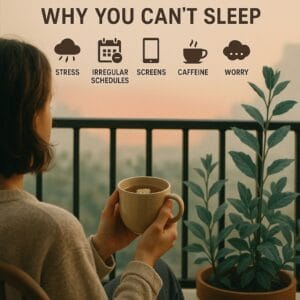 If you’re experiencing the same loop, you’re not alone. Our way of life frequently leads us to late screens, irregular meals, caffeine at the wrong time, and a pace that doesn’t allow the nervous system to reset. The sleep becomes lighter. Stress builds. Each of them worsens the other.
This guide is a complete, practical breakdown of natural sleep and stress relief. It’s not just about hacks and trends; it’s about the habits that actually calm the body and support deep rest. I will guide you through the root causes, daily habits that reset your system, food choices that matter, and tools that assist in times of need.
To begin, we should comprehend what is happening within your body when you feel tired and stressed out.
Section 2: The root cause and why it happens
Most people assume that bad sleep is about not trying hard enough to relax. It’s not. The physiological chain reaction initiates before bedtime.
1. Your nervous system is on high alert
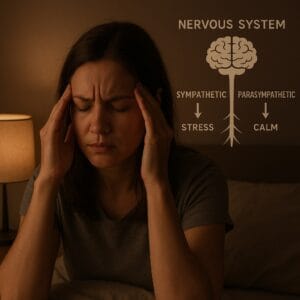
Whenever you experience stress, whether it’s because of calls, deadlines, notifications, arguments, or rushing, your brain enters a mild fight-or-flight state. The levels of cortisol are still high. Adrenaline remains present longer than it should.
Deep sleep and high-alert physiology are mutually exclusive.
If you have a tense day, your night will be shallow. It’s not weakness, it’s biology.
2. Your circadian rhythm is misaligned
 Your sleep-wake cycle is influenced by two signals:
- Light
- Timing
When your brain receives the opposite message when you have low sunlight exposure during the day and lots of screens at night. The release of melatonin has been delayed. You have a feeling of sleepiness late. You experience grogginess upon waking up.
The typical Indian routine involves having dinner at 9:30–10:00 PM, scrolling until midnight, and obtaining a quality sleep of 6–7 hours. It’s not working. The rhythm has already been disrupted.
3. Sleep and stress are inseparable
The next day, cortisol levels are raised due to poor sleep. A higher cortisol level causes the next night’s sleep to be worse.
This cycle can continue for months without you realizing it.
4. Your brain is wired by lifestyle friction
Some examples you may not even associate with your sleep:
- Consuming too much tea or coffee after 2 PM.
- Heavy dinners
- Thinking too much before going to bed
- There is no real mental shut-down
- Your mind is replaying unfinished tasks.
Even if nothing major happened that day, this creates a baseline level of anxiety.
5. There are not enough recovery signals being received by your body.
You can’t expect the body to rest at night if it never gets enough “mini-rests” during the day. Without small breaks, the nervous system stays active.
6. The emotional burden plays a role
Your mind can’t forget what you neglected during the day. Everything returns at night. The reason why bedtime is the time when your thoughts become louder is because of that.
Section 3: Reset Your Body’s Natural Rhythms
Most people begin their night routines immediately when their sleep becomes messy. That’s not the correct starting point. Sleep is not a problem at night. There’s a problem with my 24-hour rhythm. If you have a chaotic day, your nights will follow the same pattern.
A stable sleep cycle is dependent on four factors:
Light, timing, temperature, and predictability.
The issue cannot be fixed even if the night ritual is perfect.
Let’s take a look at what actually works.
3.1 Morning Light: The Most Ignored Sleep Habit
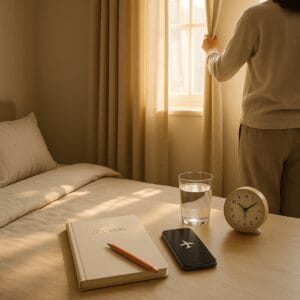 Your circadian rhythm can be anchored by strong daylight exposure within the first hour of waking your brain. Without it, melatonin stays elevated for a longer time. This is why people feel groggy even despite sleeping enough hours.
What steps should I take?
- Walk outside for 5-10 minutes after waking up.
- Sit close to a window when there is weak sunlight.
- It’s best not to check your phone while you’re doing this.
Why it is important:
Light signals the brain that the day has started.
This triggers cortisol in the morning where it belongs, not late at night.
Indian example:
If you wake up at 6 and take your chai on the balcony or terrace instead of sitting in bed scrolling.
3.2 The real anchor is waking up consistently.
People obsess over their bedtime and ignore the wake-up time, which is the real stabilizing factor. Waking up at different times confuses your melatonin cycle.
Target:
A consistency range of nearly 20 minutes, even if your sleep was poor.
This feels painful at first, but after a week, your body starts regulating itself.
3.3 Stop Eating Too Late
Late dinners are a major factor in disrupting sleep in India. Heavy meals after 9:30 pm cause digestion when your body wants to shift into recovery mode. The release of melatonin is delayed and nighttime cortisol levels are raised.
Simplify the regulation:
- Finish dinner 2.5-3 hours before going to sleep.
- If you cannot avoid late dinners:
Go lighter. The digestion of moong dal khichdi, vegetable soup, or steamed idlis is much quicker than that of roti-sabzi or oily foods.
3.4 Create a strict restriction for screens.
Your brain perceives screens as if they were morning light. The fastest way to ruin deep sleep is by scrolling at 11 pm. Melatonin levels can decrease by almost 40% when exposed to bright light at night.
Practical rule:
- Do not use screens 60–90 minutes before going to bed.
- If it’s necessary to use your phone:
Use night mode, low brightness, and avoid social media.
3.5 The Essential Evening Wind-Down
A ritual that looks like a spa is not necessary. You need something that signals that we’re done for today.
Make the routine predictable to make your brain associate it with sleep.
Examples:
- Warm shower
- Light stretching
- Reading for a 10-minute period
- Herbal tea
- Completing a ‘tomorrow list’ to shut down the mind.
It’s sufficient to spend just 15 minutes.
Internal links (contextual)
To build morning rhythm and reduce friction at night, read:
- How to Start a Morning Routine for Mental Clarity Read Here
- How to Sleep Better Without Medication Read Here
3.6 What is the fix for this section?
- Having a hard time getting to sleep
- Excessive morning grogginess
- Overthinking during the night
- Feeling tired upon waking up
The presence of predictable signals in your system leads to a deep sleep without any effort.
Section 4: Reduce daily stress load through small habits.
Having a calm nervous system in the evening is necessary for good sleep. Most people do not give their brain a minute of recovery during the entire day. Then they expect immediate relaxation at night. That’s unrealistic.
This section is about reducing the baseline stress load so that your nights aren’t spent undoing the damage of the entire day.
4.1 Focus on micro-recoveries rather than large breaks.
Your brain doesn’t require prolonged vacations. It needs repeated signals to indicate that you’re safe.
At least twice a week:
- Slow breathing for 60 seconds
- Going for a refill on my water
- Looking out of a window.
- Holding your phone in front of you
These micro-pauses have a better effect on lowering cortisol than forcing 20 minutes of meditation at night.
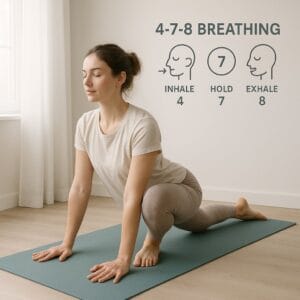
4.2 Breathing that actually works.
Not all breathing exercises are effective in calming the nervous system. Your exhalation controls relaxation. Longer exhalations have the effect of elevating vagal tone and lowering heart rate.
- Simple pattern:
Inhale for 4 seconds.
Exhale for 6–8 seconds.
Repeat 8-10 rounds.
This resets your system in a much faster manner than any motivational advice.
4.3 Reduce stimulation that you don’t even notice.
When you’re overwhelmed by noise and notifications, your brain stays in alert mode.
Reduce obvious friction:
- Keep your phone on silent or vibrate while working
- Minimize WhatsApp groups with constant chatter
- Eliminate half of all push notifications
- Use a single browser window instead of ten tabs
Chaos creates internal tension even when you don’t feel stressed.
4.4 Boundaries that protect your evening.
You can’t relax at 10 pm if work, chores, messages, and social media spill into the evening.
Set up two boundaries:
- Work cut-off
- The end of home tasks
Your brain needs a clear ‘no more input’ point.
Even if the work is not finished, stopping at a certain time decreases the stress of repeating it at night.
4.5 Mental shutdown ritual
In order to stay alert, your mind replays all the unfinished tasks before bed.
This can be prevented by a 2-minute routine:
Write down:
- 3 tasks you need to do tomorrow.
- What are the 3 things you’re done contemplating tonight?
Open loops are closed by this.
The reason why you sleep faster is because your brain trusts you won’t forget things.
4.6 Simple emotional release
Stress is not solely caused by workload. It’s an emotional backlog – irritation, sadness, anger, and guilt.
You don’t need to journal for marathons. Create a single sentence:
What’s bothering me the most today?
Name it, don’t analyze it.
This is more effective than people expected in reducing mental noise at night.
4.7 Movement breaks that lower cortisol levels.
 Movement is the fastest way to stabilize stress.
You don’t need to work out.
After eating, take a 5-minute walk. Perform 10 squats in between tasks.
Your blood sugar levels are stable and your mood is steady.
4.8 Indian lifestyle examples.
- The timing for Chai is limited to the morning and early afternoon. Evening chai increases stress hormones and decreases sleep hormones.
- Delegating one task daily is part of family responsibilities. The cumulative effect of small reliefs is significant.
- If your home is noisy in the evening, try using soft instrumental music to mask chaotic sounds.
Internal links (contextual)
To manage stress more deeply:
How to Manage Stress Naturally Without Therapy Read Here
How to Do a Digital Detox for Mental Health Read Here
4.9 What is the solution for this section?
- Overthinking
- Evening anxiety
- Emotional heaviness
- Tightness in the chest and shoulders
- Feeling irritable during the night
Your nights will no longer feel like recovery battles as your daily stress levels decrease.
Section 5: Support Your Body Through Food and Evening Rituals
Most people underestimate how strongly food timing, food choice, and small night rituals influence sleep and stress. If your daytime habits shape your nervous system, your dinner and evening choices determine how smoothly your brain transitions into rest mode.
This section is long and detailed because it is where most people unknowingly sabotage their sleep.
5.1 Stop treating food and sleep as separate problems.
Your digestive and nervous systems are interconnected.
Heavy meals, random snacking, caffeine timing, or spicy food late at night can push your body into alert mode. When digestion works overtime, the body cannot prioritize deep sleep.
If your sleep feels broken, start evaluating what you ate and when.
The pattern is almost always found.
5.2 The food-stress-sleep triangle (Simple explanation)
Here’s the simplified version of how food impacts sleep and stress:
A. Heavy food at night can lead to poor sleep.
- Digestion takes precedence over repair in your body.
B. Low magnesium levels can lead to higher stress levels.
- This mineral soothes the nervous system. The majority of people lack enough.
C. Sugar spikes can lead to stress spikes.
- Having a high-sugar evening snack results in a blood sugar crash at night.
The result of this is midnight waking, a fast heartbeat, anxiety, or vivid dreams.
D. Caffeine late in the day delays melatonin production.
- It doesn’t matter whether it’s chai, coffee, or cold coffee.
Your sleep window will be changed if it’s after 2–3 pm.
E. Sleep can be improved by eating comfort food.
- Fried food or heavy carbs are a common way for people to relax, as they believe it is soothing.
These foods cause your gut to work harder, keeping you awake.
Once you change your diet, half of your stress and sleep symptoms disappear without any other intervention.
5.3 Indian and global foods that help you sleep.
 These foods are packed with nutrients that promote calmness, lower cortisol, and support melatonin’s smooth functioning.
Indian-Friendly Options
- Moong dal khichdi is a healthy option due to its lightness, ease of digestion, and ability to stabilize blood sugar levels.
- Warm milk with nutmeg (jaiphal) has a natural mild sedative effect.
- Dates and ghee are warm, grounding, and good for evening cravings.
- Banana contains magnesium and tryptophan.
- Buttermilk (chaas) is cooling and reduces acidity, which often disturbs sleep.
- Steamed idli with sambar is easy to digest.
- Oats with warm milk regulate blood sugar and keep you full.
Global Options
- Oatmeal with banana
- Greek yogurt with berries
- Chamomile tea
- Almonds, cashews, and pistachios are nuts that are rich in magnesium
- Soups that are warm, such as vegetable, bone broth, and lentil
These foods are not meant for sleeping. They’re food that regulates. They balance your system so that the body can slow down naturally.
5.4 Foods that quietly impede sleep.
The majority of people fail to associate their night disturbances with their previous eating habits.
Don’t do these in the evening:
- Fried food
- Spicy food stimulates the gut and raises body temperature.
- High-sugar desserts
- The leftover food that contains a lot of masala
- Coffee or tea after 2 pm
- Late night chocolate that contains caffeine
- Paneer dishes that are heavy
- Roti and sabzi dinners with lots of oil.
If you eat these after 8:30–9:00 pm, your sleep quality may decrease even if you fall asleep quickly.
5.5 The perfect evening meal plan.
If you want a predictable and stable sleep, your dinner should be:
Light, warm, and easy to digest.
A simple formula:
Protein, carbohydrates, and warm hydration.
Examples:
- Khichdi with kadhi
- 1–2 idlis with sambar.
- A bowl of dal and vegetables that have been lightly cooked.
- Vegetable upma
- Oatmeal with warm milk.
If you need roti urgently:
Pick whole wheat, but cut back on the quantity. Increase the amount of vegetables.
This is not a diet rule. It’s a rule for sleeping.
5.6 Timing is the real game changer.
Late dining is a cultural norm for Indian households.
But if you push dinner to even 8 PM, your digestion window becomes much more beneficial to your sleep cycle.
Your target:
- Dinner will be served from 7:30 to 8:30 pm.
- Sleep around 10:00 to 10:45 pm.
- Devices must be turned off between 9:00 and 9:15 pm.
This timing pattern is the most reliable way to improve your sleep, regardless of your lifestyle.
5.7 How evening rituals can lower stress.
Your brain does not shut down automatically.
A pattern that conveys safety and closure is necessary.
The essence of a good ritual is simple:
A. Take a warm shower or wash your face.
- The body temperature decreases after you step out.
This helps to increase melatonin levels.
B. Turn down the lights.
- Reduces stimulation.
Warm-toned bulbs are more effective than bright white LEDs.
C. Calming drink (choose one).
- Warm milk
- Herbal tea
- Turmeric milk (light)
- Cinnamon water
D. Light stretching
- Release tension by moving your upper body slowly for 5 minutes.
E. Phone outside the bedroom.
- The most effective stress-relieving tool you’ll ever implement.
A ritual is not necessarily about aesthetics.
Consistency is what it’s all about.
5.8 Resetting the evening
At night, your mind stays active because it feels incomplete.
Fixing this requires a 2-minute reset
1. List 3 things that went well today
- The brain is shifted from survival mode to safety mode by this.
2. Create 3 tasks for tomorrow
- Reduces the amount of mental replay.
3. Acknowledge one emotion you felt.
- This prevents emotions from spilling over into the night.
It seems straightforward.
80% of the useless thinking that keeps people awake is shut down by it.
5.9 Caffeine timing (non-negotiable rule)
Taking chai or coffee after 3 pm can lead to a decrease in your sleep quality, even if you fall asleep quickly.
Caffeine has a half-life of 5-6 hours.
Drinking tea at 4 pm will still result in caffeine in your body at 10–11 pm.
Backs the statement that caffeine after mid-afternoon can still affect sleep (half-life ~5 hours, wide individual range). NCBI
NCBI/Pharmacology of caffeine (textbook summary on half-life). NCBI
This includes:
- Cold coffee
- Masala chai
- Green tea
- Chocolate
If evenings feel stressful, caffeine is often the real culprit.
5.10 Hydration Mistakes at Night
The majority of people drink too much water too close to bedtime.
This results in night waking and disrupts deep sleep.
Fix it:
- Reduce the amount of water you consume after 8 pm
- Take a sip instead of gulping
Prioritize drinking during the day, not at night.
5.11 Internal Links (contextual)
These posts expand on the connection between food, stress, and sleep.
How to Boost Your Immune System Naturally at Home Link Here
How to Improve Gut Health Without Probiotics Link Here
Both help regulate inflammation and digestion, which are two underrated sleep disrupters.
5.12 What this section fixes.
- Midnight waking
- Overheating at night
- Anxiety spikes after dinner
- Heavy stomach
- Difficulty unwinding
- Light, fragmented sleep
Most sleep problems improve once food, caffeine and evening rituals stop working against your biology.
Section 6: Supplements, tools, and when to use them.
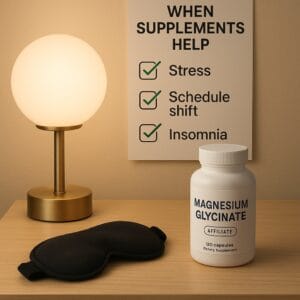 Most people rush to supplements when they can’t sleep. It’s a mistake. Supplements only help when the basics are already in place – rhythm, food, stress, light, and timing. If they are still chaotic, no capsule will fix the problem.
This section will give you the specifics of what works, when to use it, and what to avoid.
6.1 When Supplements Actually Help
Use supplements only when:
- Your schedule is relatively consistent.
- Your sleep remains shallow or delayed
- Your stress level feels high even with daily habits.
- You wake up between 2 and 4 am on a regular basis.
If any of this is not accurate, address your lifestyle first. The foundation must be clean for supplements to work effectively.
6.2 Magnesium (The most reliable option)
Magnesium supports muscle relaxation, lowers night-time cortisol levels, and improves deep sleep. Stress and diet are the main causes of deficiency in most people.
Supports claims that magnesium can improve sleep quality and reduces cortisol/ anxiety in some studies. Use for the line about magnesium glycinate and evidence-based benefit. PMC
Primary / review: Association of magnesium intake with sleep duration and quality (PMC review). PMC
Recent systematic review on magnesium & sleep/anxiety. Cureus
Best form:
- Magnesium glycinate
- Magnesium bisglycinate
It’s best to avoid oxide or citrate at night as they can upset digestion.
Who is it beneficial to?
- Individuals who wake up tense
- People with insomnia caused by anxiety.
- Individuals who experience muscle tightness
Suggested product placeholder:
Affiliate: Magnesium Glycinate Capsule.
6.3 Ashwagandha (Stress and Sleep Combined)
Ashwagandha helps your body transition out of alert mode by reducing cortisol. It’s not a sedative. It soothes your body, which in turn enhances your sleep.
Use if:
- You are feeling restless
- At night, you tend to overthink
- Work pressure is a cause of your stress
- You wake up feeling energized
Product placeholder:
Affiliate: Ashwagandha extract.
6.4 Valerian / Chamomile / Lavender
Herbal options that work mildly for relaxation, not for knockout sleep.
Valerian:
Excellent for individuals who struggle with falling asleep due to anxiety.
- Chamomile tea:
Relieves mild tension. Suitable for a ritual.
- Lavender oil:
Aids in lowering heart rate and calming the nervous system.
Product placeholder:
Affiliate: Chamomile tea.
Affiliate: Lavender Essential Oil.
6.5 Melatonin (Use Only With Intention)
Most people misuse melatonin.
Melatonin is a hormone that regulates time, not a sleeping pill.
Only use if:
- You’re changing your schedule
- You’re transitioning from late nights to early sleep
- You traverse time zones
- You struggle with delayed sleep phases.
- Do not take it daily for a long time.
Reputable clinical guidance on melatonin being for short-term/timing use, and cautions about long-term use and side effects. Use to justify “use only with intention” wording. Mayo Clinic
Mayo Clinic summary (melatonin uses and safety). Mayo Clinic
NHS guidance on how/when to take melatonin (short courses). nhs.uk
NCCIH/NIH summary on melatonin safety (short-term vs unknown long-term). NCCIH
6.6 Tools That Help More Than People Expect
1. Eye Mask
Blocks artificial light that hinders the production of melatonin.
2. White Noise and Brown Noise
It is useful in households that are noisy in India.
3. Glasses that block blue light
Helpful if your work requires screen time in the evening.
4. Weighted Blanket
Enhancing parasympathetic response is beneficial for individuals with anxiety or restlessness.
6.7 When You Should NOT Use Supplements
It’s best to avoid supplements if:
- Your sleep issues may be caused by untreated worry or emotional load.
- You’re drinking caffeine late in the evening
- Your dinner is too heavy
- Your brain is not getting any rest
- You’re making use of them as a shortcut
Supplements are not a substitute for rhythm.
Section 8: Conclusion
 Supporting your biology and stopping fighting it leads to an improvement in sleep. There’s no need for complicated rituals or perfect discipline. You need a predictable rhythm, calmer evenings, lighter dinners, better light exposure, and a few minutes of actual mental shutdown.
When the body feels regulated, stress becomes manageable.
Deeper sleep is achieved when the system is not constantly pushed.
Begin with a single change today.
It’s not a matter of which one.
The most important thing is consistency.
Your nights will improve faster than you expected.





Sibani is the founder of The Calm Bloom, sharing mindful living tips, wellness guides, and practical routines for a balanced lifestyle.