Section 1 – Introduction
Most women live with hormonal symptoms for so long that they start to believe it’s normal.
Recurring PMS. Bloating that fluctuates. Cravings that suddenly arise. A stubborn belly fat. Afternoon fatigue even after 7-8 hours of sleep. Anxiety levels rise before your period. Skin and hair issues that are unpredictable.
 These issues don’t randomly appear.
They are direct responses from your hormone system, which reacts to everything you do, including your meals, sleep consistency, stress load, movement, light exposure, gut health, and even the chemicals hidden in daily home-care products.
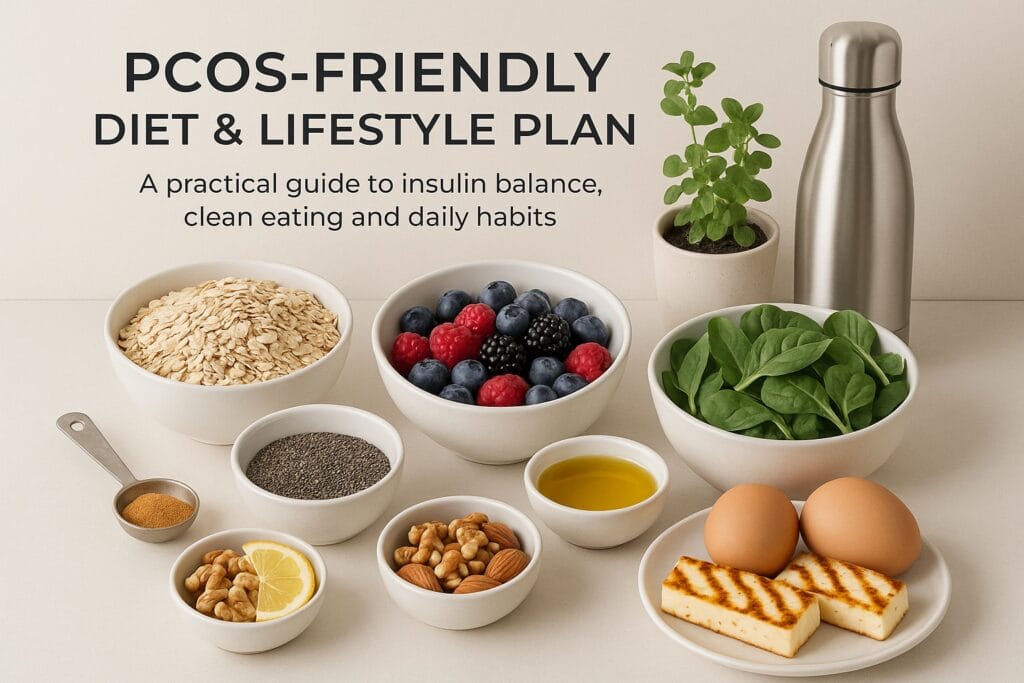
A hormonal balance lifestyle is not a medical program. The solution does not involve expensive tests, supplements, or extreme diets. A scientific-backed, practical framework for balancing your natural hormones is created through consistent habits that support your biology rather than fight it.
The purpose of this guide is to provide women with a natural hormone reset without complicated routines. The steps here focus on daily triggers that can be controlled.
- The stability of blood sugar
- circadian rhythm
- Support for the gut and liver.
- stress modulation
- Reducing environmental toxin levels
- cycle-aligned habits
Internal links to The Calm Bloom’s resources are available to help you go deeper into each area. For example:
To improve your sleep without medication, Check Out .
How to Manage Stress Naturally Without Therapy, Check Out
How to reduce inflammation through diet , Check Out
A guide to non-toxic cleaning products for a healthy home, Check Out
Throughout the guide, I will also cite external research sources so that your readers know the information is legitimate and not generic wellness fluff. Examples include:
APA: Stress and Hormonal Response
Harvard School of Public Health – Fibre and Estrogen Health
NIH – Sleep and Circadian Rhythm Research
At the end, you will be able to comprehend:
- What is the real meaning of hormonal balance beyond social media myths?
- What are the early signs of imbalance?
- The hormones are disrupted by the root lifestyle.
- Nutritional principles that naturally balance hormones.
- Supporting women’s hormone health through stress and sleep patterns
- Cycle-aligned living that satisfies your biology
- Environmental toxins that quietly disrupt hormones.
- Supplements that actually serve a purpose (and those that are unnecessary)
- Basic hormone tests are worth considering.
This isn’t a one-week reset.
It’s a structured, sustainable lifestyle that supports your endocrine system day after day.
Changes that are small but have a compounding effect.
Actual physiological results.
A stronger and more stable version of yourself.
Section 2 – What is the actual definition of hormonal balance?
The majority of women assume that ‘hormonal balance’ means that every hormone is always at a perfect level. That’s not the way biology works. Hormones naturally fluctuate throughout the day, your menstrual cycle, and various life stages.
Hormonal balance is the process of your hormones fluctuating in the correct pattern, at the right time, and in the correct proportion.
A healthy hormonal balance lifestyle ensures that your body follows predictable rhythms.
2.1 Cortisol Works with Your Clock
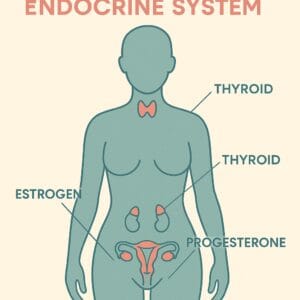 This is how a stable cortisol rhythm appears:
- High in the morning gives energy and motivation.
- Low at night allows melatonin to rise for sleep.
Reference (external):
NIH – Cortisol and Circadian Rhythm
If cortisol stays high in the evening, you may experience:
- anxiety
- irritability
- poor sleep
- cravings
This can be fixed by learning how to do it inside
Internal link: “Natural Ways to Sleep Better and Manage Stress”
2.2 Insulin Stays Stable
The term ‘balanced insulin’ means:
- steady energy
- fewer cravings
- reduced inflammation
- healthier metabolism
The fastest way to experience weight gain, mood swings, and PMS is through unstable insulin.
The core pillar of women’s hormone health is the balance of insulin.
Internal link :
How to Reduce Inflammation Through Diet
2.3 Estrogen and Progesterone Stay in Ratio
The objective is not to enhance estrogen or increase progestin levels.
The aim is to maintain their coherence:
- Estrogen levels should increase in the first half of your cycle.
- After ovulation, progesterone should take the lead.
Problems begin when estrogen becomes too high compared to progesterone, which is often called estrogen dominance.
Symptoms include:
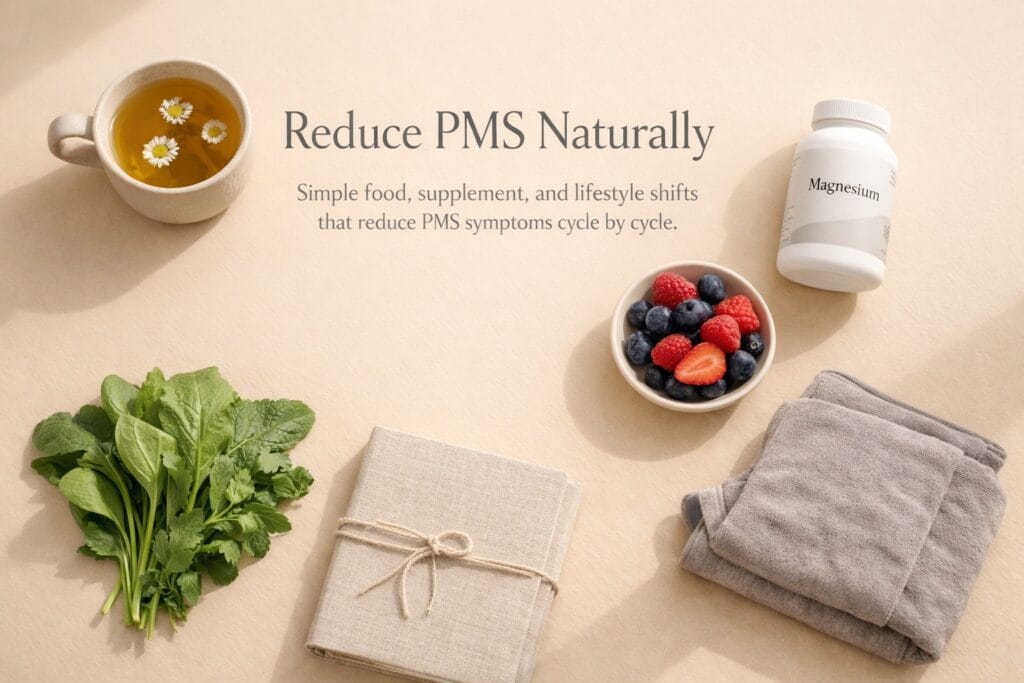
- PMS
- bloating
- breast tenderness
- mood dips
- menstrual headaches
External source :
Harvard School of Public Health
2.4 Thyroid Hormones Stay Efficient
Thyroid hormones are responsible for regulating:
- metabolic rate
- hair growth
- energy levels
- temperature regulation
- menstrual regularity
Even minor disturbances can cause a situation:
- weight plateaus
- fatigue
- hair thinning
- irregular cycles
Many women don’t realize that thyroid imbalance often begins with stress, poor sleep, and blood sugar instability, not just issues with iodine or medication.
Internal link:
How to Stay Healthy Working a 9-to-5 Desk Job
2.5 All Hormone Systems Interact
Your endocrine system works like a web, not as isolated parts.
When a hormone changes, other hormones compensate for it.
- High cortisol levels result in lower progesterone levels.
- Poor sleep can lead to higher insulin levels.
- High inflammation disrupts estrogen levels.
- Low vitamin D can cause sluggish thyroid function.
This is why symptoms don’t appear on their own.
Women rarely experience just PMS, low energy, or cravings.
They come as a cluster because the system is interconnected.
Through this guide, you can learn how to naturally balance hormones by developing habits that support all of these systems together, including food, sleep, movement, stress, and detox.
2.6 The Bottom Line
Hormonal balance is not defined by perfect numbers.
The body responds normally with predictable rhythms, stable energy, and a normal response:
- steady mood
- regular periods
- healthy sleep
- less inflammation
- stable weight
- controlled cravings
When done correctly, a hormonal balance lifestyle can restore this exact thing.
Section 3 – Common signs that your hormones are out of balance.
Hormonal imbalance is rarely seen as a single isolated symptom. Your endocrine system is like a network that reacts to changes in one hormone. That’s why most women experience a cluster of symptoms, not just one issue.
Here are the early warning signs that your body is asking for a shift towards a healthier, hormonally balanced lifestyle.
3.1 Cycle-Related Symptoms
 When estrogen, progesterone, and insulin are not stable, symptoms first appear in your menstrual cycle.
Typical signs:
- Irregular cycles
- Severe PMS
- Cramps that are stronger than usual
- Spotting before your period
- Heavier bleeding or clotting
- Cycles can be short (less than 25 days) or long (more than 35 days).
The causes of these issues are either disrupted estrogen-progesterone ratios, inflammation, or stress-driven decreases in progesterone levels.
Internal link for readers who need deeper hormonal cycle support:
How to Start a Morning Routine for Mental Clarity
Morning structure stabilizes cortisol and influences cycle health.
3.2 Metabolic Symptoms
Hormones can fall out of rhythm quickly due to insulin imbalance.
Signs include:
- Belly fat, especially in the lower abdomen.
- Even though I eat clean, my metabolism slows down
- Cravings for sugar or carbs
- Between 2-5 PM, there are energy crashes.
- Feeling shaky or irritable due to hunger
- Weight gain that occurs in the hips, thighs, or waist.
These symptoms indicate unstable blood sugar, which is a root trigger for estrogen dominance, PCOS, PMS flare-ups, and thyroid slowdown.
An internal link that provides nutrition-related fixes:
How to Reduce Inflammation Through Diet
3.3 Skin & Hair Symptoms
Your skin and hair directly respond to hormone changes, especially insulin, testosterone, and thyroid function.
Watch for:
- Acne cysts that affect the jawline, chin, and neck
- Hair sheds excessively.
- Hair is thinning around the crown.
- Skin that is dry, dull, or flaky
- Unpredictable sensitivity or breakouts
- Before periods, acne worsens
Hormonal imbalance is the root cause of these symptoms, not just “bad skin.”
The most common causes are insulin spikes, inflammation, low progesterone, poor sleep, and nutrient deficiencies (vitamin D, omega-3, and zinc).
3.4 Emotional & Cognitive Symptoms
Hormones have an impact on the chemistry of your brain. Your mood may be affected by changes in estrogen, progesterone, cortisol, or thyroid hormones.
Common signs:
- Having mood swings or being irritable
- Anxiety or restlessness
- Difficulty focusing
- Brain fog
- Low motivation
- Easily feeling overwhelmed
- Reduce the amount of stress you can handle
Research link :
American Psychological Association – Stress and Hormone Interaction.
Internal link for support:
How to Manage Stress Naturally Without Therapy
3.5 Sleep & Energy-Related Symptoms
If your sleep cycle is disrupted, every hormone — insulin, cortisol, thyroid, and estrogen — gets affected.
Typical red flags:
- Sleeping difficult
- waking up during the night
- Feeling tired despite having slept for 7–8 hours.
- Afternoon exhaustion
- At night, I feel both wired and tired.
- Having a heavy grogginess in the morning
- Having an addiction to caffeine
External reference:
NIH — Sleep, Circadian Rhythm & Hormonal Regulation
Internal link:
Sleep Better Without Medication: A Complete Guide
When it’s imperative to take these symptoms seriously
If three or more symptoms from different categories match your current experience, your body is signalling hormonal instability, and lifestyle intervention is necessary.
Through evidence-based habits, you can correct these patterns with the help of this guide.
- food
- sleep
- stress
- movement
- cycle support
- low-toxin living
Small adjustments, repeated consistently, can reverse most early hormonal symptoms within 4-12 weeks.
Section 4 – Root causes of hormonal imbalance can actually be controlled.
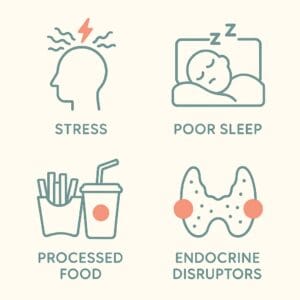 Hormones don’t often go out of balance without a reason.
Your endocrine system is constantly influenced by your habits, environment, and daily stress load. The real problem is that most women focus on symptoms like PMS, fatigue, and weight gain without addressing the underlying causes.
What’s the good news?
Almost all common hormonal disruptions today come from modifiable lifestyle factors that can be changed without the need for tests, medication, or expensive treatment.
To achieve a stable hormonal balance lifestyle, you must comprehend these major roots.
4.1 Chronic Stress
Chronic stress is a powerful hormone disruptor.
When cortisol levels stay high for too long, it directly affects:
- progesterone drops
- Thyroid hormones slow down.
- Insulin becomes unstable.
- Estrogen becomes harder to metabolize.
Symptoms that you may experience:
- anxiety
- irregular periods
- PMS flare-ups
- insomnia
- cravings
- afternoon crashes
External research reference:
APA — Chronic Stress & Hormonal Effects
Internal support link:
How to Manage Stress Naturally Without Therapy
4.2 Poor Sleep Quality
Sleep is not optional for hormone regulation; it is essential.
It is possible for one night of poor sleep to disrupt:
- Blood sugar spikes are caused by insulin
- Cortisol stays elevated.
- Leptin causes hunger to increase.
- Melatonin changes circadian rhythms.
- Thyroid function slows down.
Consistent poor sleep leads to PMS, weight gain, cravings, irritability, brain fog, and irregular cycles.
External source:
NIH — Sleep, Circadian Rhythm & Hormonal Regulation
Internal link for your readers:
Sleep Better Without Medication: A Complete Guide
4.3 Ultra-Processed Foods
Ultra-processed foods quickly spike insulin, trigger inflammation, and put stress on the liver, the organ responsible for detoxifying excess estrogen.
This leads to:
- estrogen dominance
- bloating
- acne
- weight gain
- PMS intensification
- low energy
Indian foods that pose a problem:
- packaged namkeen
- white bread
- biscuits
- instant noodles
- sugary chai
- sweetened yogurt
- bakery items
Internal link :
How to Reduce Inflammation Through Diet
4.4 Blood Sugar Instability
This is the fastest way to harm women’s hormone health.
When blood sugar fluctuates throughout the day:
- cravings increase
- cortisol rises
- insulin resistance begins
- progesterone drops
- PMS worsens
- energy crashes become normal
- fat storage increases
Nearly every woman experiencing hormonal issues today has some degree of blood sugar instability, even without diabetes.
A core goal of this hormonal balance lifestyle is to stabilize insulin through predictable meal patterns.
4.5 Nutrient Deficiencies
The nutrients needed for hormone production, detoxification, and regulation are lacking in most Indian women.
Top deficiencies:
- Vitamin D deficiency due to indoor lifestyle.
- Magnesium deficiency (poor soil quality) is common among individuals who experience high stress levels.
- Omega-3 is low in typical Indian diets.
- Stress and processed foods are linked to B-complex.
- Iron is common in menstruating women.
These deficiencies can cause fatigue, stress sensitivity, cravings, hair fall, irregular cycles, and poor sleep.
Internal link to support nutrient-rich eating:
How to Boost Your Immune System Naturally at Home
External reference:
Harvard School of Public Health — Nutrient Support for Women
4.6 Endocrine-Disrupting Chemicals (EDCs)
EDCs can mimic or cause harm to estrogen, progesterone, thyroid hormones, and insulin.
They conceal themselves within:
- plastics
- household cleaners
- fragrances
- skincare
- pesticides
- non-stick cookware
Regular exposure can lead to mood swings, irregular cycles, bloating, PMS, weight gain, and thyroid imbalance.
External resource:
Environmental Working Group (EWG) — Endocrine Disruptor Guide
Internal link for a safer home:
Best Non-Toxic Cleaning Products for a Healthy Home
and
How to Create a Low-Toxin Home Environment
The Core Point
Your symptoms are not random.
They result from consistent disruptions such as stress, sleep loss, blood sugar swings, poor nutrition, and environmental toxins that accumulate over months and years.
The rest of this guide shows you exactly how to reverse these root causes and build a sustainable, science-backed lifestyle that balances hormones.
Section 5 – Nutritional Guidelines for Maintaining Hormonal Balance
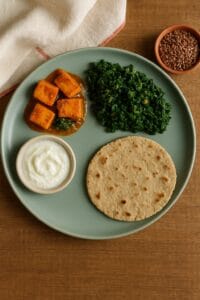 Food is the most direct and immediate way to naturally balance hormones.
Your eating habits have an impact on your:
- Insulin response
- Inflammation levels
- Estrogen metabolism
- Thyroid health
- Gut bacteria
- Sleep quality
- Cravings and mood
A sustainable hormonal balance lifestyle doesn’t rely on extreme diets, cutting entire food groups, counting calories, or fasting aggressively.
What you need is structure, not restriction.
To maintain natural hormone balance, every woman should follow these nutrition principles.
5.1 Stabilize Blood Sugar First
If you fix your blood sugar, you can fix 50% of your hormone symptoms.
Women’s hormone health is most affected by this single dietary habit.
Every meal must include the four basics:
- Protein
- Fiber
- Healthy fats
- Slow carbs
This prevents insulin spikes and crashes, reduces cravings, and stabilizes mood and energy levels.
Examples of balanced Indian plates:
- Paneer bhurji, multigrain roti, and stir-fried greens.
- Dal, brown rice, salad, and ghee.
- Eggs, poha, and peanuts.
- Chicken curry with millet (jowar, bajra) and cucumber.
- Rajma, quinoa, and sautéed vegetables.
- Sprouts chaat with boiled eggs.
An internal link that supports nutrition foundations:
How to Boost Your Immune System Naturally at Home
5.2 Adopt an Anti-Inflammatory Eating Pattern
Inflammation has a direct impact on estrogen, progesterone, thyroid hormones, and insulin sensitivity.
An anti-inflammatory plate consists of:
- colourful vegetables
- quality proteins
- whole grains
- healthy fats
- fermented foods
- Herbs and spices (turmeric, ginger, methi, cinnamon)
Anti-inflammatory foods that are friendly to Indians:
- Curd and homemade yogurt with probiotics.
- Coconut chutney for idli or dosa
- Vegetable-loaded khichdi
- Palak, methi, cabbage, lauki
- Seeds like flax, sesame, and pumpkin
- Turmeric and black pepper
- Coconut, mustard oil, or ghee are all options
Internal link:
How to Reduce Inflammation Through Diet
5.3 Fix Estrogen Dominance with Specific Foods
Estrogen dominance doesn’t mean that estrogen is too high.
It means estrogen is not being metabolized efficiently, usually due to liver overload, poor gut health, or chronic inflammation.
Foods that naturally balance estrogen:
- Broccoli, cauliflower, and cabbage all fall under the category of cruciferous vegetables.
- Flax seeds (lignans) help with estrogen metabolism.
- Sesame seeds
- Methi seeds improve insulin and estrogen clearance.
- Lemon water can support liver function.
- High-fiber vegetables
- Chia seeds
- Sprouts
External reference:
Harvard School of Public Health — Fiber & Hormone Health
Internal link to support detox and gut health:
How to Create a Low-Toxin Home Environment
5.4 Build a Consistent Meal Pattern
Having irregular eating is a significant cause of insulin spikes, cortisol surges, and mood swings.
A structure that supports hormones looks like this:
Daily eating routine
- Breakfast should be eaten within 1–2 hours of waking up
- The lunch time is between 12 and 2 PM.
- Snacks are optional, but only if you’re feeling hungry
- Before 8 PM is the time for an early dinner
- Overnight fast: 12-14 hours (ideal for most women).
What makes this important:
- Supports stable insulin levels.
- Reduces late-night cortisol levels.
- prevents overeating
- Coordinates circadian rhythm with digestion
- Supports thyroid and metabolism.
Internal link to support morning rhythm:
How to Start a Morning Routine for Mental Clarity
5.5 Add Functional Hormone-Supporting Foods
These foods don’t replace habits, but they simplify the process.
- Turmeric and ginger are anti-inflammatory.
- Cinnamon is used to regulate blood sugar levels.
- Fennel seeds can support digestion.
- Green leafy vegetables for detoxification and minerals.
- Nuts and seeds contain healthy fats and minerals.
- Berries and citrus fruits are antioxidants.
5.6 What to Reduce or Avoid
These aren’t ‘never eat’ items, but limiting them accelerates natural hormone balance.
- packaged snacks
- refined sugar
- deep-fried foods
- bakery items
- sodas and commercial juices
- excess caffeine
- alcohol
- instant noodles
- Sugary tea multiple times a day.
Insulin is disrupted, inflammation is increased, and estrogen metabolism is overwhelmed by these foods.
The key takeaway
There’s no need for complicated diets.
Structure, consistency, and nutrient density are necessary.
When you combine the ‘Big 4’ meals with anti-inflammatory foods and regular meal timing, your body naturally shifts towards a healthier hormonal balance lifestyle — often within 4-8 weeks.
Section 6 – Stress-reducing habits that reset cortisol
 Stress-reducing habits that reset cortisol
You cannot naturally balance hormones without fixing cortisol.
All other hormones, including estrogen, progesterone, thyroid hormones, insulin, and your sleep-wake cycle, are influenced by cortisol.
If cortisol is unstable, your entire hormonal balance and lifestyle can collapse.
The stress management habits are simple, scientifically proven, and practical for Indian lifestyle patterns.
6.1 Morning Sunlight (10 Minutes Daily)
One of the fastest ways to regulate cortisol rhythm is by using morning sunlight.
Why it is effective:
- Tells your brain that it’s morning.
- establishes your circadian rhythm
- Lowers evening cortisol levels.
- Stabilizes mood and energy levels.
- boosts serotonin levels (your natural mood stabilizer)
External research reference:
NIH — Light Exposure & Circadian Hormone Regulation
Internal link to support stress–sleep rhythm:
Natural Ways to Sleep Better and Manage Stress
The method to follow:
- Walk on your balcony, terrace, or outside your building for 5-10 minutes within 1 hour of waking up. No sunglasses.
- Breaking up stress with micro breaks.
- Consistent stress can lead to harm.
The cortisol curve is broken by micro-breaks. - Every 90 minutes, perform a 2-minute reset.
- Step outside
- Relax your upper back
- Slowly take 5 deep breaths
- Drink water without relying on screens
- Take a walk around your house
- Try to release the neck/shoulder quickly
Internal link for practical stress relief strategies:
How to Manage Stress Naturally Without Therapy
Micro-breaks keep cortisol from staying elevated all day, which can lead to anxiety, PMS, and sleep problems.
6.3 Reduce Caffeine (Especially After 2 PM)
Consuming caffeine causes an increase in cortisol levels.
- without food
- in large amounts
- late in the day
- when there’s a lack of sleep or stress
- Signs that caffeine is affecting your hormones:
- afternoon irritability
- anxiety
- heart racing
- poor sleep
- late-night “wired but tired” feeling
Recommendation:
Limit caffeine to one cup before 2 PM, always with food.
For many women, switching afternoon tea or coffee to herbal tea significantly stabilizes their mood and sleep.
6.4 Grounding & Breathwork (2 Minutes Is Enough)
The focus here is on physiology, not spirituality.
Slow breathing increases vagus nerve activity, lowering cortisol in real-time.
A straightforward technique:
- Box breathing (2 minutes):
- Inhale for 4 seconds.
- Hold for 4 seconds.
- Exhale for 4 seconds.
- Hold for 4 seconds.
- Repeat for 8-10 cycles.
External research :
NIH – Breathwork improves cortisol and nervous system balance
Internal link for grounding techniques:
How to Manage Stress Naturally Without Therapy
6.5 Do a Daily “Stress Off-Ramp” Routine
Your body needs a clear transition from day mode to night mode.
This prevents evening cortisol spikes that disrupt sleep.
Examples:
- Taking a leisurely walk after dinner
- light stretching
- listening to soothing music
- Keeping a journal for 5 minutes
- warm shower
- limiting the brightness of the screen
The connection between stress and sleep is explained here:
Internal link: “Sleep Better Without Medication: A Complete Guide”
https://thecalmbloom.com/sleep-better-without-medication
6.6Protect Your Evening Cortisol Curve.
At night, cortisol levels are high.
→ poor sleep
→ low progesterone
→ worse PMS
→ cravings
→ fatigue
Stay away from these after 7 PM:
- high-intensity workouts
- intense emotional conversations
- exhausting work meetings
- scrolling through social media with a sense of doom
- Sugary desserts or caffeine
A calmer evening routine is more effective at restoring women’s hormone health than any supplement.
Section 7 – Guidelines for achieving hormonal balance during sleep
 Hormone health cannot be compromised by sleep.
You can eat perfectly, exercise consistently, and take every supplement — but if your sleep is disrupted, your hormones will not stabilize.
Poor sleep disrupts:
- Cortisol stays too high.
- Insulin increases cravings and fat storage.
- Thyroid hormones (slow metabolism)
- Progesterone drops can lead to PMS and anxiety.
- Estrogen becomes harder to metabolize.
- Melatonin levels (lower) can result in poor recovery.
Even one week of poor sleep can cause hormonal chaos.
External research:
NIH – Sleep, Circadian Rhythm, and Hormone Regulation.
7.1 Build a Consistent Sleep Routine
Your body loves rhythm: the same sleep time and wake time.
The Non-Negotiables
- Do not use screens 60 minutes before going to bed
Blue light kills melatonin, resulting in low-quality sleep. - Turn off your home lights after 8 PM
- Make sure your room is cool (22–25°C is a good temperature for most women)
- Have a dinner rich in magnesium.
Leafy vegetables, paneer, dal, nuts, and seeds are some examples.
Internal link for support of sleep rhythm:
Natural Ways to Sleep Better and Manage Stress
A consistent night-time routine is more effective at balancing natural hormones than most supplements.
7.2 Reduce exposure to blue light.
Melatonin is suppressed by blue light because it tricks the brain into thinking it’s still daytime.
Do this routinely in the evening
- Put your phone and laptop into warm light mode.
- Switch between a night mode and a reading mode
- Shut down the white LED lights in the bedroom.
- Replace the warm lamps with bulbs that have a yellow tint.
- Blue light-blocking glasses can be used if necessary.
These changes alone can improve sleep depth within 7-10 days.
7.3 Control evening cortisol levels by avoiding stimulation.
Women often describe the feeling of being ‘wired but tired’ due to high evening cortisol levels.
Stay away from going after 7 PM.
- intense workouts
- work calls
- problem-solving tasks
- heavy arguments
- Reading news or social media
- caffeine
- sugary desserts
Instead, opt for activities that are soothing:
- stretching
- a warm shower
- light reading
- soft music
- Keeping a journal of your thoughts
Internal link to support stress reduction:
How to Manage Stress Naturally Without Therapy
7.4 Create a Hormone-Friendly Bedroom
Your bedroom environment is more significant than people realize.
Checklist
- Make sure the room is dark and use blackout curtains if necessary.
- Maintain a cool temperature
- Bright clocks or blinking electronics should be avoided
- Avoid charging your phone next to your head
- Choose either a low-toxic room freshener or no room freshener at all.
Internal link for toxin reduction:
How to Create a Low-Toxin Home Environment
7.5 Support Melatonin Naturally
If not recommended by a professional, avoid taking melatonin supplements immediately.
Support your body’s natural production instead.
- Section 6 provides support for obtaining morning sunlight
- turn down the lighting in the evening
- Eat a dinner that is full of nutrients
- It’s best to avoid eating heavy meals late at night
- Include soothing herbal teas like chamomile, lavender, or tulsi in your diet.
External source:
Harvard — Sleep Quality & Light Exposure
7.6 Eat Your Last Meal 2–3 Hours Before Bed
- Eating late at night has an impact on:
- insulin
- digestion
- melatonin
- cortisol
- thyroid function
Women experience better sleep and stable energy when their digestive system is off duty at bedtime.
Recommended:
Eat dinner before 8 PM.
7.7 Magnesium: The Sleep Mineral
Stress, caffeine, and low dietary intake are responsible for most women’s magnesium deficiency.
Magnesium supports:
- progesterone production
- deep sleep
- muscle relaxation
- anxiety reduction
- insulin sensitivity
Food sources:
- spinach
- peanuts
- almonds
- pumpkin seeds
- dal
- bananas
Internal link:
How to Boost Your Immune System Naturally at Home
Bottom line for sleep and hormones.
Poor sleep makes it impossible to naturally balance hormones.
The foundation for the hormonal balance lifestyle is built upon fixing sleep, it’s not an option.
Good sleep is key to achieving stable cortisol levels, healthy periods, fewer cravings, better mood, and faster weight regulation.
Section 8 – The exercise routine for hormonal health
 Most women assume that intense workouts burn more fat and balance hormones faster. Wrong.
High-intensity routines done at the wrong time or too often can spike cortisol, worsen PMS, disrupt sleep, and stall weight loss.
For true hormonal balance, your workout routine should stabilize cortisol, improve insulin sensitivity, and support metabolism — without further stressing your body.
These exercise guidelines can reliably enhance women’s hormone health.
8.1 Strength Training (3 Days a Week)
Strength training is the single most effective exercise for naturally balancing hormones.
The reason for its success:
- Enhances insulin sensitivity
- boosts metabolism
- reduces belly fat
- Boosts progesterone stability
- Improves the quality of sleep
- Enhances mood and confidence.
Prioritize large, functional motions:
- Squats
- Deadlifts
- Pushups
- Row variations
- Lunges
- Hip hinges
Weekly structure:
- 30–40 minutes
- 3 days per week
- Moderate intensity
- Rest between sets
Internal link to support posture and desk-job movement:
How to Stay Healthy Working a 9-to-5 Desk Job
These exercises can deliver results even with minimal equipment.
8.2 Walking (Daily, 7,000–10,000 Steps)
Walking is not well-known, but it has a positive impact on hormones.
Benefits:
- Lowers the levels of stress hormones
- Lowers blood sugar levels
- Enhances the effectiveness of fat-burning
- boosts digestion
- Reduces inflammation
- Aids in controlling cravings
Most effective:
A 10-15 minute walk after meals is clinically proven to reduce post-meal blood sugar spikes.
External reference (NIH):
Walking after meals improves glucose regulation
Even if you only have 5,000 steps now, build slowly.
8.3 Gentle Movement (1–2 Times Per Week)
Gentle movement is beneficial for progesterone, cortisol, and recovery.
Best options:
- Yoga
- Pilates
- Light stretching
- Mobility routines
- Slow-flow movement
Why it is effective:
- regulates the nervous system
- improves flexibility
- decreases pelvic tension
- aids in better sleep
- lowers inflammation
This is especially helpful during the luteal and menstrual phases. Section 9 will cover this.
8.4 Limit HIIT (Once a Week, Max)
High-intensity interval training is known as HIIT.
Great tool. It’s terrible when used excessively.
Issues with excessive HIIT:
- Raises cortisol
- Worsens PMS
- Disrupts sleep
- Triggers cravings
- Slows thyroid function
- Increases inflammation
- Stalls weight loss despite making a lot of effort
Women with PCOS, PMS, or thyroid issues often see better results by reducing their HIIT, not increasing it.
Recommendation:
- Every week, I schedule one session that lasts 15-20 minutes.
- Late evening is not the time to do it
- Do not use during the luteal or menstrual phase
8.5 Rest & Recovery Are Non-Negotiable
Most women push through fatigue and pay for it with hormonal consequences.
Signs that your body is in need of rest:
- Irritability
- Poor sleep
- Low strength
- Heavy legs
- Cravings
- Cycle irregularity
- Afternoon fatigue
Taking rest days can help prevent cortisol overload and improve metabolism in the long run.
8.6 Build a Weekly Hormone-Friendly Workout Plan
A simple structure is in place to support hormones year-round:
A sample plan for a week
- Monday’s workout is focused on strength training
- On Tuesdays, it takes me approximately 30–45 minutes to walk.
- Wednesday’s Strength Training
- Thursday is dedicated to yoga or stretching.
- Friday’s Strength Training
- Saturday is a good day for a light walk or rest.
- You can opt for Sunday HIIT (optional) or gentle movement.
This combination improves insulin, cortisol rhythm, sleep, metabolism, and cycle health without burning out.
Bottom line for exercise and hormones.
You don’t need rigorous workouts to naturally balance hormones.
You need consistency and the right mix of things.
- Strength
- Walking
- Gentle movement
- Controlled intensity
- Strategic rest
The foundation of a sustainable hormonal balance lifestyle is exercise, which supports your biology instead of fighting it.
Section 9 – Cycle-sync your habits
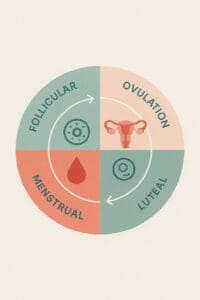 Women’s hormones follow a monthly rhythm, and your energy, cravings, metabolism, sleep, and stress tolerance shift with that rhythm. By adjusting your lifestyle to match your cycle, you can reduce internal stress and stabilize your hormones faster.
Cycle-syncing is not an exact science, but research and real-world patterns show that aligning food, movement, and routines with each phase improves overall women’s hormone health.
Here’s how to do it in a practical and simple way.
9.1 Follicular Phase (Day 1–14)
- Estrogen levels are on the rise
- Your energy levels are increasing.
- Mood: Clear and motivated.
- The metabolism is slightly faster
- Best for building new habits and strengthening workouts.
✔ Best Habits
- Begin new routines
- Engage in creative work
- Longer walks
- Moderate to heavy weight training
- Planning and productivity tasks.
✔ Eat More Of
- Iron-rich foods help compensate for blood loss.
- Spinach, beetroot, methi, and eggs.
- Lean proteins
- Fermented foods include curd, idli/dosa, and sauerkraut
- Fruits that are high in vitamin C.
- Sprouts and beans
An internal link :
How to Start a Morning Routine for Mental Clarity
Morning routine and follicular energy are key to habit success.
9.2 Ovulation (Day 14–16)
- Estrogen is at its peak
- Your energy is the highest.
- Mood: social and confident.
- Metabolism: Strong
- Best for high-intensity tasks, communication, and heavy lifting.
✔ Best Habits
- Large workplace meetings
- Presentations
- If you’re feeling good, you can do intense workouts
- High-impact cardio or HIIT (maximum one per week)
- Social activities
✔ Eat More Of
- Hormone-supporting nutrients:
- High-fiber vegetables include broccoli, cabbage, and carrots.
- Omega-3 sources include flax seeds, chia seeds, and fatty fish.
- Coconut water, cucumber, and oranges are all hydrating foods
External research source:
Harvard School of Public Health — Fiber & Hormone Health
9.3 Luteal Phase (Day 17–28)
- Progesterone levels are increasing
- Your energy: Start strong, then gradually decrease.
- The mood is more sensitive
- Metabolism slightly slower.
- The symptoms include bloating, cravings, and irritability
This is where most women sabotage their hormonal balance by pushing too hard.
✔ Best Habits
- Training for strength that is light to moderate
- More rest
- The routine for winding down at night
- Lower caffeine
- Evening walks
- Early bedtime
- Prep meals to avoid PMS cravings
✔ Eat More Of
- Magnesium-rich foods
- Peanuts, spinach, dal, and pumpkin seeds
- Meals that are warm and easy to eat
- Complex carbs
- Millets, quinoa, sweet potatoes, dal, and rice.
- Herbal teas that soothe the nervous system.
- Chamomile, lavender, and tulsi.
Internal support link:
Natural Ways to Sleep Better and Manage Stress
A calm and low-stress environment is where progesterone thrives.
9.4 Menstrual Phase (Your Period)
- Hormones that are low are estrogen and progesterone.
- Your energy is low.
- Mood: inward and quiet.
- Metabolism: Slower
- Focus on recovery and rebuilding the body.
✔ Best Habits
- Light walking
- Gentle stretching or yoga
- Extra hydration
- Journaling / self-check-in
- Lower workload if possible
✔ Eat More Of
- Warm soups and stews.
- Iron-rich foods
- Minerals that include salt, potassium, and magnesium
- Herbal teas
- Cooked vegetables
✔ Avoid
- HIIT
- Intense workouts at the gym
- Conversations that are intensely emotional
- Ice-cold foods can cause worse cramps for many women.
Internal link for inflammation reduction:
How to Reduce Inflammation Through Diet
Why does cycle synchronization work?
Cycle syncing improves hormonal balance by reducing unnecessary stress on your body during sensitive phases. When you match food and movement with hormonal shifts, you can:
- Reduce PMS
- Stabilize blood sugar levels.
- Improve sleep
- Reduce cravings
- Support metabolism
- Lower inflammation
- Feel more mentally aligned with your natural rhythm
This enhances the sustainability of your hormonal balance lifestyle.
Section 10 – Environmental detoxification.
 Most women focus on food and workouts when trying to fix hormones, but environmental toxins are one of the strongest disruptors of estrogen, thyroid hormones, progesterone, and insulin.
These chemicals, which have been identified as Endocrine-Disrupting Chemicals (EDCs), are commonly referred to as EDCs.
They mimic hormones, block receptors, and interfere with your body’s natural signaling.
They show up in:
- plastics
- fragrances
- skincare
- household cleaners
- cookware coatings
- pesticides
- air fresheners
Reducing exposure doesn’t require becoming chemical-free.
It means lowering your daily toxin load so that your liver and hormones can function normally.
External reference:
Environmental Working Group — Guide on Endocrine Disruptors.
Internal link for low-toxin home support:
How to Create a Low-Toxin Home Environment
10.1 Replace Plastics Wherever Possible
Plastics contain compounds like BPA, BPS, and phthalates, all of which are linked to irregular cycles, estrogen dominance, thyroid disruption, and fertility issues.
✔ What to replace
- Plastic bottles should replaced with stainless steel or copper bottles
- Plastic meal boxes replace with glass or steel containers
- Plastic spoons/plates replaced by steel or ceramic
- To keep hot food safe, use borosilicate glass instead of tupperware.
✔ Stop Heating Food in Plastic
- Microwaves and plastic can leech endocrine disruptors into your food.
✔ Switch to BPA-Free Options
- If you must use plastic, ensure that it is BPA-free (but this is still not perfect).
Internal link for home detox basics:
A Guide to Non-Toxic Cleaning Products for a Healthy Home
10.2 Cleaner Personal Care Products
Your skin absorbs part of what you apply to it.
The majority of Indian personal care brands include:
- artificial fragrances
- parabens
- sulfates
- formaldehyde releasers
- mineral oils
- phthalates
Women’s hormone health is negatively impacted by all of these.
✔ Switch To:
- Sulphate-free shampoos
- Fragrance-free lotions
- Aluminium-free deodorants
- Cleaner face wash formulas
- Mineral-based sunscreens
- Paraben-free moisturizers
You don’t need to overhaul everything at once — replace one item per month.
10.3 Improve Home Air Quality
Outdoor air is often less polluted than indoor air.
Poor indoor air has an impact on thyroid health, cortisol, inflammation, sleep, and metabolic function.
✔ Practical Steps
- Ventilate your home daily for 5-10 minutes.
- When cooking, make sure to use exhaust fans
- Avoid incense sticks on a daily basis (use them only occasionally).
- Replace commercial room sprays with essential oil diffusers
- Instead of dry dusting, use a wet mop on floors to reduce particulate spread
Internal link:
How to Create a Low-Toxin Home Environment
10.4 Reduce Fragrance Exposure
Fragrances contain dozens of chemicals that are not listed, some of which mimic estrogen or interfere with thyroid activity.
Avoid or Reduce:
- scented candles
- room fresheners
- car perfumes
- body mists
- fragranced detergents
- heavily scented soaps
- Better Alternatives:
- essential oil diffusers
- fragrance-free detergents
- naturally scented soaps
- beeswax candles
- activated charcoal bags for deodorizing
This change has a significant impact on your hormone-disruptor load.
10.5 Rethink Cookware
When the cookware is overheated, it releases toxic fumes and hormone-disrupting particles.
Better Choices:
- cast iron
- stainless steel
- ceramic-coated cookware
- clay/earthen pots
They have a longer lifespan and help maintain natural hormone balance by minimizing exposure to PFOA/PTFE chemicals.
10.6 Clean Up Your Water Quality
Water can have traces of:
- pesticides
- microplastics
- heavy metals
- chlorine
- Ideal Setup:
- RO filtration (for urban areas)
- Copper vessel storage (pathogen control + trace minerals)
- Stainless steel bottles (no plastic leaching)
10.7 Start a Simple Home Detox Routine
You don’t need a complete overhaul.
Begin with these weekly steps:
- Take care of your bedding once a week
- Mop the floor twice a week.
- To reduce indoor dust, it’s best to keep shoes outside
- Make sure to air out cushions/mattresses every month
- Include plants like money plant, snake plant, and areca palm in your home
- Pollutants are removed and the air quality is maintained for your endocrine system.
Bottom line for environmental detoxification.
Hormonal imbalance isn’t caused overnight by environmental toxins — they accumulate.
Reducing toxin exposure results in a lighter burden on your liver, stabilizing estrogen metabolism, protecting thyroid health, and improving overall hormonal resilience.
To maintain a sustainable hormonal balance lifestyle, a low-toxin home is essential.
Section 11 – Supplements are optional but can be beneficial
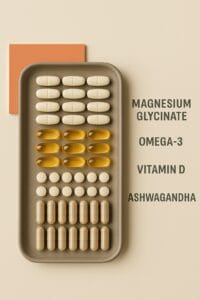 Supplements do not replace the core habits of a hormonal balance lifestyle – stable blood sugar, good sleep, low inflammation, and controlled stress.
The foundation must be in place for them to work.
Look at supplements as aid, not solutions.
Women’s hormone health can be improved by considering these supplements, which are based on research and common deficiencies found in Indian women. Do not use any of these as a shortcut.
11.1 Magnesium Glycinate
This is the first supplement most women benefit from because stress, caffeine, poor soil quality, and heavy menstrual cycles rapidly drain magnesium.
✔ Benefits for Women’s Hormone Health:
- Improves the quality of sleep
- Reduces PMS symptoms.
- Reduces anxiety and irritability.
- lowers cortisol
- enhances insulin sensitivity
- promotes muscle relaxation
- Magnesium glycinate is a more gentle option for the stomach and is more effective for sleep and anxiety than magnesium oxide.
✔ Dosage Guidance
200–300 mg 1–2 hours before bed.
Always confirm with your doctor if you are pregnant, breastfeeding, or on medication.
Internal link supporting sleep and stress regulation:
Natural Ways to Sleep Better and Manage Stress
11.2 Omega-3 Fatty Acids
Indian diets are typically low in omega-3 fats, and the imbalance between omega-6 and omega-3 fats can cause inflammation, which is a major trigger for hormonal imbalance.
✔ Benefits:
- reduces inflammation
- enhances estrogen metabolism
- Supports thyroid health
- stabilizes mood
- Improves skin and hair quality.
- Reduces the intensity of menstrual pain
✔ Food Sources:
- Fatty fish like salmon and sardines
- flax seeds
- chia seeds
- walnuts
- fish oil supplements
- A high-quality fish oil or algae-based omega-3 supplement (for vegetarians) is often useful.
External research:
NIH — Omega-3 and inflammation
11.3 Ashwagandha
Ashwagandha is one of the most researched adaptogens for reducing cortisol, which is the primary stress hormone.
✔ Benefits:
- lowers cortisol
- aids thyroid function
- reduces anxiety
- improves sleep
- stabilizes mood
- supports energy production
✔ Who Benefits Most:
Women who suffer from chronic stress
- poor sleep
- anxiety
- low energy
- irregular periods due to stress
External clinical reference:
Research shows Ashwagandha reduces cortisol levels and supports stress balance.
Internal link to stress foundations:
How to Manage Stress Naturally Without Therapy
11.4 Vitamin D
95% of Indians are deficient in Vitamin D, making it one of the most important supplements for hormone balance.
✔ Why It Matters:
The benefits of Vitamin D include:
- insulin sensitivity
- mood stability
- thyroid function
- bone health
- immune health
- menstrual regularity
- energy levels
Low Vitamin D levels can lead to deficiencies :
PMS, cravings, mood swings, and irregular cycles are common symptoms of fatigue.
✔ Dosage
It’s important to test your levels before anything else (25-OH Vitamin D test).
Most women require 1000–2000 IU per day, but it can vary depending on their deficiency.
External reference:
Harvard — Vitamin D & Women’s Health
11.5 B-Complex (Optional but Commonly Needed)
Useful for women who have experienced:
- chronic stress
- fatigue
- hair fall
- brain fog
- PMS
- low appetite
- poor digestion
Methylation, hormone production, and energy metabolism are supported by B vitamins.
11.6 Who Should NOT Rely on Supplements Alone
Avoid using supplements if:
- Your sleep is not good
- Your blood sugar is not stable
- You consume too much caffeine
- you are experiencing constant stress
- Your diet is not consistent
- You’re skipping meals
- your lifestyle is full of chaos
Supplements can enhance good habits.
They do nothing when their lifestyle is out of alignment.
11.7 How to Introduce Supplements Safely
- Start with one supplement at a time.
- Make sure there is a 2-week delay before adding another.
- Watch for changes in sleep, mood, digestion, and energy.
- Avoid taking anything at random because someone recommended it.
- Check with your doctor if pregnant, breastfeeding, or on medication.
What is the purpose of supplements?
Supplements are optional, not essential.
They support your hormonal balance lifestyle but do not create it themselves.
Prioritize sleep, nutrition, stress, movement, and detox.
Then strategically add supplements for faster and more stable results.
Section 12 – When testing is helpful
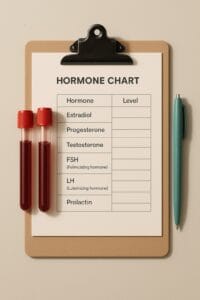 You do not need expensive or complicated tests to begin a lifestyle that promotes hormonal balance.
Most women improve dramatically through structured habits alone: better sleep, balanced meals, reduced stress, steady movement, and lower exposure to toxic chemicals.
Testing becomes useful when:
- Despite making lifestyle changes, symptoms are still present
- Your cycle is extremely irregular
- You are experiencing weight gain that is not explained
- There is a constant feeling of fatigue
- The symptoms of PMS are severe
- Rapid loss of hair
- The feeling of anxiety is too much.
- The symptoms of thyroid are strong
- PCOD and PCOS are suspected
- You’re planning to have a baby.
By testing, you can gain clarity, eliminate guesswork, and track your progress.
Below are the only tests that truly matter for women’s hormone health.
12.1 Thyroid Panel (TSH, FT3, FT4)
Thyroid dysfunction is one of the most common (and often overlooked) causes of fatigue, weight gain, mood swings, and menstrual issues.
Combine these together:
- TSH
- Free T3
- Free T4
- Optional add-ons if symptoms are severe:
- Anti-TPO
- Anti-thyroglobulin
This indicates whether your thyroid is underactive, overactive, or struggling due to inflammation.
External reference (NIH):
Thyroid disorders & hormonal symptoms
12.2 Fasting Insulin
For women, fasting insulin is more significant than fasting sugar.
Despite normal blood sugar, high fasting insulin is a sign of early metabolic imbalance, which is a key trigger for:
- cravings
- belly fat
- irregular cycles
- PCOS-like symptoms
- low energy
- PMS flare-ups
Most women with hormonal imbalances have insulin issues first, and they often go undetected without this test.
12.3 Vitamin D (25-OH Vitamin D)
Vitamin D deficiency is almost universal among Indian women.
Low Vitamin D causes:
- mood fluctuations
- fatigue
- thyroid imbalance
- poor immunity
- hair fall
- PMS
- low motivation
- sleep problems
Ideal range: 40–60 ng/mL (general functional range)
Internal link for immune and nutrient support:
How to Boost Your Immune System Naturally at Home
12.4 Progesterone (Day 21 Test)
Taking a progesterone test on Day 21 or 7 days after ovulation is a way to determine whether you’re ovulating and if your progesterone dose is enough.
Low progesterone is equal to
- anxiety
- PMS irritability
- spotting
- short cycles
- poor sleep
- mood swings
This test is particularly significant for women who have irregular cycles or fertility concerns.
12.5 Estrogen (E2)
Identifying estrogen dominance or low estrogen patterns can be done with this method.
There is a possibility that high estrogen may cause:
- bloating
- breast tenderness
- PMS
- mood swings
- weight gain
- Low estrogen may cause:
- low libido
- dryness
- joint pain
- fatigue
- poor concentration
Make sure to test with progesterone for clarity.
12.6 Morning Cortisol
The morning is when cortisol levels should be highest.
If morning cortisol levels are too high or too low, it disrupts the body’s ability to function properly.
- mood
- cravings
- sleep
- stress tolerance
- cycle regularity
Morning cortisol testing provides information about adrenal stress patterns.
Internal support link for cortisol regulation:
How to Manage Stress Naturally Without Therapy
12.7 Additional Optional Tests (Only if Needed)
These are not a necessity for everyone. Consider them only if the symptoms are persistent.
- Long-term blood sugar control with HbA1c.
- CRP (C-Reactive Protein) is an inflammation marker.
- Ferritin storage for iron.
- B12 levels are important for fatigue and mood.
- The LH/FSH ratio is an indicator of suspected PCOS.
- AMH is used to assess ovarian reserve and fertility.
Avoid unnecessary hormone panels that cost between rupees 8,000 and rupees 20,000.
They rarely give insight that you can act on.
The conclusion of the testing process
Testing is not mandatory, but it is helpful when lifestyle changes do not resolve symptoms within 6-12 weeks.
Begin with the fundamentals:
- thyroid panel
- fasting insulin
- Vitamin D
- progesterone
- estrogen
- morning cortisol
Adjust your hormonal balance lifestyle based on what you learn.
Section 13 – Affiliate Section: Helpful Tools for Hormonal Balance
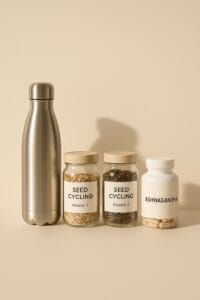 These tools cannot replace lifestyle habits such as sleep, blood sugar stability, and stress management, and are not miracle cures.
The hormonal balance lifestyle is made easier and more consistent with supportive add-ons.
The suggestions below are based on evidence, clinical relevance, and what Indian women commonly benefit from, rather than trends.
13.1 Magnesium Glycinate
Best for: sleep quality, PMS, anxiety, and stress management.
Why it is beneficial:
- Ensures the stability of the nervous system
- Enhances deep sleep
- Helps progesterone production
- Reduces cramps and PMS irritability.
If you’re having trouble, use this:
- Poor sleep, anxiety, mood swings, chronic stress, and restless legs.
13.2 Omega-3 Fish Oil (or Algae Omega for Vegetarians)
Best for: inflammation, skin health, mood stability, hormone production
Why it is beneficial:
- enhances estrogen metabolism
- lowers inflammation
- Supports thyroid function
- Improves hair and skin.
- reduces the pain of menstruation
13.3 Ashwagandha Capsules
Best for: cortisol balance, low energy, anxiety, and thyroid support.
Why it is beneficial:
- reduces cortisol
- Improves the quality of sleep
- stabilizes mood
- promotes thyroid hormone conversion
Excellent for women who have hormonal symptoms that are driven by stress.
13.4 Stainless Steel Water Bottle
Best for: reducing exposure to endocrine disruptors from plastic
Why it is beneficial:
Plastic bottles, especially heated ones, leech hormone-disrupting chemicals like BPA/BPS, which worsen estrogen imbalance.
Switching to steel is a simple, daily detox choice.
13.5 Seed-Cycling Blend
Best for: PMS, irregular cycles, mild estrogen–progesterone imbalance
Why it is beneficial:
- Flax seeds and pumpkin seeds support estrogen metabolism.
- Sesame seeds and sunflower seeds help balance progesterone levels.
- a rich source of fiber, lignans, and minerals
Seed cycling is not a cure, but many women notice improved symptoms after 2–3 cycles.
13.6 Glass or Borosilicate Food Storage Containers
Best for: reducing toxin exposure from heated plastics
Why it is beneficial:
- Suitable for hot food
- Supports hormone-free food storage.
- Minimizes BPA/BPS interaction with food
- Ways to use affiliate tools responsibly
- Make sure to only introduce one at a time
- Keep an eye on your body for one to two weeks
- Don’t combine everything at once
- Use supplements after fixing sleep, food, and stress.
- Make sure to use detox tools daily (steel bottle, glass containers)
Keep your recommendations honest. Readers trust transparency over hype.
The primary objective of affiliate tools
The purpose of these tools is to support hormone balance, not to drive it.
Make use of them to strengthen your foundation, not to replace it.
A healthier home, better sleep, reduced stress, and nutrient-rich eating will always deliver better results than any supplement.
Section 15 – Final Takeaway
 Hormonal balance does not come from a single supplement, a strict diet, or a week of ‘clean eating.’
A consistent, supportive lifestyle can lead to the natural outcome of stabilizing your biology instead of overwhelming it.
You have now viewed the entire blueprint. Every step you take towards:
- better sleep
- stable blood sugar
- structured meals
- consistent movement
- daily stress resets
- low-toxin living
- cycle-aligned habits
- pushes your body towards a state of equilibrium.
- Patterns are what hormones respond to, not perfection.
It’s not necessary to overhaul everything at once. To allow your body to recalibrate, you require direction, commitment, and small changes that are repeated long enough.
Your body naturally shifts into a more resilient, energized, and stable state when you establish a sustainable hormonal balance lifestyle.
- PMS is made manageable
- Sleep becomes a restorative experience
- The power of cravings declines
- Energy remains constant
- bloating reduces
- Consistent mood becomes the norm
- The predictability of cycles increases
- metabolism strengthens
This guide gives you the framework, but the transformation comes from implementation.
- Begin with the simplest changes.
Anchor them.
Then expand.
Your hormones are designed to adapt, recover, and return to balance when given the right environment.
Small shifts.
- Consistently repeated.
- Long-term results.

Sibani is the founder of The Calm Bloom, sharing mindful living tips, wellness guides, and practical routines for a balanced lifestyle.