Section 1: Introduction — The Reason Why Fitness Routines Fail and How to Develop One That Lasts
If you’ve ever started a fitness routine with a lot of motivation but then lost interest a few weeks in, you’re not alone. Most people fail not because they are lazy or lack discipline; they fail because they establish routines that do not fit their real lives. I have experienced the same thing: starting strong on January 1st, tracking every meal, buying new workout gear, and slowly slipping back into old habits by March.
The truth struck me when I realized that fitness is not a 30-day challenge. Your body is a relationship that lasts a lifetime. Like any relationship, it only works when it’s balanced and not under pressure.
The idea of a sustainable fitness routine is where that comes in. Creating a system that works even when life gets busy is not the goal, it’s about creating one that supports both your body and mind.
In India, we often associate fitness with extremes – either intense gym training or complete inactivity. Sustainability is not the same thing. It’s about waking up with energy, moving your body in ways you enjoy, and fuelling it with real food that you actually like eating. The goal is to walk to the local market instead of sitting all day. It’s either yoga on Sunday morning or 20 minutes of bodyweight training in your living room. Movement becomes a part of your lifestyle instead of disrupting it.
By focusing on sustainable fitness, I stopped chasing short-term results and began to feel truly well. I started to feel more energetic, my sleep became deeper, and I stopped dreading workouts. I want you to experience that shift.
 In this guide, I will walk you through ten practical steps to create a fitness routine that is attainable, pleasurable, and durable. You’ll learn:
- How to maintain consistency without succumbing to burnout
- The psychology behind fitness habits that endure
- How to strike a balance between strength, flexibility, and recovery
- Tools such as resistance bands or supplements can help.
- Ways to maintain motivation without relying on willpower.
By the end, you’ll have a framework that can be adjusted to your schedule, lifestyle, and energy levels, whether you’re a novice or returning after a break.
Let’s start building a fitness routine that supports your total wellness if you’re ready to stop the all-or-nothing approach.
How to Start a Morning Routine for Mental Clarity — a good first step if you’re trying to bring structure and focus into your day.
Section 2: Why Most Fitness Routines Don’t Last
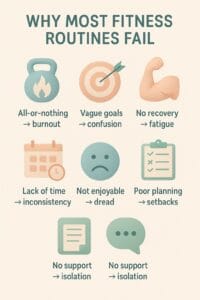
Most people don’t quit fitness because of physical exhaustion; they quit because their fitness routine isn’t designed for their real life. Motivation is the focus, not systems. Even on days when motivation fades, systems keep you moving forward.
Let’s break down the root causes that make most fitness plans unsustainable.
1. The “All or Nothing” Trap
This is the biggest one. Many of us think fitness has to look perfect: one hour of intense workouts, strict diets, no missed days. That perfectionism is exactly what kills consistency.
You might start strong — waking up early, following YouTube workouts, tracking calories — but the moment life gets messy (a busy week, travel, late-night work), the routine collapses. Because it wasn’t flexible enough to handle reality.
A sustainable fitness routine, on the other hand, allows for imperfection. It adjusts with your schedule. If you can’t do a 60-minute workout, you do 20. If you miss a day, you move the next. Progress isn’t lost — it just shifts.
2. Burnout from Overtraining
 Overtraining can be disguised as dedication. When your body fails to get enough rest, your energy drops, your sleep is disrupted, and even your mood tanks.
A Mayo Clinic in 2023.
A review found that chronic overtraining can increase cortisol (your stress hormone), which can lead to fat gain and muscle loss.
Rest and recovery are part of training, not a break from it. Training smarter, not harder, is the key to sustainable fitness.
3. Lack of Clear Goals
‘Get fit’ isn’t a real goal – it’s a vague idea. Clarity is essential for sustainable routines to thrive. What is the meaning of “fit” to you?
Is it walking 10,000 steps daily, reducing joint pain, or feeling energetic throughout the day? As your goal becomes more specific, it becomes easier to develop habits around it.
When I started, my goal was just to exercise more. That was unsuccessful. When I reframed it as ‘move for 30 minutes every morning before breakfast,’ it suddenly became real. Specific goals create structure, which builds sustainability.
4. Mismatch Between Lifestyle and Routine
Most Indian readers will connect with this one. Our routines already run on tight schedules – family responsibilities, work commutes, and social obligations. If your fitness plan requires a schedule that is not compatible with your life, it will be doomed from the start.
A sustainable fitness routine should fit your lifestyle, not the other way around.
- If you work long hours, you might need short 20-minute home workouts using resistance bands.
- If you’re a parent, maybe it’s taking walks with your kids in the evening.
- If you travel often, bodyweight exercises or yoga apps can keep you consistent wherever you go.
The purpose of exercise is to reduce stress, not to add to it.
5. The Mind-Body Disconnect
We often focus on how workouts look – the visible transformation – but neglect how they feel. The body’s signals can be ignored, leading to injury and resentment. Trust is built when you listen to your body.
There are days when you will crave an intense strength session. On other days, all you require is a walk or stretching. Both ways of progress are valid.
Once I started seeing my workouts as part of my mental health toolkit, not as punishment for eating too much, my consistency skyrocketed.
If you treat your body with respect instead of controlling it, it will respond better in every way.
6. No Recovery or Nutrition Support
Recovery is essential for a fitness routine, just as it is for driving without refueling.
Your body is stuck in survival mode when you skip rest days, eat erratically, or sleep poorly.
Recovery is not a passive activity. It’s strategic. Your body’s ability to adapt to exercise is determined by how well you sleep, hydrate, and ingest balanced nutrition.
If you want a deeper breakdown of this, read [How to Sleep Better Without Medication] – it explains how restorative sleep improves muscle repair and hormone balance.
7. No Emotional Connection
This is the subtle one that most people overlook. If your reason for working out is just to look better, it won’t last.
But when you train to feel calmer, have more stamina for your kids, or manage stress naturally, it sticks.
Movement becomes meaningful when it is connected to something more than aesthetics.
Fitness becomes a sustainable lifestyle due to that emotional connection.
🧠 Quick Summary
| Root Cause | Why It Fails | What to Do Instead |
|---|---|---|
| All-or-nothing thinking | Leads to burnout | Focus on flexibility |
| Overtraining | Raises cortisol | Add rest and recovery |
| Vague goals | No structure | Set measurable goals |
| Lifestyle mismatch | Feels unsustainable | Adapt to your reality |
| Mind-body disconnect | Causes injury | Listen to your body |
| Poor recovery | Fatigue and plateau | Prioritize sleep and food |
| No emotional link | No motivation | Tie it to a deeper purpose |
Section 3: Steps 1–3 — Building the Foundation for a Sustainable Fitness Routine
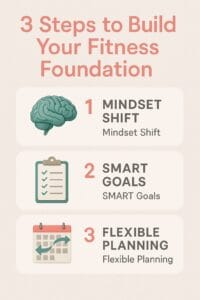
Forget ‘no pain, no gain.’ That’s outdated. Sustainable fitness comes from consistency over intensity.
If you view fitness as a way of life rather than a challenge, you won’t seek immediate results. Your focus is on staying active, not just starting. The difference lies in whether individuals give up after three weeks or remain consistent for years.
Begin by altering your internal dialogue. Instead of saying I have to work out, try saying I get to move today. This isn’t empty motivation; it’s cognitive reframing. According to NCBI.
Research on habit psychology suggests that positive framing helps the brain build long-term associations between behaviour and reward.
Your brain reinforces movement more quickly if you view it as a privilege instead of punishment.
💡 Personal note: I used to dread early workouts. Once I reframed them as’my morning reset,’ I started looking forward to them. The small mental change made a significant difference.
Mini Action Plan:
- Describe the reason why you want to move. To have energy to play with my kids.
- Celebrate small wins – 15 minutes of stretching still counts.
- Avoid comparing yourself to others – your consistency is more important than their progress.
Related Reading: ‘Manage Stress Naturally Without Therapy’ explains how physical movement can regulate stress hormones and improve mood naturally.
Step 2: Set Clear, Measurable Goals
 Your brain is unable to perceive a vague goal. It’s crucial to set goals that are specific, measurable, achievable, realistic, and time-bound — the SMART approach.
Example:
❌ “I want to be fit.”
✅ “I’ll walk 5 days a week for 30 minutes after dinner for the next 2 months.”
The elimination of mental resistance is achieved through clarity. You’re not negotiating with yourself every day; you already know the plan.
If you’re just starting, focus on achieving habit goals, not outcome goals.
- Habit goal: Exercise 4 times a week.
- The outcome is to lose 5 kg.
Outcome goals depend on multiple variables, such as sleep, hormones, and diet. The success of your habit goals is solely dependent on your actions. The reason they’re more sustainable is because of that.
.
Mini Action Plan:
Choose one primary goal for the next 4–6 weeks.
Track your progress with a calendar or journal (not just a fitness app).
Focus on consistency — aim for 80% adherence, not perfection.
Related Reading: How to Start a Morning Routine for Mental Clarity — it’s a great resource for learning how to create structure and stick to daily habits.
Step 3: Plan for Real Life, Not an Ideal Life
Here’s the part most people ignore. Your routine has to work on bad days, not just good ones.
If your plan only works when everything goes right — perfect weather, perfect energy, no interruptions — it won’t survive reality.
The trick is building flexibility into your structure. Instead of one rigid plan, create a “Plan A” and “Plan B.”
Example:
Plan A (ideal day): 45-minute gym session after work.
Plan B (busy day): 20-minute home resistance band workout.
 When Plan B is ready, you eliminate excuses. You always have a backup that keeps momentum going.
💡 Pro Tip: Set up a small “home movement corner.” Make sure to bring your [Affiliate: Resistance Bands], yoga mat, and water bottle with you. No setup time means no friction.
How to Design a Weekly Schedule That Sticks
Here’s a simple framework to build around:
| Day | Focus | Example |
|---|---|---|
| Monday | Strength | 30-min resistance workout |
| Tuesday | Mobility | 20-min yoga or stretching |
| Wednesday | Cardio | 30-min brisk walk |
| Thursday | Rest or gentle movement | Evening stroll |
| Friday | Strength | 30-min band training |
| Saturday | Fun activity | Dance, hike, play sport |
| Sunday | Full rest or light yoga | Recharge |
Notice the rhythm: it’s balanced, not extreme. Two rest or active recovery days protect you from burnout and keep your joints healthy.
You can swap days based on your schedule — what matters is balance and regularity.
How to Track Progress Without Obsession
Tracking can motivate or destroy your mindset depending on how you do it. Avoid metrics that make you anxious (like daily weight). Focus on energy levels, mood, sleep quality, and consistency.
Here’s a quick self-assessment method:
Did I move today?
How did I feel before and after?
Am I sleeping better this week?
Do I feel less stressed overall?
If your answers are trending positive, your routine is working — even if the scale hasn’t moved much.
Why This Foundation Matters
Skipping these foundational steps is like building a house without a base. You can start lifting weights or running, but without a mindset, goal, and plan, it collapses under pressure.
Once you have this foundation, everything else — workouts, nutrition, supplements — becomes easier to maintain. You’re not just working out anymore; you’re building a lifestyle system.
Section 4: Steps 4–6 — Movement, Balance, and Recovery: The Core of Sustainable Fitness
Once your foundation is set, it’s time to build the physical structure of your routine — the actual movement, training balance, and recovery rhythm. This is where most people either go too hard or too soft. The goal here is sustainability, not intensity.
Think of your body like a battery: your goal is to keep it charged, not drained. That means combining strength, flexibility, and rest intelligently.
Step 4: Move in Ways You Enjoy (Not What Looks “Effective”)
 If you hate your workout, it’s not sustainable.
Too many people follow routines they dread because they think it’s the “right” way to get fit. That mindset burns you out fast.
Sustainable fitness is about finding movement that you actually look forward to — whether that’s dancing, yoga, swimming, or walking your dog.
You don’t have to join a gym or buy fancy gear. Start with what fits your environment and mood.
Here’s what “movement you enjoy” might look like:
A 20-minute resistance band session while watching Netflix
Evening walk after dinner with your family
Weekend badminton match with friends
YouTube yoga flow on a quiet Sunday morning
Enjoyment drives consistency — and consistency beats any “perfect” workout plan.
💡 Quick Tip: Try different forms of movement for two weeks each. Track which ones make you feel energized afterward. Keep those, drop the rest.
Related Reading: [How to Stay Healthy Working a 9-to-5 Desk Job] — includes posture and mini-movement ideas you can use between long work hours.
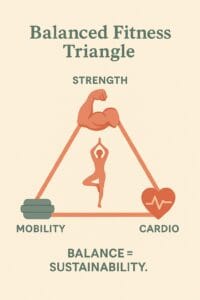
Step 5: Balance Strength, Mobility, and Cardio
A sustainable routine includes three key elements — strength, mobility, and cardiovascular health. Too much of one and too little of the others can lead to imbalance or injury.
 Strength Training
 Strength Training
Builds muscle, supports joints, and improves metabolism. You don’t need heavy weights — your bodyweight and Resistance Bands are enough to start.
Focus on full-body moves: squats, push-ups, rows, lunges, and planks. Two sessions a week are plenty for beginners.
💡 Why it matters: Strength training helps prevent age-related muscle loss (sarcopenia). According to WebMD, it also improves bone density and posture.
Mobility and Flexibility
This is the part most people ignore until they get injured.
Mobility training (dynamic stretches, yoga, foam rolling) keeps your joints healthy and muscles elastic.
Just 10–15 minutes of mobility work before or after a workout can drastically reduce stiffness.
💡 Pro Tip: Use a light resistance band for mobility drills — it helps deepen stretches safely.
Cardiovascular Fitness
Cardio doesn’t mean punishing runs. Walking, cycling, swimming, or dancing all count. The goal is to get your heart rate up moderately for at least 150 minutes a week (as recommended by the Mayo Clinic).
Alternate between moderate and light cardio days to prevent fatigue. You should finish a session feeling refreshed, not drained.
Step 6: Prioritize Recovery Like It’s Training
Recovery isn’t a luxury — it’s the other half of fitness. Without it, your muscles don’t rebuild, your hormones stay unbalanced, and you end up overtrained.
If you constantly feel tired, moody, or sore, you’re not “weak” — you’re under-recovered.
Here’s how to fix that:
1. Respect Rest Days
Plan at least one full rest day per week. That doesn’t mean lying around all day — light movement like stretching, walking, or slow yoga is ideal.
2. Sleep Well
Sleep is when your body releases growth hormone and repairs tissue.
Poor sleep makes you hungrier (due to higher ghrelin) and less motivated.
If you struggle with rest, read [How to Sleep Better Without Medication] for actionable habits to restore your sleep rhythm.
3. Refuel Properly
Your body needs fuel to repair. Add a mix of protein (paneer, dal, eggs), complex carbs (brown rice, roti, fruits), and healthy fats (nuts, ghee, avocado).
Skipping meals after workouts is one of the fastest ways to sabotage recovery.
4. Manage Stress
High stress = high cortisol = poor recovery.
Meditation, journaling, or mindful breathing can help. A few minutes of slow breathing before bed can drop your stress levels dramatically.
Related Reading: [Manage Stress Naturally Without Therapy] — outlines simple non-medicated ways to reduce cortisol and improve mental calm.
How I Learned This the Hard Way
I used to think “rest days” were wasted days. I’d train six times a week, pushing through soreness. Eventually, my knees started aching, my sleep got worse, and my motivation dropped. The irony? I got weaker.
Once I started treating rest as part of training, not the absence of it, everything changed. My strength went up, I stopped getting random aches, and I actually started looking forward to workouts again.
You can’t outrun burnout. But you can prevent it by respecting your body’s rhythm.
How to Tell If You’re Training Too Hard
| Sign | What It Means | What to Do |
|---|---|---|
| Constant fatigue | Nervous system fatigue | Take 2–3 full rest days |
| Poor sleep | Hormonal imbalance | Cut intensity for a week |
| Mood swings | Cortisol overload | Add meditation or yoga |
| Loss of progress | Overtraining | Reduce frequency or volume |
| Frequent colds/injury | Weakened immunity | Focus on nutrition + rest |
Sustainable fitness is all about listening, not forcing. When you train from awareness, not ego, your results last longer.
🧱 Weekly Structure Example (Intermediate Level)
| Day | Workout Type | Duration | Focus |
|---|---|---|---|
| Monday | Strength | 40 mins | Full body with resistance bands |
| Tuesday | Cardio | 30 mins | Brisk walk or cycling |
| Wednesday | Mobility | 20 mins | Stretching + yoga flow |
| Thursday | Strength | 40 mins | Lower body focus |
| Friday | Cardio | 25 mins | Interval walk/run |
| Saturday | Recovery | 15 mins | Foam rolling or mobility work |
| Sunday | Rest | — | Deep rest, family time |
You don’t need to follow this exactly — use it as a reference. The point is balance. You should never feel like fitness is “consuming” your life. It should enhance it.
Section 5: Steps 7–9 — Nutrition, Consistency, and Motivation: Keeping the Routine Alive
By now, you’ve built the structure: mindset, balance, and recovery.
Now comes the harder part — keeping it alive. Sustainability depends on three pillars most people underestimate: what you eat, how you stay consistent, and what keeps you motivated when things get boring or hard.
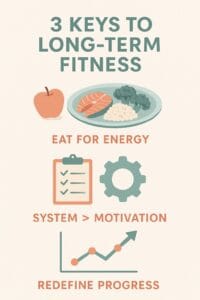
Step 7: Eat to Support Your Movement (Not Punish Your Body)
 Fitness and nutrition are inseparable.
But let’s clear one myth first — you don’t have to follow extreme diets to stay fit. You need balanced, consistent nourishment.
Your body isn’t a machine you punish for eating — it’s an ecosystem you fuel.
Sustainable eating supports your workouts, helps recovery, and keeps hormones in check.
1. Prioritize Real Food
Skip the “fitness snacks” and “diet drinks.” Stick to food that looks like food.
Your goal: meals rich in protein, complex carbs, healthy fats, and fiber.
Example Indian meal structure:
Breakfast: Besan chilla with curd and fruit
Lunch: Dal, rice, sabzi, and salad
Snack: Roasted chana, nuts, or fruit
Dinner: Grilled paneer, roti, and sautéed veggies
2. Don’t Fear Carbs
Carbs aren’t the enemy — poor choices are. Choose roti, rice, fruits, and millets over refined snacks or sugary cereals.
If you train regularly, carbs help you perform and recover better.
3. Stay Hydrated
Even mild dehydration can reduce performance and focus.
If plain water bores you, try lemon water, coconut water, or infused mint water.
4. Time Your Meals Smartly
Eat something light within 30–45 minutes after a workout — a banana smoothie, eggs and toast, or paneer wrap.
Skipping post-workout meals slows recovery.
💡 Pro Tip: Keep [Affiliate: Resistance Bands] and a water bottle together in your home workout area — visual cues keep you consistent with both movement and hydration.
Related Reading: [How to Boost Your Immune System Naturally at Home] — includes food and lifestyle choices that also support recovery and resilience.
Step 8: Create a Consistency System (Not Just Motivation)
Motivation is unreliable. You won’t always feel like working out.
That’s why consistency has to come from systems, not emotions.
Here’s how to build a consistency system that actually lasts:
1. Schedule Workouts Like Appointments
Put them on your calendar. Treat them like meetings you can’t cancel.
If 7 AM doesn’t work, try lunch breaks or evenings — find your energy peak and stick to it.
2. Keep a “Minimum Dose Habit”
Your minimum dose is the smallest version of your workout that still counts.
Example:
Ideal workout: 40 minutes strength + mobility
Minimum dose: 10-minute bodyweight circuit
Even if you do the smaller version, you stay consistent — and consistency matters more than duration.
3. Use Accountability
Find a friend, trainer, or online community. Accountability increases follow-through.
If you like tech, fitness apps and smartwatches (like Fitbit or Apple Watch) can track your progress.
Related Reading: [Fitbit vs Apple Watch: Which One is Best for Wellness] — comparison of their tracking and recovery features.
4. Remove Friction
Keep your gear ready the night before.
Tiny barriers (like searching for shoes or bands) kill momentum.
5. Stack Habits
Pair fitness with something you already do.
Example: “After brushing my teeth, I’ll stretch for 5 minutes.”
This creates automatic triggers that help habits stick.
Step 9: Stay Motivated When Progress Slows
Every long-term routine has slow phases. The difference between people who quit and those who stay consistent isn’t talent — it’s perspective.
1. Redefine Progress
Stop measuring only in kilos or inches.
Look at your energy, sleep, strength, mood, or how your clothes fit.
These are invisible wins that matter more than scale numbers.
2. Track Feelings, Not Just Data
Once a week, jot down:
“How did I feel after my workouts this week?”
Over time, this record becomes proof that your routine is working — even when results aren’t visible yet.
3. Refresh Your Routine Every 8 Weeks
Your body and brain both adapt to repetition.
Change your workout playlist, swap resistance band exercises, or try a new yoga flow every two months.
Novelty keeps you engaged.
4. Reward Yourself for Consistency
Don’t wait until you “achieve results.” Reward yourself for showing up.
Buy a new workout top, try a spa day, or simply acknowledge your discipline.
Recognition builds momentum.
5. Connect It to a Bigger Why
You’re not just training your body — you’re building resilience, energy, and focus for every part of your life.
When you start linking movement to how you want to live, not just how you want to look, motivation becomes self-sustaining.
💡 Personal Note: My most consistent streak started when I stopped chasing weight goals and focused on feeling stronger. Once I noticed I could carry heavier grocery bags or climb stairs without gasping, that became my motivation.
Common Pitfalls That Break Consistency
| Pitfall | Why It Hurts | How to Fix It |
|---|---|---|
| Relying on motivation | Fades quickly | Build systems and routines |
| Overtraining | Causes fatigue | Plan rest days |
| Comparing progress | Creates frustration | Focus on your own data |
| Ignoring nutrition | Slows recovery | Eat balanced meals |
| Skipping sleep | Reduces energy | Prioritize 7–8 hrs rest |
A Word on Balance
 You can’t sprint your way to sustainability.
Balance is the glue that keeps all this together. The best routines have flexibility built in — enough structure to stay consistent, but enough freedom to adapt.
Some weeks you’ll train five times. Some weeks you’ll barely manage two. That’s fine.
Consistency doesn’t mean never missing a day. It means never quitting altogether.
Remember, the goal isn’t perfection — it’s momentum.
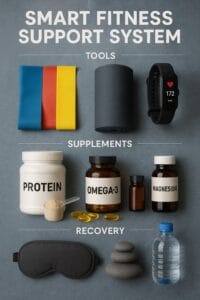
Section 6: Step 10 — Tools, Supplements, and Smart Support (When Nutrition and Movement Need a Boost)
Even the most committed person hits a plateau. You start strong, follow your plan, but then your energy dips or progress stalls. That doesn’t mean your routine failed — it means your body is adapting and asking for better support.
Instead of quitting or pushing harder, this is the time to use smart tools and supplements that keep your momentum alive.
These aren’t shortcuts. They’re amplifiers — tools that make your effort go further, recovery smoother, and progress visible.
1. Tools That Help You Stay Consistent

Consistency is built on convenience. If your gear is easy to access, portable, and fits your lifestyle, you’ll move more often without overthinking it.
a. Resistance Bands
Why they work:
They’re affordable, compact, and surprisingly effective for both beginners and advanced users. You can do a full workout — squats, pushups, bicep curls, shoulder presses, and glute work — without needing a single machine.
How to use:
Beginner: Start with light resistance and focus on slow, controlled movements.
Intermediate: Add them to your existing workouts for extra tension.
Travel: Loop them around a door handle for quick hotel-room strength training.
📦 Recommended starter kit: [Affiliate: Resistance Bands]
b. Foam Roller
Why it matters:
A foam roller acts like a personal massage therapist. It helps release tight muscles, improve flexibility, and speed up recovery — especially for people who sit long hours.
Try this 5-minute recovery flow:
Quads (1 minute per leg)
Upper back (2 minutes)
Glutes (1 minute)
Calves (1 minute)
Pair this with slow breathing — it calms the nervous system while relaxing the muscles.
c. Smartwatch or Fitness Tracker
Tools like Fitbit or Apple Watch don’t just count steps; they track sleep, heart rate, stress levels, and recovery.
That data helps you personalize your routine.
If your heart-rate variability drops or your sleep score is poor, you know it’s time for a rest day.
Related Reading: [Fitbit vs Apple Watch: Which One is Best for Wellness]
d. Yoga Mat & Home Setup
Never underestimate comfort. A soft, stable yoga mat makes you more likely to actually stretch or train.
Set a designated corner in your home — even a 3×3 ft space — with your mat, towel, and [Affiliate: Resistance Bands]. When everything’s visible and ready, excuses disappear.
2. Supplements That Support Long-Term Wellness
Supplements fill the gaps your diet might miss — especially in India, where busy schedules and vegetarian diets can leave common deficiencies in protein, Vitamin D, or Omega-3.
But here’s the key: food first, supplements second.
Below are the most useful categories, backed by science and long-term safety.
| Supplement | Benefit | Best Time to Take | Notes |
|---|---|---|---|
| Protein Powder (whey or plant-based) | Repairs muscle, supports strength training | Post-workout or breakfast | Choose clean, low-sugar blends |
| Omega-3 (Fish Oil or Flaxseed) | Reduces inflammation, improves heart health | With meals | Aim for 1000 mg daily |
| Vitamin D3 | Boosts immunity, bone health, mood | Morning with fat | Especially needed if indoors most of the day |
| Magnesium Glycinate | Helps with sleep, recovery, muscle cramps | Before bed | Pairs well with relaxation routines |
| Multivitamin | Covers micro-nutrient gaps | Morning | Choose trusted, third-party tested brands |
Read next: [Himalayan Organics Multivitamin Review After 90 Days]
3. Recovery — The Secret Ingredient of Sustainability
You can’t grow stronger if you don’t recover properly. Most people overtrain without realizing that rest is part of the plan, not a break from it.
Here’s what smart recovery looks like:
Sleep: Non-negotiable. Aim for 7–8 hours. Quality matters more than quantity.
Read: [How to Sleep Better Without Medication]Hydration: Even mild dehydration cuts performance by 20%.
Active Rest Days: Try yoga, walking, or light mobility. Your body stays active without fatigue.
Mindful Cooldowns: Spend 5 minutes after every workout stretching and breathing deeply. It resets your system.
💡 Tip: If you wake up sore or drained, skip intensity that day. Walk, stretch, or meditate instead. Consistency isn’t about doing more — it’s about staying functional.
4. Smart Gadgets and Minimal Tech That Help
 Not all gadgets are distractions. The right tech creates awareness and accountability.
Sleep apps for tracking rest quality (Sleep Cycle, Calm).
Workout log apps like Strong or FitNotes.
Habit trackers such as Notion templates or simple journals.
Meditation apps like Insight Timer for mental reset.
The goal isn’t to depend on tech — it’s to use it as feedback for smarter living.
5. Professional Guidance — When to Ask for Help
If you’re feeling pain, chronic fatigue, or confusion about progress, stop guessing.
A fitness coach, physiotherapist, or dietitian can save you months of frustration.
A few guided sessions can refine your posture, nutrition, and mindset — giving you long-term confidence.
The biggest mistake is assuming you need to “figure it out alone.”
Sustainability is about efficiency, not stubbornness.
6. Mindful Support — The Invisible Advantage
Sustainability depends as much on mindset as on movement.
Integrating mindfulness into your fitness routine makes it feel natural, not forced.
Try this:
Before your workout: 3 deep breaths — focus on your energy.
After your workout: one line of gratitude in a journal — “I moved today. I showed up.”
Those 10 seconds rewire your mind to see fitness as a gift, not a punishment.
Also read: [Manage Stress Naturally Without Therapy] — it ties perfectly into the emotional recovery side of wellness.
🪷 Conclusion — Your Wellness Is a Long Game
 A sustainable fitness routine isn’t built on hype or discipline — it’s built on self-awareness and patience.
The goal is not perfection but momentum.
Start with one thing today — a 10-minute walk, a glass of water, or one mindful stretch.
Once that becomes part of your rhythm, add the next layer.
In a few months, you won’t be trying to “stay fit.” You’ll simply be fit






Sibani is the founder of The Calm Bloom, sharing mindful living tips, wellness guides, and practical routines for a balanced lifestyle.