
Introduction: My First Encounter with Journaling
I still remember the first time I opened a blank notebook to start journaling.This evening was particularly heavy – work stress, family worries, and a restless feeling that’s difficult to explain. I was uncertain about what to write. I started with:
“I feel tired, but I don’t know why.”
 My life was changed in unexpected ways by that small, awkward sentence. The goal wasn’t to write beautifully; it was to find a space to breathe on paper. Over time, journaling became my private therapist, a gentle mirror that reflected not only my thoughts but also my emotions, even the ones I was trying to hide.
If you’ve ever felt emotionally drained, overwhelmed, or disconnected from yourself, journaling for emotional wellness can be one of the most healing habits you can start today.
In this guide, I will share everything I have learned about journaling, including the science, emotional shifts, daily practice, and even small tools that make it enjoyable. The Calm Bloom has links to helpful posts, including How to Manage Stress Naturally Without Therapy. Because emotional health is never one-dimensional – it’s a delicate ecosystem.
🌙 Why Emotional Wellness Needs Our Attention
In India, physical wellness is often more important than emotional health. We drink kadha for immunity, go for morning walks, but rarely pause to ask, ‘How am I feeling, really?’
The constant notifications, career pressure, relationships, and societal expectations of modern life can lead to silent emotional fatigue. Without conscious release, those emotions turn into inward emotions such as stress, burnout, or irritability.
I’ve observed this pattern in both myself and the individuals I mentor.
- Unprocessed emotions are a source of tension for us.
- Instead of reflecting, we scroll.
- Externally, we look good, but inside we feel empty.
Journaling has a button that allows you to take a break. It allows you to process emotions safely without judgment and create a space where healing can naturally begin.
🧠 The Science Behind Journaling for Emotional Wellness
This ancient wisdom is supported by research.
The National Center for Biotechnology Information (NCBI) has published studies that indicate,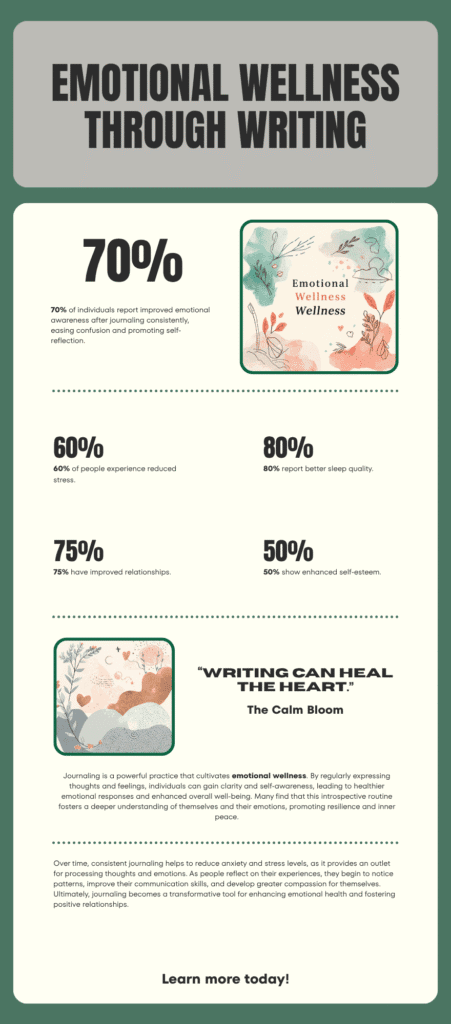
- Expressive writing, which involves writing about emotions and experiences, has been shown to:
- Relieve the symptoms of anxiety and depression
- Enhance emotional processing and resilience
- Increase overall psychological well-being
In 2022, there will be a Mayo Clinic. The article also notes that journaling helps manage overwhelming emotions by providing a safe outlet for thoughts that feel too heavy to share. Essentially, writing helps the brain integrate emotional experiences, turning chaos into clarity.
Journaling is often recommended in cognitive-behavioural therapy and mindfulness practices due to this reason.
By labelling emotions in words, the prefrontal cortex (the logical part of your brain) is activated and the amygdala (the fear canter) is reduced.
In simple terms, writing can calm your mind.
 Emotional Wellness through Writing: What Changes
 Emotional Wellness through Writing: What Changes
Journaling consistently leads to subtle yet powerful changes:
| Shift | Before Journaling | After Journaling |
|---|---|---|
| Emotional awareness | Confused, reactive | Calm, self-aware |
| Stress response | Easily triggered | Responds with perspective |
| Sleep quality | Restless mind | Better relaxation |
| Relationships | Miscommunication | Clearer communication |
| Self-esteem | Self-critical | Compassionate toward self |
Personally, I found that my anxiety decreased when I started writing down my worries every night in my journal.
I was able to write without having to carry them to sleep.
A small, soothing ritual that helped me wind down and is still anchoring me today was created when I paired this with a cup of chamomile tea [Affiliate Link: Herbal Tea Blend]
💬 Linking Journaling with Holistic Wellness
If you’ve been following The Calm Bloom, you already know we love holistic wellness, where emotional, physical, and spiritual health are interconnected.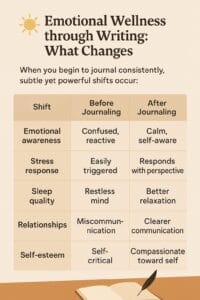
Just like nourishing your gut influences your mood, (see How to Improve Gut Health Without Probiotics). Journaling nurtures the mind-space where self-care begins.
This mental detox helps you process thoughts before they spill over into stress, sleeplessness, or emotional eating.
Journaling is transformed from a hobby into an emotional hygiene practice when paired with mindful breathing, herbal teas, or evening gratitude rituals.
🌷 How to Start Journaling for Emotional Wellness
✨ Step 1: Choose Your Style of Journaling
When people ask me, ‘What’s the right way to journal?’, my answer is always:
The right way is the one you’ll actually enjoy doing.
There is no method that is universally applicable. The magic of journaling for emotional wellness lies in finding your own rhythm — whether that’s writing on paper, typing in an app, or journaling by voice.
Here are the most popular approaches and how to decide which one fits you best:
🖊️ 1. Free-Writing Journal
My personal favourite is stream of consciousness journaling, which is also known as this. You simply write whatever comes to mind – no grammar rules, no editing, no judgment.
Example prompt:
“Right now, I feel…”
Free-writing enables emotional release, which is why it is beneficial. It’s raw and real — perfect for processing stress or sadness.
For a smoother writing experience, use a soft-bound notebook with smooth pages ([Affiliate Link: Journal Book]) and a fine gel pen ([Affiliate Link: Pen Set]) as an affiliate tip. A tactile experience often makes journaling feel more grounded.
🌸 2. Prompt-Based Journaling
If you find staring at a blank page daunting, begin with daily prompts. Prompts guide your thoughts and aid in the discovery of emotional clarity.
Here are some things I love to begin or end the day with:
- What emotion am I trying to avoid today?
- What was the one thing that made me smile?
- What are the things I need to forgive myself for?
- What is one small thing that I am grateful for?
💡 You can find many printable or guided options online, but I personally use a guided emotional wellness journal that includes space for reflection and gratitude ([Affiliate Link: Guided Journal Kit]).
🌿 3. Gratitude Journal
This simple method of journaling has significant psychological benefits. WebMD states that Practicing gratitude reduces stress hormones and boosts mood-regulating chemicals like serotonin and dopamine.
Write down three things you’re grateful for every night, no matter how small.
- I drink my morning tea on the balcony
- A message from a friend that was kind
- The noise of rain
With time, your mind will be reprogrammed to focus on what’s working, not what’s absent.
If you want to make this habit feel like self-care instead of another task, try using a nicely designed gratitude journal ([Affiliate Link: Gratitude Notebook].
☀️ 4. Bullet Journaling
Bullet journaling is a great way to combine creativity and organization for those who love structure. Tracking moods, habits, affirmations, or even emotional triggers is what you can do with it.
Example setup:
🗓️ Monthly mood tracker
💭 “Emotional reflection” section
🌈 Gratitude log
It resembles a personal emotional dashboard.Use a dotted notebook ([Affiliate Link: Dotted Journal]) and pastel markers ([Affiliate Link: Marker Set]) to create visual calming effects. The colors of The Calm Bloom (muted coral, soft green, warm grey) work beautifully here.
💫 5. Digital Journaling
Journaling apps are a modern blessing for those who are always on their phones. It’s easy to write down feelings, add mood icons, and sync across devices with apps like Journey, Stoic, or Daylio.
These are ideal for individuals who frequently travel or feel more comfortable typing than writing. Guided emotional prompts, audio entries, and privacy locks are all included in most cases.
🌼 Step 2: Create a Journaling Routine That Sticks
The biggest mistake people make is overcomplicating it.
Start small — two lines a day is enough to begin.
🕯️ When to Journal
I recommend one of these times:
Morning: Helps you set intentions and clarity for the day
Evening: Helps you release thoughts before sleep
When I started, I made journaling part of my “digital sunset” . I’d switch off screens by 9 PM, make a cup of calming tea ([Affiliate Link: Herbal Tea Blend]), and spend 10 minutes writing.
It felt like brushing my mind before bed.
⏰ Habit Stacking Tip:
Pair journaling with an existing habit:
Right after morning meditation
After your evening skincare routine
Before switching off lights at night
Stacking it on a consistent cue makes journaling automatic , not something you have to “remember.”
🪶 Step 3: Set Up a Calming Journaling Space
Your journaling space doesn’t have to be fancy — just intentional.
Think of it as a sanctuary where emotions feel safe to land.
Here’s how to create it:
| Element | Why It Matters | Simple Ideas |
|---|---|---|
| Lighting | Soft light signals calm | Use a warm lamp or candles ([Affiliate Link: Soy Candle Set]) |
| Sound | Music can regulate emotions | Play lo-fi or soft instrumental tunes |
| Scent | Aromatherapy enhances focus | A diffuser with lavender or sandalwood oils ([Affiliate Link: Essential Oil Diffuser]) |
| Comfort | Comfort increases consistency | Keep a soft throw or cushion nearby |
| Tools | Makes journaling enjoyable | Use pens, stickers, or markers you love |
When your environment invites calm, your thoughts naturally open up.
🌙 Step 4: Use Prompts to Explore Your Emotional Landscape
Once you start writing regularly, you’ll notice recurring themes — self-doubt, gratitude, relationships, career, or identity.
Prompts help you go deeper into those areas without getting stuck.
Here are a few emotional wellness journal prompts I personally return to often:
🧘 For Self-Awareness
What emotion has been showing up most lately?
What situations make me feel small or anxious?
What boundaries do I need to feel safe?
💗 For Healing
What would I tell my younger self today?
What do I need to let go of to feel lighter?
What emotion am I tired of carrying?
🌈 For Growth
What am I learning about myself this week?
How can I show kindness to myself today?
What kind of person do I want to become?
💡 Tip: If you prefer structure, guided journals like [Affiliate Link: Emotional Growth Journal] already include these prompts.
You can also print your own pages and keep them in a binder.
☕ Step 5: Turn Journaling Into a Ritual
When journaling transforms from “a task” into “a ritual,” it becomes a nurturing habit instead of another item on your to-do list.
Here’s how to make it sacred:
Brew your favourite tea ([Affiliate Link: Chamomile Wellness Tea]).
Light a candle or incense.
Play slow instrumental music (try “Forest Piano” playlists on Spotify).
Set a 10-minute timer — and just write.
Over time, your mind begins to associate journaling with peace. It becomes your emotional anchor — a pause amid chaos.
🧩 Step 6: Combine Journaling with Mindful Reflection
To deepen your emotional wellness, end each journaling session with a micro-reflection ritual:
Read one or two lines from what you wrote.
Ask: “What is this emotion teaching me?”
Write a one-sentence takeaway.
This tiny step helps integrate emotional learning instead of just venting. It’s where transformation begins — moving from reacting to understanding.
As you continue journaling, consider pairing it with other self-care practices:
Try mindfulness techniques from How to Manage Stress Naturally Without Therapy
Learn to sleep better with insights from How to Sleep Better Without Medication
Together, they form a gentle ecosystem of emotional and physical balance.
🌱 Overcoming Common Journaling Challenges
Even with the best intentions, we all hit roadblocks when trying to journal regularly. Some days the words don’t come easily. Other times, life gets too noisy. When I first began journaling for emotional wellness, I skipped weeks because I thought every page had to look “perfect.” Spoiler: it doesn’t.
Let’s break down a few of the biggest challenges — and how you can overcome them.
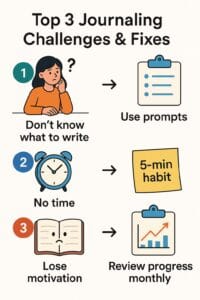
1. “I don’t know what to write.”
This is the most common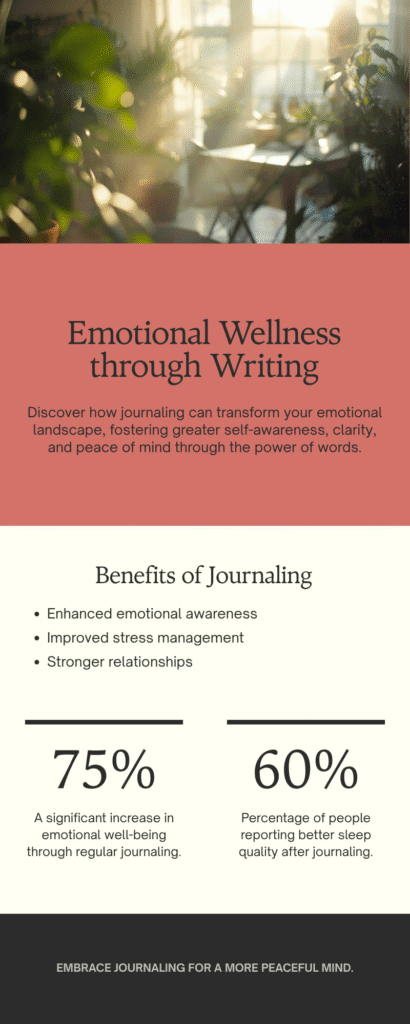 block. The blank page can feel intimidating — like it’s waiting for profound thoughts. But emotional wellness journaling isn’t about perfection; it’s about release.
👉 Try this:
Start with prompts like:
“Today I felt ___ because ___.”
“What’s one thing I wish I could tell my younger self?”
“Right now, I need more of ___ in my life.”
2. “I don’t have time.”
You don’t need an hour. Five minutes before bed can change your emotional rhythm. I personally write right after brushing my teeth — it’s my “mental rinse.”
If mornings work better, keep a small pocket journal like [Affiliate Link: Mini Wellness Notebook] on your nightstand. A few sentences can be enough.
💡 Tip: Pair journaling with tea time. A cup of chamomile or tulsi tea ([Affiliate Link: Organic Calm Tea]) sets a grounding tone.
3. “I lose motivation after a few days.”
Motivation fades, but habits last. Emotional wellness grows through small consistency, not intensity.
If you fall off, just restart — no guilt needed.
✨ Try this:
Use an app like Journaling App to set gentle reminders.
Reward yourself after a week of consistency (a fresh candle, cosy playlist, or weekend treat).
🌼 Long-Term Journaling Habits That Actually Stick
Journaling should evolve with you – not feel like homework. Over time, it turns into a private space where you can track growth, not just emotions.
To make it a part of your long-term emotional wellness toolkit, here’s how:
1. Create a “Journaling Corner”
Dedicate a calm spot in your home — a corner with soft lighting, a plant, maybe an oil diffuser.
I decorated mine with a small salt lamp and cozy throw. That visual cue instantly shifts my mood.
2. Pair Journaling with Reflection Rituals
Combine your writing time with rituals that make you feel peaceful — evening prayers, meditation, or even mindful skincare.
Write for 10 minutes
Light an incense stick or candle
Reflect on one lesson from the day
These sensory rituals make journaling more intuitive and less like a chore.
3. Mix Formats to Keep It Fresh
Emotional journaling doesn’t have to be words only. Try:
Gratitude lists
Mood tracking doodles
Vision board pages
Mind maps
Sometimes, I paste photos or ticket stubs to reflect special memories. Visual journaling engages creativity and emotion together — a powerful combo for mental clarity.
4. Read Your Old Entries Once a Month
Looking back shows the extent of your development. I came across an old entry that stated, ‘I am afraid of failing again’, and after reading it months later, I realized that I had already overcome that fear.
Journaling is a method for making growth visible in the future.
Make sure to schedule a monthly review date with yourself. It’s like talking to your past self and saying, ‘We accomplished what we set out to do.’
🌸 Final Thoughts: Start with One Page Today
Journaling for emotional wellness is not a new productivity trend. This is a quiet rebellion against chaos – a place where your inner voice is finally heard.
It’s not necessary to have fancy tools, perfect handwriting, or long paragraphs. You just need honesty — and a few minutes every day.
Begin with a single page. Express your heart. Allow the ink to hold what your mind shouldn’t carry on its own.
If you’re ready, grab your favorite pen and try this tonight:
“Today I give myself permission to feel ___.”
It’s that simple. Your healing starts with a single line. 🌿






Sibani is the founder of The Calm Bloom, sharing mindful living tips, wellness guides, and practical routines for a balanced lifestyle.