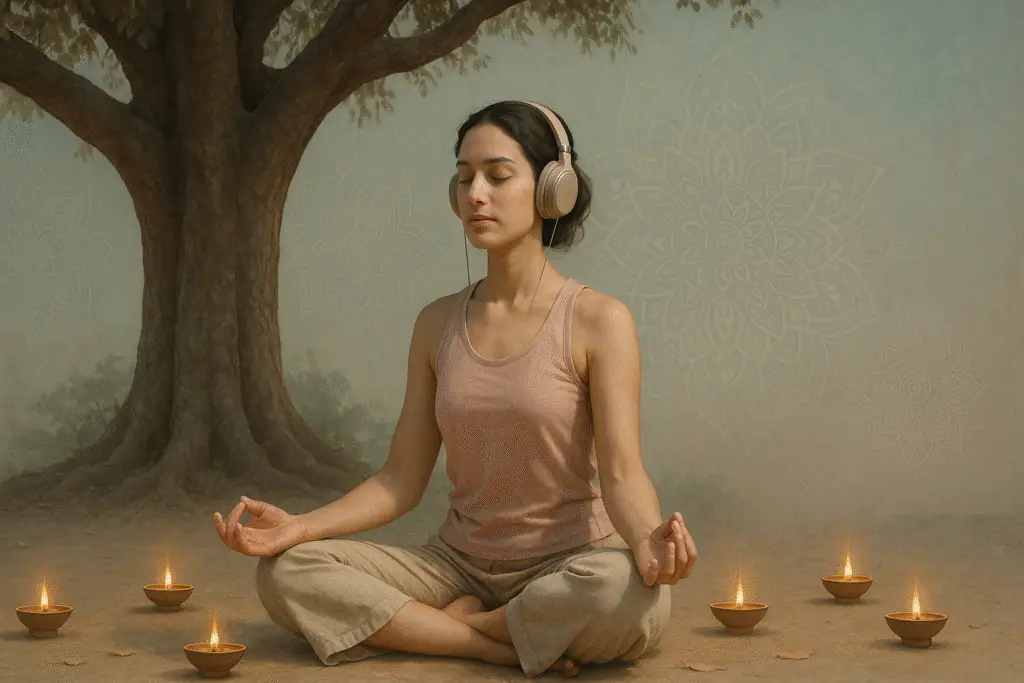
The Silent Burnout Nobody Talks About
When You’re Functioning Normally but Feel Emotionally Disconnected.
“You can be emotionally exhausted without completely falling apart”
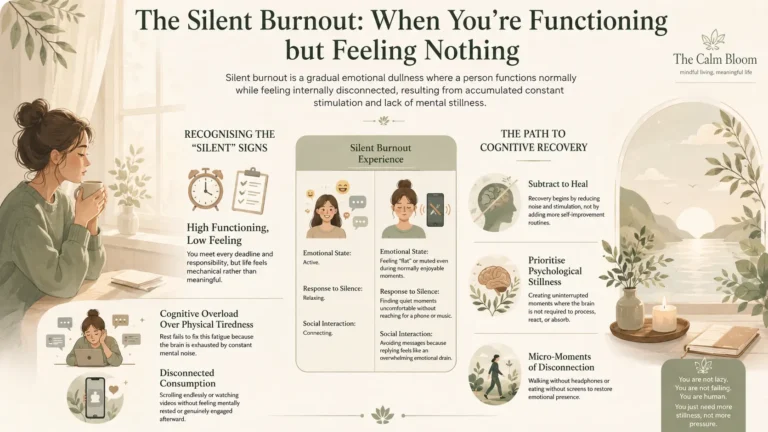
You wake up on time.
- You reply to messages.
- You complete your responsibilities.
- You continue moving through your routines the way you always do.
From the outside, everything appears normal.
“But internally, something feels distant.”
→ You feel mentally tired in a way that rest does not fully fix.
→ You struggle to feel present in your own life.
→ Even moments that are supposed to feel enjoyable can feel strangely flat.
You are functioning normally.
But emotionally, you feel disconnected from yourself.
This is the kind of burnout many people experience quietly.
⇒ Not dramatic exhaustion.
⇒ Not complete collapse.
⇒ Not a visible breakdown.
Just a slow emotional dullness that builds over time while life continues normally around you.
And because it does not always look serious from the outside, many people ignore it for far too long.
They assume:
“I’m just tired.”
“Maybe everyone feels this way.”
“I should be grateful because my life is technically fine.”
But emotional exhaustion does not always arrive through crisis.
Sometimes it develops through accumulation.
⇔ Too much mental noise.
⇔ Too much stimulation.
⇔ Too little genuine stillness.
And eventually, the mind begins feeling emotionally far away from the life it is still actively living.
Related Articles – :
Digital Detox for Real Life
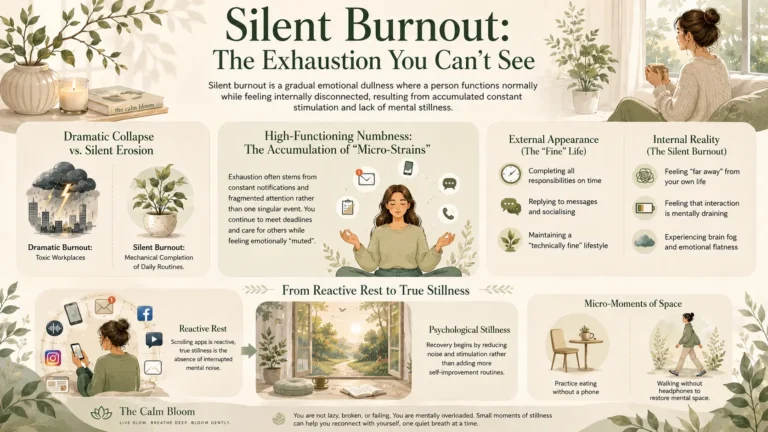
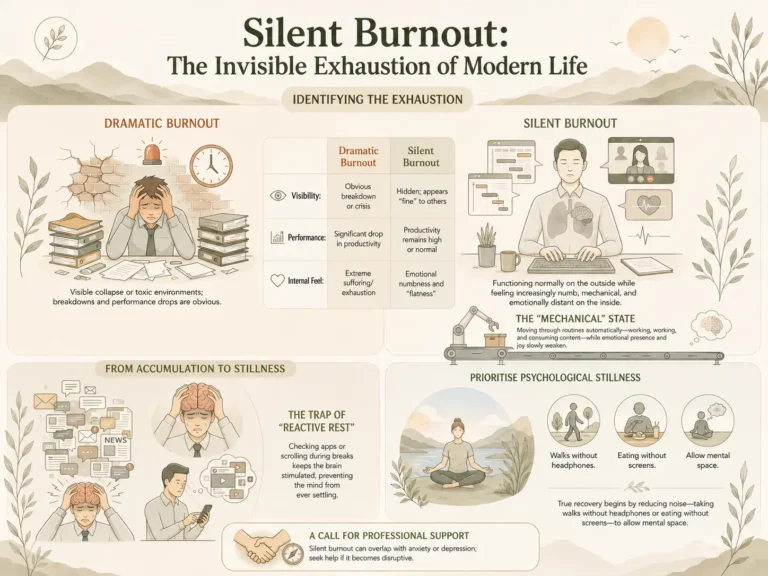
Silent burnout is difficult to recognize because it often does not feel dramatic enough to justify concern.
🌱You may still be productive.
🧺You may still handle responsibilities.
☁️You may even appear emotionally “fine” to other people.
But internally, something feels muted.
Life starts feeling more mechanical than meaningful.
You move through routines automatically:
→ waking up,
→ checking your phone,
→ completing tasks,
→ consuming content,
→ sleeping,
→ repeating the cycle again tomorrow.
And somewhere inside that rhythm, emotional presence slowly weakens.
Many people experiencing silent burnout describe:
↔ brain fog,
↔ emotional numbness,
↔ low emotional energy,
↔ irritability,
↔ constant mental fatigue,
↔ or difficulty feeling genuinely engaged with life.
You may not feel deeply unhappy.
Just emotionally far away.
Even enjoyable things can begin feeling strangely flat.
⇒ You scroll endlessly without actually enjoying anything you see.
⇒ You watch videos while simultaneously checking other apps.
⇒ You finish entire evenings of content consumption without feeling mentally rested afterward.
Sometimes the exhaustion is not even physical.
It is cognitive.
The kind that makes small tasks feel heavier than they should:
⇔ replying to messages,
⇔ making decisions,
⇔ organizing simple plans,
⇔ starting work,
⇔ maintaining conversations.
You may notice yourself withdrawing emotionally in subtle ways too.
Not because you dislike people.
But because interaction itself begins feeling mentally draining.
And perhaps the most confusing part is this:
Your life may appear objectively “fine.”
Which makes the exhaustion harder to explain.
You begin questioning yourself:
❔ “Why do I feel this tired?”
❔ “Why can’t I relax properly anymore?”
❔ “Why does everything feel mentally heavy lately?”
But burnout does not always come from one dramatic event.
“Sometimes it develops quietly through uninterrupted mental strain that never fully gives the mind space to recover.”
One of the biggest misconceptions about burnout is that it must come from extreme suffering.
People imagine burnout as:
🍂 toxic workplaces,
🌫️ emotional breakdowns,
⏳ impossible schedules,
or ☁️ total collapse.
And while burnout can absolutely look like that, many people experience a quieter version that is much harder to notice.
You do not need to hate your life to feel emotionally exhausted.
In fact, many people experiencing silent burnout continue functioning well enough that nobody realizes anything is wrong.
They still:
🌱 work,
📚 study,
🤍 care for others,
🕰️ meet deadlines,
↺ maintain routines,
and ☀️ continue showing up every day.
But internally, they feel emotionally depleted by the constant mental demand of modern life.
Because exhaustion is not always caused by dramatic pain.
Sometimes it comes from accumulation.
Small layers of mental strain build over time:
📱 constant notifications,
📰 endless information,
🌫️ emotional suppression,
⚖️ pressure to stay productive,
🧩 fragmented attention,
and 🌙 never fully disconnecting mentally.
The deeper issue is often not physical busyness alone.
It is the absence of psychological stillness.
Many people move through entire days without experiencing a single uninterrupted moment of mental quiet.
The mind stays reactive from morning to night:
✉️ messages, 🔔updates, 📖 content, 💬 conversations, 📲notifications, 🧠 decisions, 🌆 background noise.
And eventually, emotional fatigue becomes normalized.
People continue functioning, so they assume they are okay.
But emotional exhaustion does not always immediately stop productivity.
Sometimes it slowly reduces:
🌫️ emotional presence,
🎯 focus,
🍂 motivation,
🕯️creativity,
☀️ joy,
and 🤍 connection.
“The person still functions externally.
But internally, life begins feeling increasingly distant.”
Modern life constantly competes for attention.
Most people no longer experience true mental quiet for extended periods of time.
The moment silence appears, many instinctively reach for stimulation:
📱 scrolling,
📺 videos,
🎧 music,
◌ podcasts,
🔔 notifications,
🫧 background noise,
or 💻 another screen.
Attention becomes fragmented throughout the day.
And over time, fragmented attention affects emotional presence too.
Many people now consume multiple streams of input simultaneously:
☁️ watching videos while scrolling,
☁️ checking notifications during conversations,
☁️ listening to podcasts while working,
☁️ opening apps automatically without consciously deciding to.
Sometimes people reach for their phones during every small pause:
◌ waiting in line,
◌ sitting in traffic,
◌ eating meals,
◌ walking short distances,
◌ or sitting alone for a few quiet minutes.
The brain rarely gets space to settle.
Even rest has become filled with stimulation.
🌿 You finish work and immediately begin consuming content again.
🌿 You spend hours online without feeling emotionally restored afterward.
🌿 You watch self-improvement content hoping to feel better while your mind becomes even more overloaded.
“The issue is not technology itself.”
Technology is useful, creative, and deeply integrated into modern life.
The problem is uninterrupted cognitive engagement.
The mind was never designed to process continuous streams of stimulation every waking hour without recovery.
And eventually, constant mental engagement creates a quiet kind of exhaustion many people stop noticing consciously.
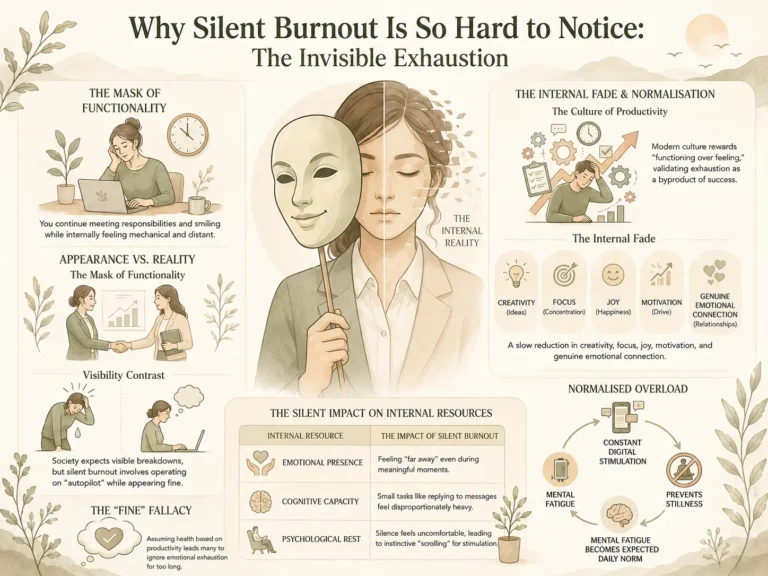
When the mind stays overstimulated for long periods of time, emotional responsiveness can begin to dull.
Psychologists sometimes describe this as emotional exhaustion or emotional blunting — a protective response where the brain conserves energy by reducing emotional intensity.
⇒ This does not mean someone becomes emotionless.
⇔ It means the mind has been carrying too much input for too long without enough recovery.
🌿 At first, this may appear as simple tiredness.
☁️ Then concentration becomes harder.
🪨 Small responsibilities feel heavier.
🌫️ Emotional engagement weakens.
🍂 Hobbies feel less interesting.
🫧 Conversations feel draining.
🌙Excitement fades quickly.
Eventually, many people begin saying things like:
“I don’t feel fully present anymore.”
“Everything feels mentally heavy.”
“Nothing feels deeply enjoyable lately.”
“The mind becomes overloaded, not necessarily broken.”
And because modern culture normalizes exhaustion, many people assume this emotional flatness is simply adulthood.
“But emotional numbness is not the same thing as peace.”
And constant overstimulation changes how people experience life internally.
🌿 It is also important to recognize that silent burnout can overlap with anxiety, chronic stress, or depression.
🌙 If emotional exhaustion or emotional numbness becomes persistent, overwhelming, or deeply disruptive to daily life, professional support may also be important.
Reference emotional exhaustion or chronic stress research from:
Silent burnout often appears through ordinary behaviours people barely notice anymore.
⇒ Small patterns.
⇒ Automatic habits.
⇒ Tiny moments repeated daily.
For example:
◌ opening social media without knowing why,
◌ switching between apps repeatedly while feeling mentally restless,
◌ avoiding texts because replying feels emotionally draining,
◌ listening to something constantly to avoid silence,
◌ procrastinating simple tasks because your brain feels overloaded,
◌ feeling mentally exhausted after basic conversations,
◌ consuming self-improvement content while emotionally feeling worse,
◌ struggling to fully engage with hobbies you once enjoyed.
Sometimes people experiencing silent burnout continue searching for ways to optimize themselves:
🌿 better routines,
🧺 better discipline,
☼ more productivity,
↺ more habits,
⌂ more efficiency.
But the real problem may not be lack of effort.
It may be the lack of recovery.
Many people are trying to solve exhaustion by forcing themselves to do even more.
Meanwhile, their minds rarely experience genuine quiet.
You may also notice:
☁️ increased irritability,
🌫️ low frustration tolerance,
◌ difficulty concentrating,
🕯️ emotional flatness,
◎ feeling disconnected during conversations,
↺ or a constant sense of internal mental noise.
The mind stays busy even during downtime.
“And over time, that internal busyness becomes exhausting in ways that are difficult to explain to other people.”
🌫️ You feel emotionally flat even during enjoyable moments.
🛏️ Rest no longer feels mentally restorative.
🔇 Silence feels uncomfortable without stimulation.
📖 You consume content constantly but rarely feel present afterward.
🧺 Simple responsibilities feel heavier than they should.
☁️ You feel disconnected during conversations.
🧠 Your brain feels busy even during downtime.
🍂 You struggle to feel excited about things you once enjoyed.
🫧 You feel physically present but emotionally distant.
↺ You continue functioning normally while internally feeling exhausted.
Not everyone experiences burnout the same way.
“But many people experiencing silent burnout recognize themselves in these quieter patterns long before they experience complete collapse.”
One of the most damaging modern wellness messages is the idea that healing always requires doing more.
🌿 More routines.
⚙️ More optimization.
📚 More self-improvement.
⏳ More productivity.
But silent burnout is often connected to overload.
And overload cannot always be solved by adding more mental effort — even healthy effort.
Sometimes recovery begins by reducing noise.
🔕 Reducing stimulation.
🍃 Reducing pressure.
🌙 Reducing constant cognitive engagement.
Not abandoning your life.
Just creating small moments where your mind no longer has to react continuously.
That can look like:
🚶 taking walks without headphones,
🍵 eating meals without scrolling,
🔕 reducing unnecessary notifications,
🕯️ sitting quietly for a few minutes without consuming content,
🌿 slowing down multitasking,
🌤️ spending time outdoors without documenting it,
☁️ allowing occasional boredom,
🌱 creating gentler routines.
These actions may seem simple.
But they help restore something many people rarely experience anymore:
mental space.
And mental space matters.
Because attention that is constantly pulled outward eventually weakens emotional presence inwardly.
Many people attempt to recover from exhaustion while remaining mentally overstimulated all day long.
They rest physically while remaining cognitively overloaded.
True recovery often involves attention recovery too.
🌙 Not just sleep.
🌿 Not just vacations.
“But moments where the brain no longer needs to constantly process, react, switch, and absorb.”
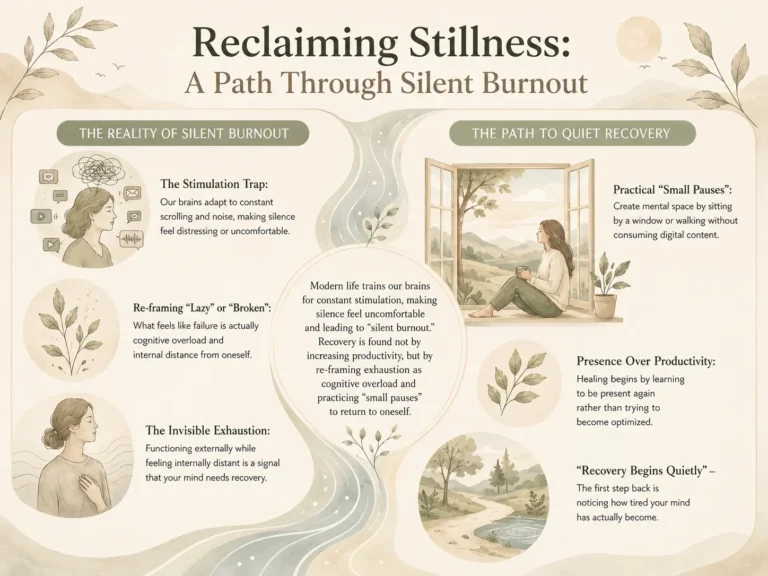
Many people no longer realize how uncomfortable stillness has become for them.
The moment quiet appears, stimulation quickly replaces it:
🎧 music,
🌫️ videos,
📱 scrolling,
🎙️podcasts,
🔔notifications,
🌫️background noise.
⇒ Not because people are weak.
⇔ But because the brain adapts to constant engagement.
And when attention becomes used to continuous input, silence can initially feel unfamiliar.
Learning to slow down again does not require dramatic lifestyle changes.
Sometimes it begins with very small pauses:
🪟sitting near a window without reaching for your phone,
🚶walking without consuming content,
☁️allowing your thoughts to settle naturally,
🍂 noticing your surroundings again,
🕯️ spending a few minutes without immediate stimulation.
These moments seem small.
But over time, they help interrupt the cycle of nonstop mental reaction.
And slowly, emotional presence can begin returning too.
Many people experiencing silent burnout blame themselves for symptoms created by overload.
They assume they are:
♣ lazy,
♣ undisciplined,
♣ emotionally weak,
♣ or simply failing to manage life properly.
But constant cognitive engagement affects emotional energy, attention, and mental capacity.
The human mind was never designed for endless stimulation without recovery.
And emotional exhaustion does not always mean something is fundamentally wrong with you.
Sometimes it means your mind has been carrying too much for too long without enough stillness.
You do not need to completely collapse before your exhaustion becomes valid.
And you do not need to earn rest only after reaching a breaking point.
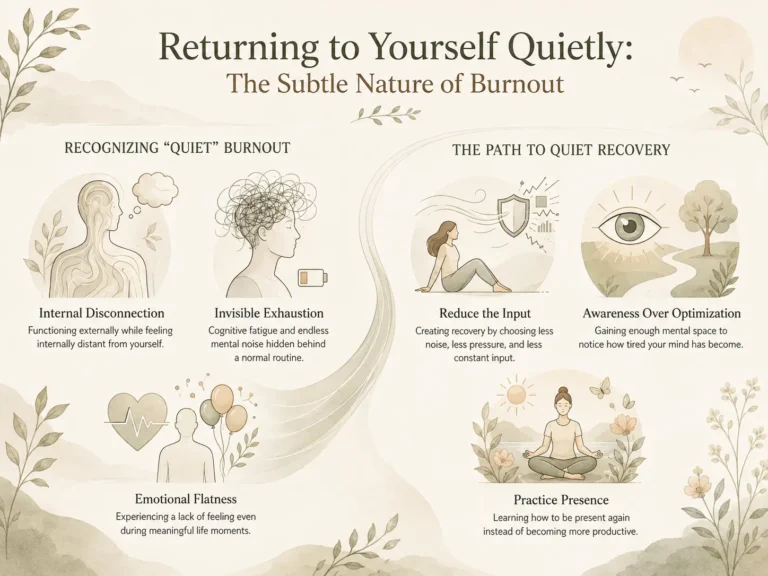
Burnout does not always look dramatic.
Sometimes it looks like continuing normally while slowly disconnecting from yourself.
It looks like:
🌱 endless mental noise,
🌱 emotional flatness during meaningful moments,
🌱 cognitive exhaustion hidden behind routine,
🌱 functioning externally while feeling internally distant.
And because this kind of burnout is quiet, many people live with it far longer than they realize.
But emotional exhaustion deserves attention even when it is invisible.
Not every form of healing needs to be dramatic or transformative.
Sometimes recovery begins quietly.
◌ With less noise.
◌ Less pressure.
◌ Less constant input.
🍂 Sometimes it begins with creating enough mental space to notice how tired your mind has actually become.
🕊️ And sometimes, the first step back toward yourself is not becoming more productive or more optimized.
🪞 Sometimes it is simply learning how to be present again.

Sibani is the founder of The Calm Bloom, sharing mindful living tips, wellness guides, and practical routines for a balanced lifestyle.