How to Improve Fertility Naturally: What Actually Affects Ovulation, Hormones, and Egg Quality.
Struggling to improve fertility naturally even though your tests look “normal”?
Ovulation doesn’t fail randomly — it shuts down when blood sugar, hormones, sleep, and inflammation are off.
“Fertility isn’t broken — it’s responding to how well your body can support ovulation.”
Table of Contents
Introduction
Improving fertility naturally does not include forcing conception or implementing internet fertility techniques.
It is all about restoring the biological circumstances necessary for ovulation, hormone signaling, and egg quality.
Most fertility issues are not caused by faulty reproductive organs. They are triggered by hormone communication, blood sugar management, inflammation, thyroid function, and nutrient availability. When these processes are interrupted, ovulation becomes erratic and egg quality suffers, even when the anatomy appears normal.
A prevalent misperception is that fertility problems indicate that something is broken. In truth, many women with normal scans and basic testing continue to suffer because hormone transmission between the brain and the ovaries is poor. Cycle tracking is insufficient to address this issue.
This article describes:
• The biological basis of fertility.
• Why ovulation and egg quality are declining.
• What promotes fertility naturally without shortcuts or false promises
For a deeper foundation on how daily habits influence hormone signalling, refer to our Hormonal lifestyle guide.
Improve Fertility Naturally – What Fertility Actually Depends On ?
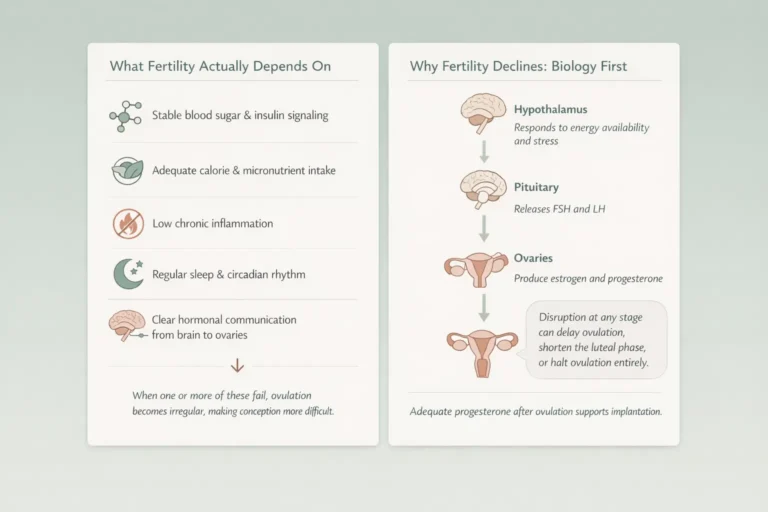
Natural fertility improvement is based on five fundamental conditions:
- Stable blood sugar and insulin signalling.
- Adequate calorie and micronutrient intake.
- Low chronic inflammation.
- Regular sleep and circadian rhythm.
- Clear hormonal communication from the brain to the ovaries.
When one or more of these fails, ovulation becomes irregular, making conception difficult.
Improve Fertility Naturally – Why Fertility Is Declining : Biology First
Fertility is dependent on synchronized communication along the hypothalamic-pituitary-ovarian (HPO) axis.
- The hypothalamus responds to energy availability and stress by releasing GnRH.
- The pituitary gland responds by releasing FSH and LH.
- Ovaries respond by producing estrogen and progesterone.
- Adequate progesterone levels after ovulation promotes implantation.
Disruption at any stage in this chain can cause ovulation to be delayed, shorten the luteal phase, or halt completely.
Improve Fertility Naturally – Common Biological Disruptor
Fertility signalling is frequently disrupted when
- Unstable blood sugar leads to insulin interference with ovulation.
- Cortisol levels remain high, deprioritizing reproductive hormones.
- Reduced thyroid output leads to irregular ovulation.
- High inflammation reduces egg quality and implantation rates.
This explains why reproductive troubles frequently occur with exhaustion, PMS, acne, weight fluctuations, or irregular periods.
Hormonal Breakdown : What Each One Means for Fertility
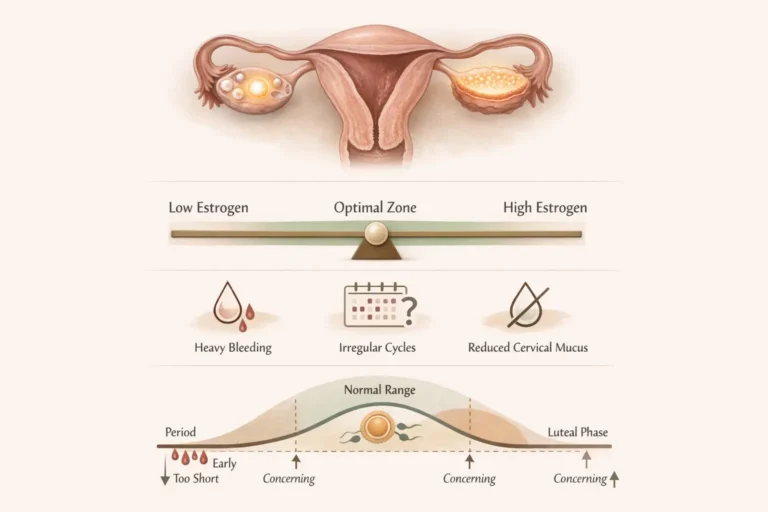
Estrogen
Normal function:
Promotes egg maturation and strengthens the uterine lining.
Imbalance symptoms may include:
Irregular periods, heavy or prolonged bleeding, and diminished cervical mucus.
Normal vs. concerning:
Mild cycle fluctuation is common. Bleeding that lasts more than seven days or cycles that are less than 24 days long should be evaluated.
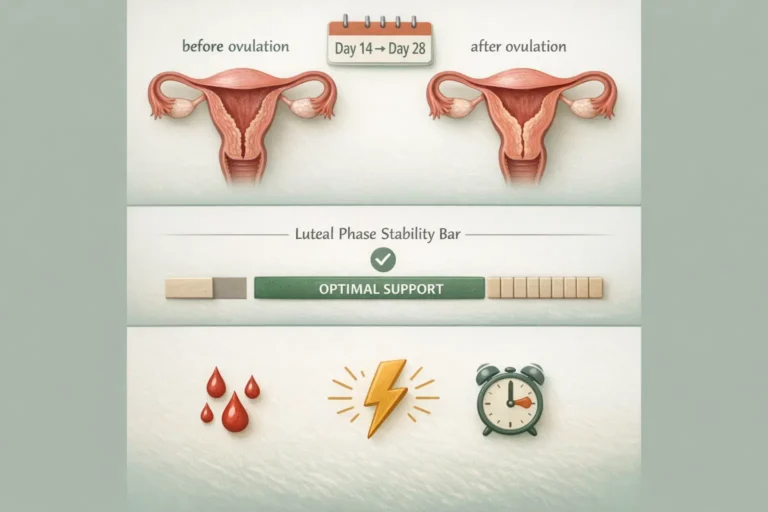
Progesterone
Normal function:
Confirms ovulation and stabilizes uterine lining after ovulation.
Imbalance symptoms may include:
Short luteal phase, spotting before periods, and worsened PMS.
Normal vs. Concerning:
Spotting can happen on occasion. Repeated luteal phases of less than 10 days are not ideal for fertility.
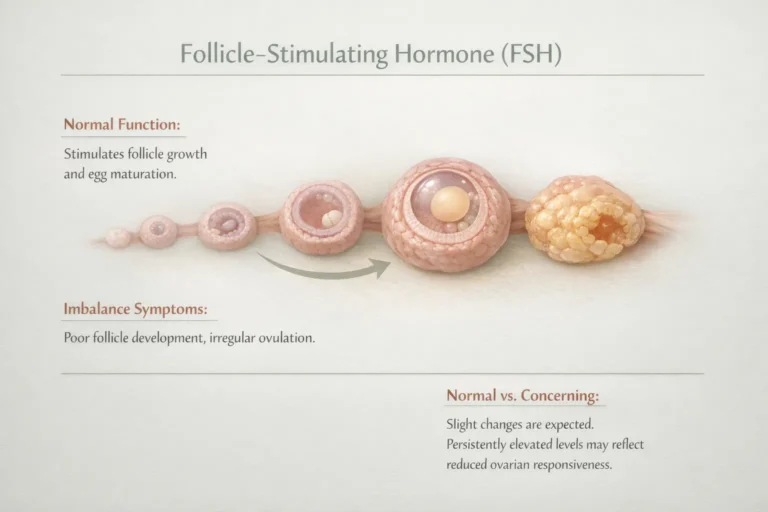
LH and FSH
Normal function:
Promote follicle development and ovulation.
Imbalance symptoms may include:
Delayed ovulation or anovulatory periods.
Normal vs. Concerning:
Monthly variation is expected. A persistently increased LH compared to FSH level frequently indicates insulin resistance or PCOS.
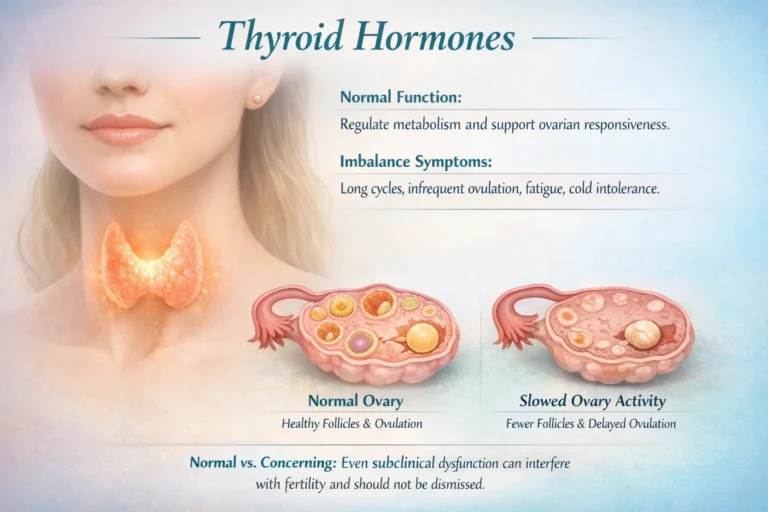
Thyroid Hormones
Normal function:
Regulates metabolism and ovarian response.
Imbalance symptoms may include:
Long cycles, irregular ovulation, exhaustion, and cold intolerance.
It is important to highlight that:
Even mild thyroid dysfunction can affect fertility and should not be ignored.
Fertility-Related Symptoms That Are Often Ignored
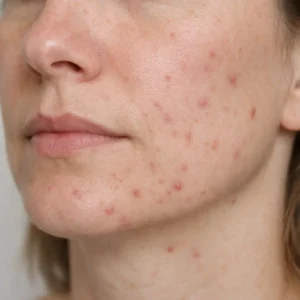
Skin Changes:
- Adult acne is related to insulin resistance or increased androgens.
- Dry or dull skin associated with low thyroid activity
Here’s a full description of Hormone-driven skin patterns.
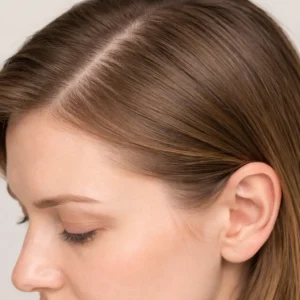
Hair changes
- Hair thinning associated with thyroid problems or iron insufficiency.
- Excess facial hair is linked to higher androgen levels.
These patterns are due to hormonal signals rather than cosmetic concerns.
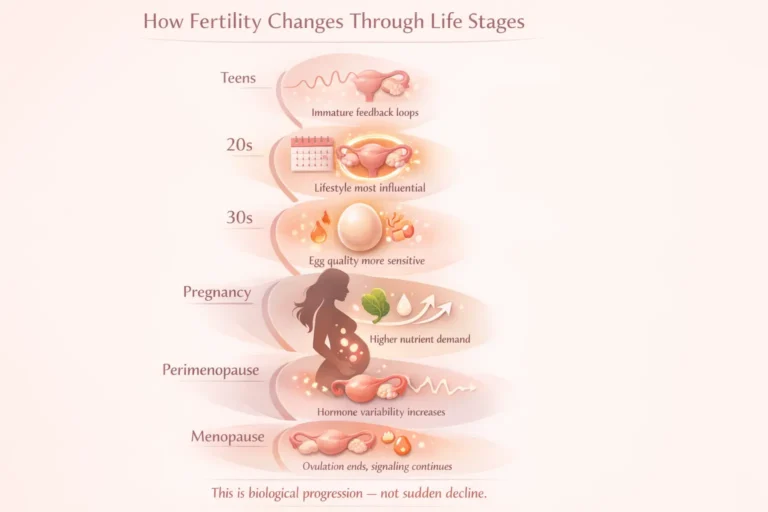
Improve Fertility Naturally – How Fertility Changes Through Life Stages
Teens
Cycles are often erratic due to underdeveloped hormone feedback circuits. It is expected.
20s
Ovulation is normally regular. Undereating, prolonged stress, and inadequate sleep are frequent reproductive suppressors.
30s
Egg quality gets increasingly affected by inflammation, sleep quality, and blood sugar regulation.
Pregnancy
The requirement for nutrients increases considerably. Deficiencies are more obvious.
Postpartum
Ovulation may be delayed as a result of increased prolactin and sleep disruption.
Perimenopause
As progesterone and estrogen levels change, cycles are shorter or longer.
Menopause
Although ovulation is no longer occurring, hormone signaling continues to influence metabolic and overall health.
This is biological progress, not a sudden fall.
How to Increase Fertility Naturally
Fundamentals of Diet
Fertility is dependent on continuous energy and food consumption.
- Protein in every meal to enhance LH and progesterone.
- Appropriate dietary fat for hormone synthesis
- Complex carbs to regulate blood sugar and insulin levels.
For anti-inflammatory food recommendations, Visit
Key Nutrients that Enhance Egg Quality
Folate, iron, iodine, choline, selenium, and omega-3 fats have all been linked to improved ovulation and implantation. Deficiency, not effort, is frequently the limiting issue.
Lifestyle Changes
- Consistent sleep time within a one-hour window daily.
- Strength training two or three times per week.
- Daily walking to help with insulin sensitivity.
For more information on hormone-friendly exercise, visit
Supplements (When Appropriate)
- Vitamin D deficiency.
- Myo-inositol to treat insulin resistance or PCOS
- Omega-3 fatty acids help with inflammation.
Supplements improve hormone function but do not cause ovulation when signaling is disrupted. Use them based on laboratory results, not assumptions.
When to Visit a Doctor
Seek medical help if you:
- Cycles are shorter than 24 days and longer than 35 days.
- Menstrual cycles stop for three months
- PMS gets severe or worsens gradually.
- Ovulation does not occur for several cycles.
- You’ve been trying to conceive for 12 months, or six months if you’re older than 35.
For evidence-based evaluation guidelines on infertility, see
Infertility
FAQ
Conclusion
Fertility symptoms are not unpredictable. They demonstrate how well the body distributes energy, nutrients, and hormonal messages.
The goal is not to force pregnancy, but rather to restore the physiologic circumstances necessary for ovulation and implantation. When hormone communication improves, cycles stabilise, and fertility follows.
It is more important to be consistent than to be intense. Begin with the fundamentals and progress from there.

Sibani is the founder of The Calm Bloom, sharing mindful living tips, wellness guides, and practical routines for a balanced lifestyle.