Stress and Hormones Connection: How Stress Disrupts Your Entire System
Stress doesn’t just make you tired. It changes how your hormones communicate, prioritize, and function..
“When stress stays constant, hormones don’t fail. They adapt to survive.”
Table of Contents
Introduction
Chronic stress affects how female hormones function. The body prioritizes survival over reproduction, repair, and metabolism, not because something is malfunctioning.
If your periods are irregular, your sleep seems lighter, your skin is breaking out despite doing everything correctly, and your energy levels plummet by the afternoon, this is most likely due to stress-related hormonal disturbance.
There is a widespread misconception that stress is only significant when it seems severe. That is not true. When low-grade stress occurs on a daily basis, it can affect hormone signalling.
This is not about calming down or repairing hormones overnight; it is about understanding the patterns that emerge when stress becomes chronic.”

The primary hormone in question is cortisol. Cortisol interferes with estrogen, progesterone, thyroid hormones, and insulin when levels are high. That interference accounts for the majority of stress-related symptoms that women experience.
The relationship between stress and hormones in women, what is biologically normal, what indicates a problem, and what may actually be improved are all explained in this article.
This stress and hormones connection explains why symptoms often appear together instead of in isolation.
The Hormonal Balance Lifestyle Guide provides a comprehensive overview of how this fits in.
Stress and Hormones Connection: Why this occurs
- The hypothalamic-pituitary-adrenal axis is triggered by stress, and cortisol levels rise.
- Cortisol levels remain high, suggesting that the brain prioritizes survival above reproduction.
- Resources used to make hormones are redirected. Progesterone production declines.
- Cortisol influences insulin sensitivity. Androgen activity rises
- Thyroid hormone conversion slows, leading to decreased metabolism.
- Increased inflammation leads to worsening skin, hair, and cycle complaints.
To put it simply, when the body detects an ongoing threat, reproduction, repair, and metabolic efficiency suffer. Hormones do not disappear. They are given less priority.
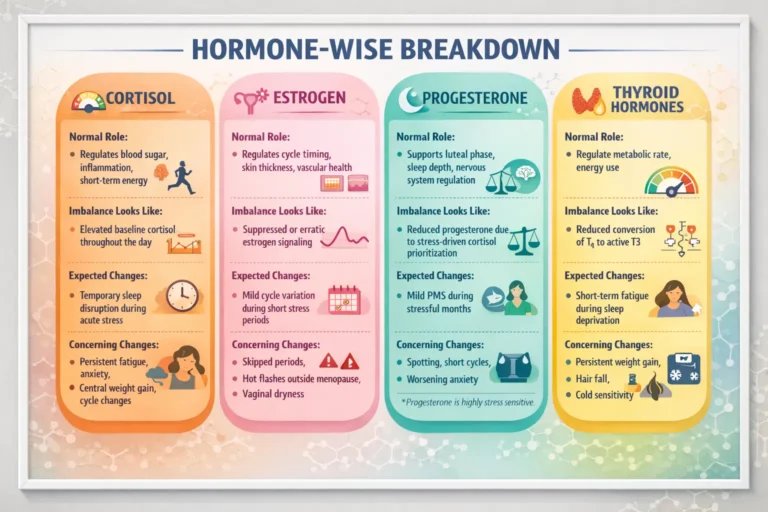
Analysis by Hormone
Cortisol
Normal function:
- Controls inflammation, blood sugar, and transient energy
An imbalance appears as:
- High baseline cortisol levels during the day
Changes that are expected:
- Sleep disturbance due to intense stress
Concerning the changes:
- Persistent fatigue, anxiety, central weight gain, cycle
The Cleveland Clinic provides information on cortisol function.
Estrogen
Normal function:
- Regulates cycle time, skin thickness, and cardiovascular health.
An imbalance appears as:
- Inconsistent or repressed estrogen signalling
Changes that are expected:
- Mild fluctuations in the cycle during brief stressful times
Concerning the changes:
- Skipped periods, hot flashes outside of menopause, and vaginal dryness
Progesterone
Normal function:
- Promotes luteal phase stability, sleep depth, and nervous system modulation.
An imbalance appears as:
- Reduced progesterone due to stress-driven cortisol prioritizing
Changes that are expected:
- Mild PMS during stressful months
Concerning the changes:
- Spotting, short periods, and worsened anxiety
Because ovulation is so susceptible to stress, low progesterone frequently manifests first. Many women experience sleep disruption or PMS before their cycle duration changes.
Thyroid hormones
Normal function:
- Regulate metabolic rate and energy consumption.
An imbalance appears as:
- Reduced conversion of T4 to active T3
Changes that are expected:
- Short-term weariness with sleep deprivation is an expected change.
Concerning the changes:
- persistent weight gain, hair loss, cold sensitivity
Common Issues Caused
Skin Problems
Stress hormones have a direct effect on the skin.
- Cortisol increases oil production.
- Progesterone disruption promotes inflammation.
- Collagen synthesis reduces.
Women will experience stress-related acne, increased sensitivity, and dull skin.
For more details, see Skin & Hair Changes Due to Hormones.
Hair Problems
- Cortisol causes follicles to shed
- Thyroid suppression inhibits regrowth
- Nutrient deficiency contributes to hair thinning.
This pattern explains why stress hormones cause hair loss instead than patchwork loss.
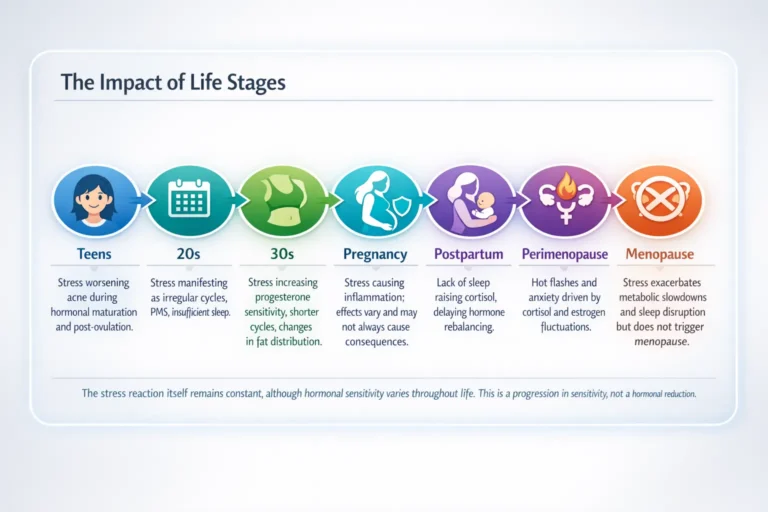
The impact of life stages
The stress reaction itself remains constant, although hormonal sensitivity varies throughout life.
Teens
Stress could worsen acne during hormonal maturation and postpone ovulation.
20s
Stress frequently manifests as breakouts, PMS, and insufficient sleep.
30s
Stress increases the sensitivity of progesterone. The length of cycles decreases. The fat distribution changes.
Pregnancy
Stress causes inflammation, however it does not always result in consequences.
Postpartum
Lack of sleep raises cortisol, which delays the balancing of hormones.
Perimenopause
Hot flashes and anxiety are exacerbated by cortisol, which increases fluctuations in estrogen.
Menopause
Stress exacerbates metabolic slowness and disrupts sleep, but it does not trigger menopause.
This is a progression in sensitivity, not a hormonal reduction.
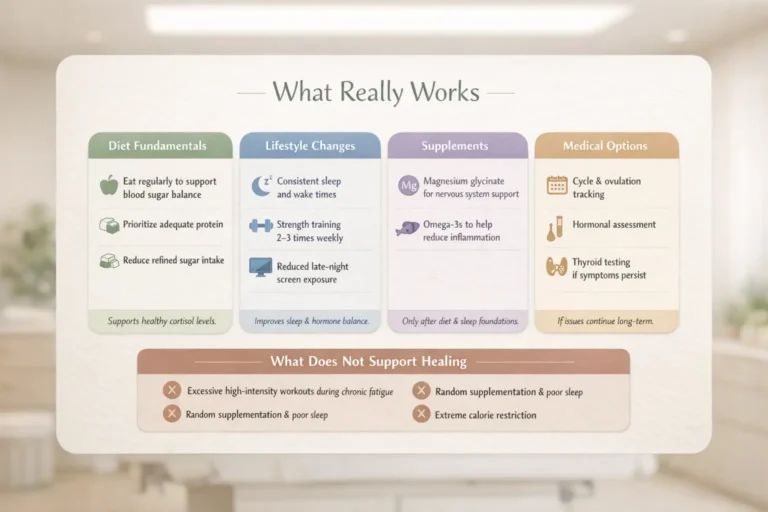
What Really Works
Diet Fundamentals
- Eat regularly to regulate blood sugar levels
- Get enough protein
- Limit refined sugar intake
This indirectly, rather than immediately, contributes to cortisol regulation.
Lifestyle Changes
- Maintaining consistent sleep and waking schedules
- Engaging in strength training 2-3 times per week
- Limiting late-night screen time
For details on sleep-related mechanisms, see How Sleep Affects Hormones.
Supplements
- Magnesium glycinate supports sleep and the nervous system.
- Omega-3s reduce inflammation.
Only when appropriate sleep and food are consumed may supplements be helpful.
Reference: Supplements for Women Over 25.
What Does Not Help
- Extreme calorie restriction
- Overtraining or frequent HIIT during chronic fatigue
- Random supplement stacking • Maximizing productivity amid sleep deprivation.
These maintain cortisol levels high even when everything else appears to be fine.
Medical Options
- Ovulation monitoring for irregular cycles;
- Hormonal assessment when periods become irregular;
- Thyroid testing if symptoms last longer than three months
When to Visit a Doctor
- Absence of periods for more than 3 months
- Sudden weight gain without explanation
- Long-term hair loss
- Fatigue that does not improve with rest
- Fertility issues after 12 months
These symptoms should be evaluated even if stress is present, as stress can conceal underlying disorders.
FAQ
Conclusion
Understanding the stress and hormones connection helps separate normal adaptation from signs that need attention.
Stress-related effects are not unpredictable. They show a shift in hormonal priorities.
The purpose is not to remove stress. That is unreal. The goal is to decrease chronic activation while restoring predictable signaling.
Awareness precedes every effective fix.
Begin by documenting sleep, cycle changes, skin flares, and energy for a month. When written down, patterns become clear.
That data shows you where to take action.


Sibani is the founder of The Calm Bloom, sharing mindful living tips, wellness guides, and practical routines for a balanced lifestyle.