How to Stop Overthinking Without Suppressing Real Problems
Overthinking starts as problem-solving and becomes harmful when nonstop thinking replaces action, rest, and emotional processing.
“Overthinking is not insight. It is a nervous system stuck on repeat.”
Table of Contents
Introduction
Oftentimes, overthinking is not as bad as people believe. It’s not a broken mindset or a lack of discipline. Usually, it’s the mind remaining active since it doesn’t feel secure enough to relax.
The majority of advice on how to stop overthinking is on thought control techniques, such as diverting your attention, forcing positivity, or using distractions. Because it approaches overthinking as a thinking problem rather than a regulatory problem, that strategy fails.
Eliminating thinking is not the objective. The intention is to establish an environment that eliminates the need for endless thought loops.
This guide explains:
- The causes of overthinking
- How to notice it early and stop overthinking?
- What eliminates mental loops in reality?
- How mindfulness can help without ignoring real concerns.
The Causes of Overthinking
Instead than being a sign of a personality defect, overthinking is a defensive reaction.
The brain repeatedly replays situations when it detects:
- Uncertainty
- Unresolved Decisions
- Avoidance of emotions
- Constant intake without recovery.
When the neurological system remains active, the mind remains awake. This leads to thought loops.
Important factors include:
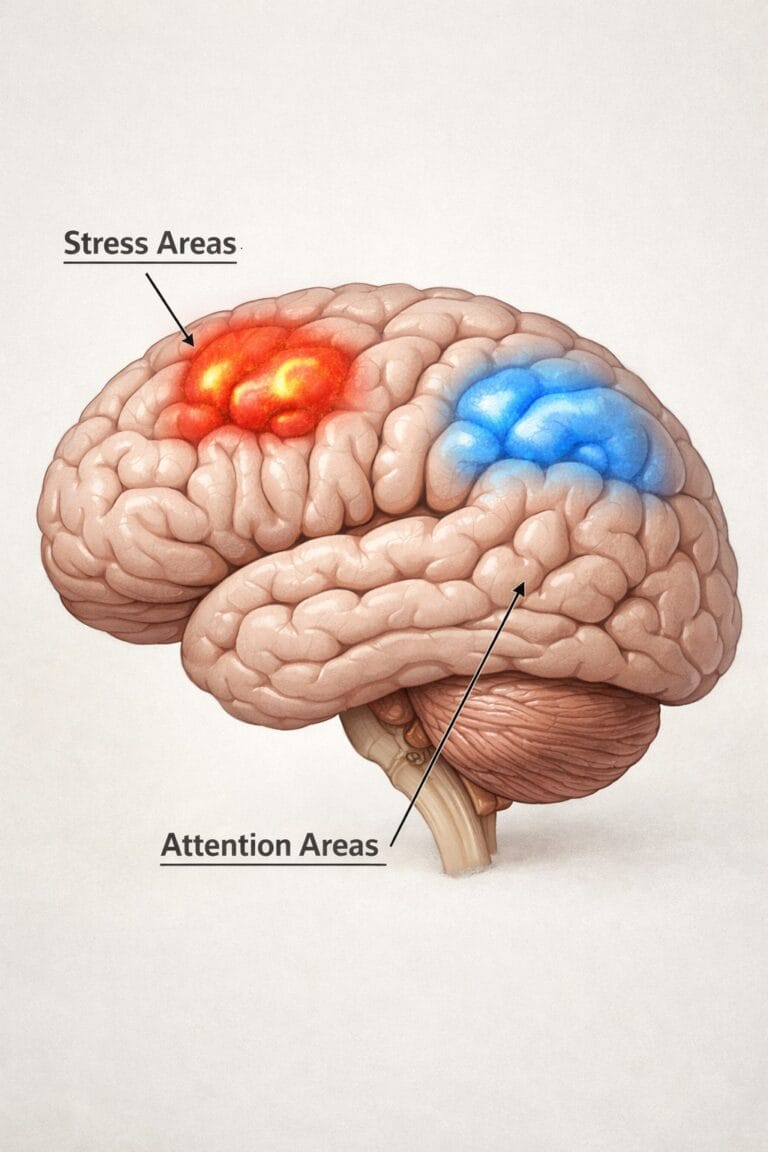
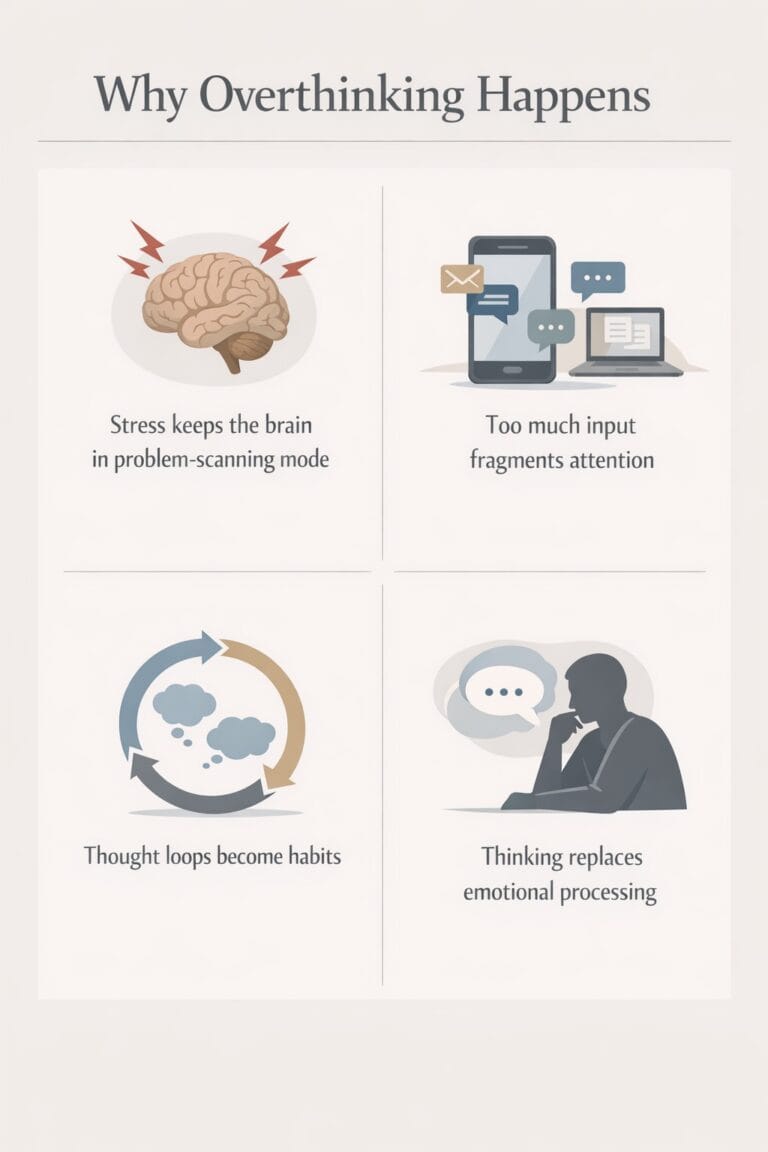
- Stress activation: the brain continues to scan problems
- Unfinished loops: unresolved decisions continue to be repeated
- Cognitive overload: Too much information inhibits clarity.
- Emotional Avoidance: Thinking Replaces Feeling
- Lack of rest signals: no defined start/stop limits.
Until the system settles down, neither will the mind.

How Overthinking Affects Our Daily Lives
Overthinking might appear normal, especially in high-functioning persons.
Common symptoms include:
- Replaying talks long after they conclude
- Struggling with little decisions
- Planning repeatedly without action
- Mental weariness with minimal physical exertion
- Difficulty resting in idle time
- Feeling mentally active yet emotionally flat.
It’s not about intelligence or motivation. It is about a mentality that does not get enough unambiguous stop signals.

What Causes Continuous Overthinking
Certain habits silently promote mental loops:
- Constant content consumption
- Digital Multitasking
- Sleep debt.
- Excess caffeine or skipping meals
- Perfectionism without closure
- Avoiding awkward discussions
- Chronic stress with no recovery.
These are not moral failures. They are system-level signals that keep the brain active.
Trying to “think less” while maintaining these behaviors doesn’t work.
What Can Help You Stop Overthinking?
Effective solutions lessen mental strain rather than combating thoughts.
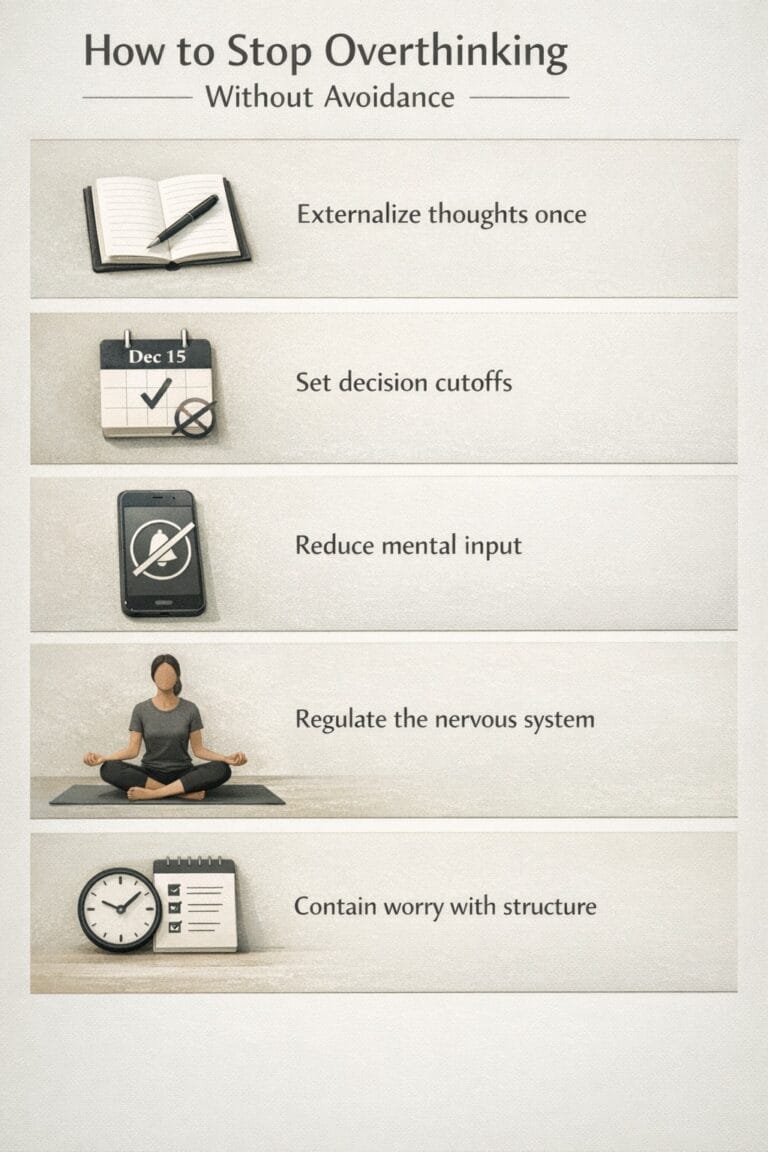
1. Externalize Thinking
Make a single record of your concerns and decisions. Knowing that knowledge is stored elsewhere causes the brain to relax.
2. Set decision cutoffs.
Limit how long you think about something. Decide, delegate, or leave it.
3. First, reduce the input.
Fewer notifications. Fewer tabs. Fewer opinions.
4. Manage the Nervous System
Walking slowly, breathing steadily, and getting plenty of sunlight. These reduce baseline activation.
5. Manage your worry.
Set aside a set time to think. Worry spreads uncontrollably.
Many of these methods are similar to those described in Mindfulness Habits for Mental Wellness, particularly mindfulness that emphasizes awareness and limits rather than suppressing thoughts.
You may also find these helpful:
Tools that can help reduce overthinking (optional)
No product can prevent overthinking on its own. These instruments are only beneficial if they reduce friction, overstimulation, and mental burden. If they do not do so, avoid them.
1. Paper Journal or Structured Notepad (Link)
Overthinking improves when thoughts leave your head and stay somewhere reliable.
A simple lined or guided journal works if:
You use it consistently
You write once, not repeatedly
You do not reread to re-ruminate
Look for:
Minimal design
No prompts that push positivity
Enough space for decision lists and brain dumps
Affiliate note: Any basic daily planner or blank notebook works. Avoid “mindset” journals with motivational prompts.
2. Analog Alarm Clock (Link)
Phones in the bedroom increase mental stimulation at night, which is when overthinking spikes.
An analog or basic digital alarm clock helps by:
Removing late-night scrolling
Reducing cognitive input before sleep
Creating a clearer mental shutdown cue
This supports better sleep, which directly improves emotional regulation and reduces rumination.
Affiliate note: Choose a simple clock without light displays or smart features.
3. Noise Control Tools (Not Silence) (Link)
Complete silence often makes overthinking worse. Gentle, predictable sound helps the brain settle.
Options include:
White noise machines
Simple fans
Neutral sound apps used intentionally, not endlessly
This works by reducing attention scanning, not by distracting you.
Affiliate note: Avoid apps that push constant content or require interaction.
4. Blue-Light Reducing Glasses (Evening Use Only) (Link)
These do not fix overthinking, but they can reduce evening stimulation.
They help by:
Supporting melatonin release
Reducing eye strain
Making mental wind-down easier
Affiliate note: Use only after sunset. Wearing them all day is unnecessary.
How Mindfulness Benefits Without Ignoring Real Issues
Mindfulness does not imply that one stops overthinking. It modifies your relationship with thinking.
As an alternative,
- Responding instantly
- Replaying automatically
- Constantly analyzing
You learn how to:
- Take note of the thought
- Decide if it requires action.
- Return your focus to the present.
This keeps overanalyzing from becoming mental noise while yet enabling genuine problem-solving when necessary.
Building the Habit without Burnout
Most people fail because they want control rather than containment.
What does work:
- Prioritize frequency above intensity
- One boundary at a time
- Short daily practices
- Consistency over motivation
Example:
Set one rule: no issue solving after 8 p.m. Write down your thoughts. Come back tomorrow.
Instead of increasing discipline, overthinking decreases when the environment gets easier.
When Further Assistance Is Beneficial
The limits of self-regulation.
Consider more help if:
- Most days, thoughts feel uncontrollable.
- Sleep is regularly disturbed.
- Stress symptoms exist in spite of modifications
- Daily functioning is impacted.
Support is not a failure. It is suitable when the nervous system requires organized direction.
Resources:
NIH overview on stress and mental health
FAQ
Conclusion
Stop overthinking isn’t about changing yourself. It’s about preserving mental clarity in the same manner that you do physical wellness.
When boundaries, relaxation, and awareness are in place, the mind does not have to fight itself to be silent.

Sibani is the founder of The Calm Bloom, sharing mindful living tips, wellness guides, and practical routines for a balanced lifestyle.