You’re not unfit. You’re training against your hormones — and your body is pushing back.
“More exercise is not the answer when your hormones are overwhelmed”
Introduction: Why “Just Work Out More” is bad advice for women.
Most training routines assume that the body is relatively stable on a daily basis. For women, that assumption is false.
Hormonal levels fluctuate on a weekly basis. It happens on a regular basis. Estrogen levels fluctuate over time. Progesterone takes up half of the month. Stress, diet, sleep, and exercise volume all have an effect on cortisol.
However, the majority of fitness advice overlooks this entirely. This is why a hormone friendly exercise routine is essential for women to consider.
That is why so many women are experiencing:
- Fat loss that stops despite consistent workouts
- PMS worsens after starting intensive workout.
- Exhaustion rather than energy
- Missed or irregular cycles
- Strong one week and then weak the next.
If exercise is your primary health tool, it must complement sleep, nutrition, and stress management. This program is intended to be integrated into a larger lifestyle approach defined in the Hormonal Balance Lifestyle Guide, which describes how everyday behaviors affect estrogen, progesterone, insulin, and cortisol.
This isn’t a lack of willpower. It’s all about biology.
A hormone-friendly fitness plan does not mean performing less work. It’s about putting stress where your body can genuinely take it.
If you already eat well and get enough sleep but still feel stuck, your workout strategy is most likely the missing link. This guide explains how to practice in a way that supports hormonal balance rather than continually fighting it.
This piece complements the Hormonal Balance Lifestyle Guide on The Calm Bloom, which goes into detail about nutrition, sleep, and stress.
Incorporating a hormone friendly exercise routine can help mitigate these issues and promote better overall health.
1. The Reasons Your Hormones Respond to Exercise
Exercising causes stress. Stress is beneficial, yet it is still stressful.
When stress is timed correctly, hormones adapt and improve. Hormones are disrupted by prolonged or untimely stress.
Women are particularly susceptible because reproductive hormones interact directly with cortisol and insulin.
Estrogen and Training Response
- Estrogen is more than just a reproductive hormone. It has the following direct effects:
- Muscle recovery.
- Absorption of glucose
- Fat metabolism
- Nervous system resiliency.
When estrogen levels rise, typically during the follicular and ovulatory periods, women:
- Recover more quickly
- Tolerate higher intensities
- Increase strength more effectively.
- Improved mood stability.
This is when pushing through workouts pays off.
Progesterone and Training stress
Progesterone levels grow following ovulation and dominate the luteal phase.
Its effects include the following:
- Raised body temperature
- A higher resting heart rate
- Faster fatigue
- Increased water retention.
- Decreased carbohydrate tolerance
This does not imply that you should quit exercising. It refers to adjusting intensity. Ignoring progesterone is how workouts begin to feel punishing rather than productive.
Cortisol: The Deal Breaker.
Cortisol is essential for survival. It boosts energy and aids in training.
The issue is persistent elevation.
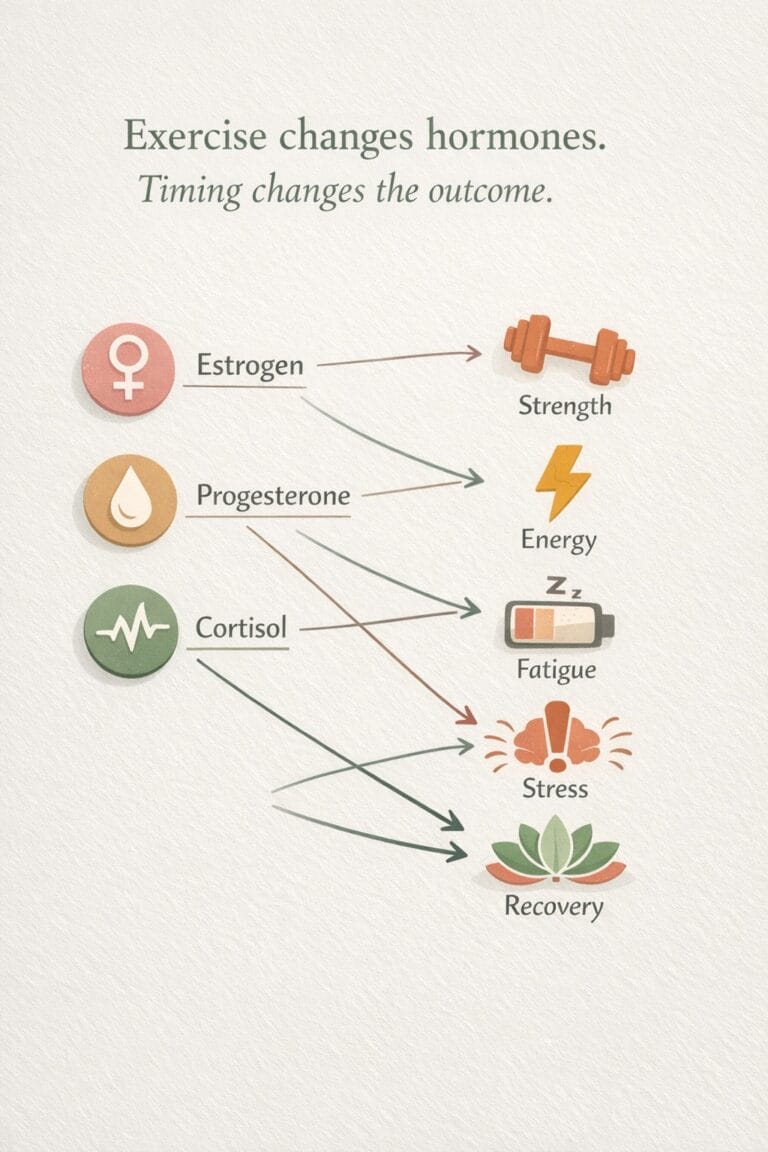
High cortisol levels:
- Prevents fat loss.
- Alters thyroid hormones
- Reduces progesterone levels
- interferes with ovulation
- Worsens anxiety and PMS
Intense workouts while your body is already stressed maintain cortisol levels high all month. This is how “healthy habits” begin to cause hormone disorders.
Check out The Calm Bloom’s Stress and Hormones Connection if this sounds familiar. It explains this relationship in depth.
2. Indications That Your Exercise Is Not Hormone-Friendly
Most women are unaware that their training is the source of their problems until they experience symptoms.
Here are some common red flags:
- You feel stimulated but exhausted after workouts.
- PMS became worse after starting HIIT or bootcamp courses.
- You lose weight at first, but then you stall.
- Sleep quality decreases during training days.
- Your cycles become erratic or unpleasant.
- You dislike workouts that you used to enjoy.
If two or more of these conditions apply, your routine is most likely overly intense, too frequent, or improperly scheduled.
3. Basics of Hormone-Safe Training
A women’s hormone workout program does not have to be complicated. It only needs to follow the guidelines your body already follows.
Principle 1: You Don’t Need to Exercise Every Day
Daily rigorous training does not translate into quicker results. It corresponds to cortisol excess.
Exercises that are difficult should be scheduled when estrogen promotes healing. Everything else ought to help that effort.
Principle 2: You Can’t Negotiate Strength Training
Strength Training:
- Increases insulin sensitivity
- Improves blood sugar stability.
- Reduces the severity of PMS
- Promotes bone density.
- Enhances resting metabolic rate
Cardio alone cannot achieve this. A hormone-friendly fitness plan must always include strength training.
Principle 3: Cardio must correspond to hormonal capacity.
Cardio is not harmful. Excessive cardiovascular activity at the wrong moment is.
When progesterone is high, long runs, spin marathons, and regular HIIT cause an increase in cortisol. That tension affects sleep, appetite, and mood.
Principle 4: Recovery is a Hormonal Skill
Sleep, rest days, and low-intensity movement control hormones far more effectively than more workouts.
If recuperation slows, hormones are the first system to suffer.
For more information on the impact of sleep, visit How Sleep Affects Hormones on The Calm Bloom.
4. A Simple Guide to the Menstrual Cycle and Exercise
Cycle-based training is effective because it balances stress with hormonal capabilities.
This is how each phase impacts workout response.
Phase 1: Menstrual Phase (Days 1-5).
Estrogen and progesterone levels are low. Inflammation has increased.
Your body requires rest, circulation, and gentle activity.
This is not the moment to “push through.” Blood loss lowers the supply of iron and oxygen. The recovery resources are limited.
Best Workouts
- Walking
- Gentle yoga.
- Stretching
- Exercises to improve mobility
- Light bodyweight strength
Why is this effective? Light movement stimulates circulation without depleting energy reserves.
What to avoid?
- HIIT
- Heavy lifting.
- Endurance Cardio
Pushing too hard here frequently causes weariness to last into the next phase.
If you have painful or heavy periods, you should make lifestyle changes. See How to Reduce PMS Naturally for additional assistance.
If menstruation exercises are excruciating or discomfort intensifies with exercise, the cause is usually inflammation, mineral depletion, or poor recuperation practices. Before increasing workout intensity, review the recommendations provided in How to Reduce PMS Naturally.
Phase 2: Follicular Phase (Days 6 to 13)
The hormonal landscape is changing, with estrogen rising. Cortisol responses improve. Insulin sensitivity improves.
What your body requires: gradual overload and challenge.
This is the ideal time for you to train.
Best workouts.
Heavy strength training.
- Short HIIT sessions.
- Running
- Cycling
- Power yoga
- Plyometrics
Why does this work?
Estrogen preserves muscles and joints while boosting glucose utilization.
Here’s where you go:
- Increase weights.
- Add reps.
- Increase the speed
It is a common mistake to skip intensity now and force it later.
Sample Follicular Week (Example)
Day 1: Lower body strength (45 minutes)
Day 3: Upper body strength + short HIIT finisher (10–12 minutes)
Day 5: Full-body strength session
Optional: 1–2 moderate cardio sessions or active recovery
This is only an example, not a prescription. The idea is to determine how intensity clusters during hormone-supportive stages.
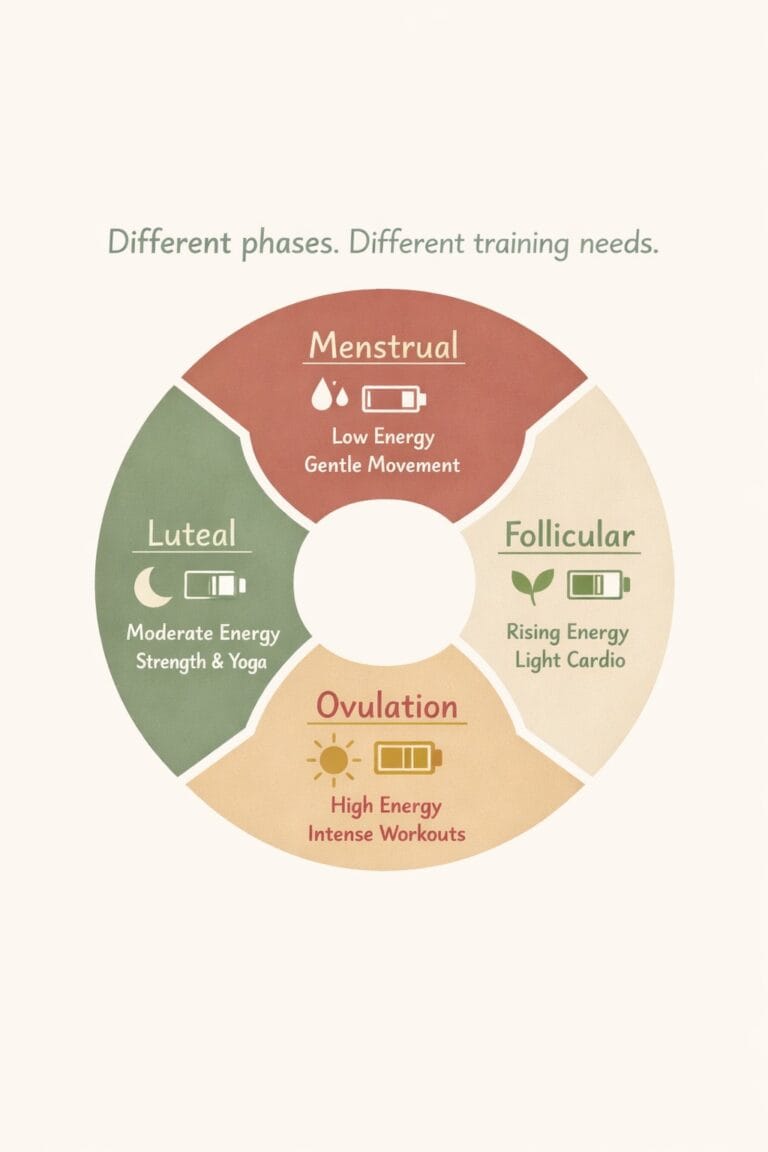
Phase 3: Ovulation Phase (Days 14-16).
Hormonal landscape: peaks in estrogen. Testosterone levels have marginally increased.
What your body requires: Maximum production while maintaining control.
Strength and power levels are at their peak right now. The risk of injury is slightly higher due to ligament laxity.
Best workouts.
- Heavy compound lifts.
- Short HIIT
- Circuit Training
Important warning.
- Warm up completely.
- Avoid sloppy forms.
- Avoid chasing ego numbers.
Train hard, but smartly.
Phase 4: Luteal Phase (Days 17 to 28)
Hormonal landscape: Progesterone levels are rising. Cortisol sensitivity rises.
What your body requires: stability and stress relief.
This period determines the severity of PMS.
Best workouts.
- Moderate strength training.
- Pilates
- Barre.
- Swimming
- Walking on an inclined surface
- Yoga for help from PMS
Why this works: These keep insulin levels constant and cortisol under control.
Avoid
- Back-to-back HIIT
- Long fasted cardio
- Late evening exercises
If the PMS is severe, this phase requires more recovery rather than more discipline.
For the beginning, Cycle Syncing for Beginners describes how to use this without tracking exactly.
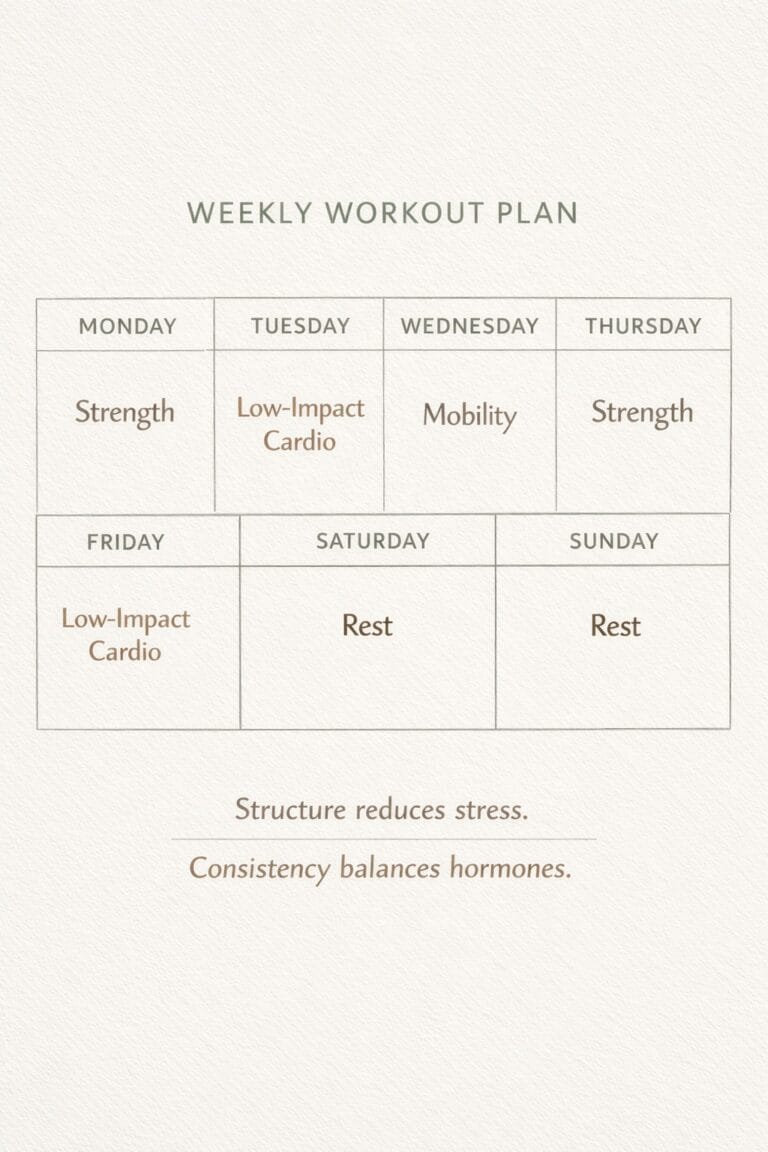
5. Weekly Template for Hormone-Friendly Workouts
This template maintains a balance between stress and recovery throughout the month.
Week 1: Menstrual.
- Three sessions of gentle movement
- One extremely light strength day is optional.
- Pay attention to circulation and movement.
Week 2: Follicular.
- Three strength sessions
- 1-2 HIIT or quick cardio workouts
- A single mobility or yoga session
Week 3: Ovulation.
- 2-3 strength training workouts.
- One HIIT session.
- One mobility session.
Week Four: Luteal.
- Two moderate strength sessions
- Two low-impact cardio workouts
- Daily brief mobility work
This approach promotes hormonal balance over time while avoiding micromanaging everyday workouts.
6. Low Cortisol Workouts That Are Effective
Exercises with low cortisol levels are not ineffective. They are considered strategic.
Here are several examples:
- Walking outside
- Pilates
- Barre
- Swimming
- Light cycling.
- Mobility flows.
- Restorative Yoga
They reduce stress hormones while keeping movement regularity.
During the luteal and menstrual cycles, these workouts protect hormones while keeping metabolism active.
7. Common Training Mistakes That Affect Hormonal Balance
Most women who experience hormonal problems make the same mistakes.
Mistake 1: HIIT Addiction.
High-intensity interval training feels beneficial. When done too frequently, it inhibits fat loss and recuperation.
Mistake 2: Training through the PMS
This causes more inflammation and worsens symptoms month after month.
Mistake 3: Ignoring Sleep Quality.
Late-night workouts increase cortisol and interfere with melatonin production.
Mistake 4: Only doing cardio.
Without muscular mass, blood sugar becomes unstable, and hormones are compromised.
Mistake 5: Never deload.
Chronic stress does not equate phase-based recovery.
When cycles are erratic or energy is unpredictable, this list is frequently the cause.
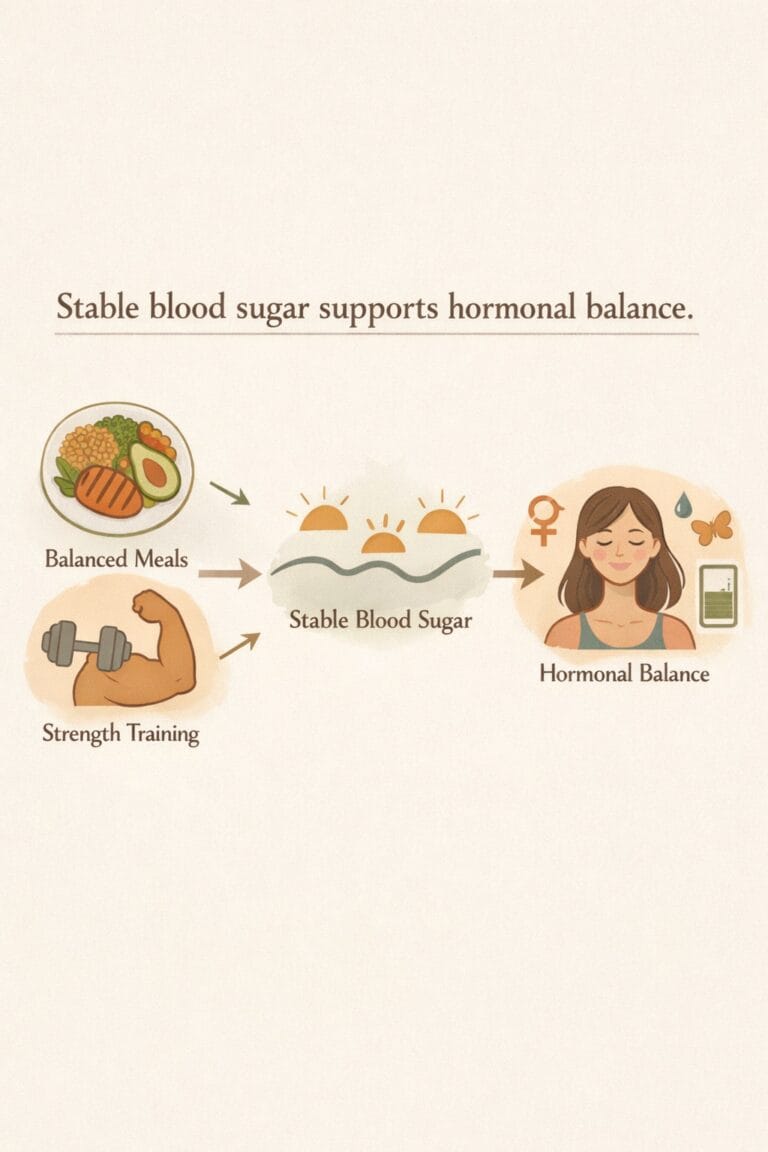
8. Exercise, Blood Sugar and Hormones
Blood sugar instability is a hidden hormonal stressor.
Strength training boosts insulin sensitivity more than cardio alone.
Stable blood sugar levels reduce:
- Cravings
- Mood swings
- Cortisol surges.
- Fat storage
This is especially crucial for women who have PCOS or are prediabetic.
Strength training is not an option in a hormone-friendly fitness plan.
This is especially critical for women with PCOS, where insulin resistance directly drives hormonal symptoms, fatigue, and stubborn fat storage.
9. Supplements that promote exercise and hormones
These are not intended to replace lifestyle changes. They help them.
Evidence-based choices
- Magnesium glycinate (Link) helps regulate the neurological system.
- Omega-3s (Link) for reducing inflammation
- Vitamin D (Link) helps in hormonal signalling.
- Ashwagandha (Link) improves stress resilience.
- B-Complex vitamins (Link) for PMS and vitality.
- Electrolytes (Link) in the luteal phase.
For more information, check out The Calm Bloom’s Supplements for Women Over 25.
10. The Ignored Connection Between Sleep and Exercise
Training does not improve hormones if you don’t get enough sleep.
Signs that working exercise is disrupting your sleep:
- Having trouble falling asleep on training days
- Waking up energized in the night
- Morning tiredness despite sufficient sleep
If this happens, lessen the intensity of the nighttime sessions and make them shorter.
For a complete explanation, see How Sleep Affects Hormones.
11. FAQs

Conclusion: This Is How You Train for the Long Term
A hormone-friendly fitness regimen is not trendy. It is sustainable.
When training corresponds with hormones:
- Energy stabilizes
- PMS decreases
- Fat loss becomes more steady.
- Cycles regulate
- Workouts seem supportive, rather than punishing.
If you’ve done everything “right” but are still struggling, this is most likely the missing tweak.
Train smarter. Respect your own physiology. The results are as follows.






Sibani is the founder of The Calm Bloom, sharing mindful living tips, wellness guides, and practical routines for a balanced lifestyle.